





Introduction
Understanding and Using Scale Drawings is an important Grade 7 math skill because students are moving from simple answers toward explaining how the math works.
In this lesson, students use models, real questions, worked examples, practice problems, and two online quizzes to build confidence with understanding and using scale drawings.
What Is Understanding and Using Scale Drawings?
Understanding and Using Scale Drawings means choosing a model, naming what each number means, and explaining the strategy.
The goal is not only to get the answer. Students should be able to show the idea, explain the strategy, and check whether the answer makes sense.
Understanding Understanding and Using Scale Drawings
Before solving, students should slow down and decide what each number, shape, unit, or label represents.
- Read the question carefully and identify what is being asked.
- Choose a model, equation, table, or diagram that matches the situation.
- Solve one step at a time and keep units or labels attached.
- Use the answer explanation to check that the result makes sense.
Visual Models
Visual Model 1
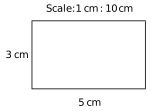
Question: A scale drawing shows a rectangle that is \(5\) cm long and \(3\) cm wide. Using the scale shown, what is the area of the actual rectangle in square centimeters?
- A. \(15\) cm\(^2\)
- B. \(375\) cm\(^2\)
- C. \(1500\) cm\(^2\)
- D. \(7500\) cm\(^2\)
Why it works: Scale factor is \(10\). Actual dimensions: \(50\) cm \(\times 30\) cm. Area: \(50 \times 30 = 1500\) cm\(^2\).
Answer: \(1500\) cm\(^2\)
Visual Model 2
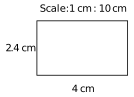
Question: Using the scale shown, what is the perimeter of the actual rectangle?
- A. \(12.8\) cm
- B. \(64\) cm
- C. \(128\) cm
- D. \(256\) cm
Why it works: Scale factor is \(10\). Actual dimensions: \(40\) cm \(\times 24\) cm. Perimeter: \(2(40 + 24) = 128\) cm.
Answer: \(128\) cm
Worked Examples
Example 1
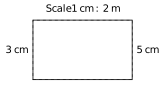
Question: What is the perimeter of the actual rectangle?
- A. \(16\) m
- B. \(32\) m
- C. \(64\) m
- D. \(128\) m
- Actual dimensions: \(10\) m \(\times 6\) m.
- Perimeter: \(2(10 + 6) = 32\) m.
Answer: \(32\) m
Example 2
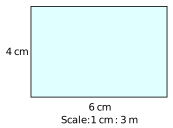
Question: A scale drawing shows a field with dimensions \(6\) cm by \(4\) cm. What is the perimeter of the actual field in meters?
- A. \(20\) m
- B. \(30\) m
- C. \(60\) m
- D. \(120\) m
- Actual dimensions: \(18\) m \(\times 12\) m.
- Perimeter: \(2(18 + 12) = 60\) m.
Answer: \(60\) m
Example 3
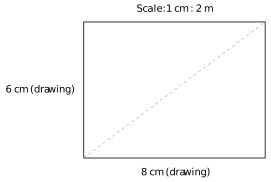
Question: Using the scale shown, what is the actual length of the diagonal side of this rectangle (approximately)?
- A. \(10\) m
- B. \(14\) m
- C. \(20\) m
- D. \(28\) m
- Actual dimensions: \(16\) m \(\times 12\) m.
- Diagonal: \(\sqrt{16^2 + 12^2} = \sqrt{256 + 144} = \sqrt{400} = 20\) m.
Answer: \(20\) m
Real-World Word Problems
Problem 1
Question: A map uses a scale of \(1\) inch \(:50\) miles. Two cities are \(3\) inches apart on the map. What is the actual distance between the cities?
- A. \(100\) miles
- B. \(150\) miles
- C. \(200\) miles
- D. \(250\) miles
Why it works: Multiply the map distance by the scale factor: \(3 \times 50 = 150\) miles.
Answer: \(150\) miles
Problem 2
Question: A scale drawing shows a rectangular garden with dimensions \(6\) cm \(\times 4\) cm. The scale is \(1\) cm \(:2\) m. What is the area of the actual garden?
- A. \(48\) m\(^2\)
- B. \(96\) m\(^2\)
- C. \(192\) m\(^2\)
- D. \(384\) m\(^2\)
Why it works: Scale factor for length is \(2\). Actual dimensions: \(12\) m \(\times 8\) m. Area: \(12 \times 8 = 96\) m\(^2\).
Answer: \(96\) m\(^2\)
Common Mistakes
- Rushing before identifying what the numbers represent.
- Choosing an operation that does not match the situation.
- Dropping labels, units, or context from the answer.
- Skipping the estimate or reasonableness check.
Strategy Tips
- Underline the question being asked.
- Use a model before jumping to computation.
- Write an equation that matches the story or picture.
- Explain the final answer in a sentence.
Practice Questions
Question 1
A scale drawing uses a scale of \(1\) cm \(:4\) m. In the drawing, a wall is \(7\) cm long. What is the actual length of the wall?
- A. \(3\) m
- B. \(11\) m
- C. \(28\) m
- D. \(32\) m
Question 2
A scale drawing has a scale of \(1\) cm \(:2\) m. If an actual room is \(8\) m wide, how wide is it in the drawing?
- A. \(2\) cm
- B. \(4\) cm
- C. \(6\) cm
- D. \(8\) cm
Question 3
Which scale would make the drawing larger than the actual object?
- A. \(1\) in \(:10\) ft
- B. \(1\) in \(:5\) ft
- C. \(2\) in \(:1\) ft
- D. \(1\) in \(:100\) ft
Question 4
A blueprint uses a scale of \(\frac{1}{4}\) inch \(:1\) foot. A door in the blueprint is \(\frac{3}{4}\) inch tall. What is the actual height of the door?
- A. \(1\) foot
- B. \(2\) feet
- C. \(3\) feet
- D. \(4\) feet
Question 5
A scale drawing has a scale of \(1\) cm \(:5\) cm. What is the scale factor?
- A. \(1\)
- B. \(2\)
- C. \(5\)
- D. \(10\)
Question 6
A map has a scale of \(2\) cm \(:3\) km. If two towns are \(10\) cm apart on the map, how far apart are they in reality?
- A. \(12\) km
- B. \(15\) km
- C. \(18\) km
- D. \(20\) km
Full Answer Explanations Click to show all answers and explanations
Question 1
Answer: \(28\) m
Multiply the drawing length by the scale: \(7\times4=28\) m.
Question 2
Answer: \(4\) cm
Divide actual length by scale factor: \(8 \div 2 = 4\) cm.
Question 3
Answer: \(2\) in \(:1\) ft
In scale \(2 \text{ in}:1 \text{ ft}\), one foot in reality becomes \(2\) inches in the drawing, making the drawing larger than the object. All others make the drawing smaller.
Question 4
Answer: \(3\) feet
If \(\frac{1}{4}\) inch represents \(1\) foot, then \(\frac{3}{4}\) inch represents \(3\) feet: \(\frac{3}{4} \div \frac{1}{4} = 3\).
Question 5
Answer: \(5\)
The scale factor is the ratio of actual to drawing: \(5 \text{ cm} \div 1 \text{ cm} = 5\). Each unit on the drawing represents \(5\) times that length in reality.
Question 6
Answer: \(15\) km
Set up the ratio: \(\frac{2 \text{ cm}}{3 \text{ km}} = \frac{10 \text{ cm}}{x}\). Cross-multiply: \(2x = 30\), so \(x = 15\) km.
Connection to Standards
This lesson supports Grade 7 math expectations for reasoning, modeling, problem solving, and explaining answers clearly. It connects classroom skills to the kind of questions students see on state math assessments.
Summary
Understanding and Using Scale Drawings becomes easier when students connect the question to a model, use clear steps, and explain why the answer fits.
GOLDEN RULE
Understand the model before choosing the operation.