




Introduction
Unit Rates with Fractions is an important Grade 7 math skill because students are moving from simple answers toward explaining how the math works.
In this lesson, students use models, real questions, worked examples, practice problems, and two online quizzes to build confidence with unit rates with fractions.
What Is Unit Rates with Fractions?
Unit Rates with Fractions means using equal parts, number lines, and clear fraction language to describe parts of a whole.
The goal is not only to get the answer. Students should be able to show the idea, explain the strategy, and check whether the answer makes sense.
Understanding Unit Rates with Fractions
Before solving, students should slow down and decide what each number, shape, unit, or label represents.
- Identify the whole before naming a fraction.
- Make sure each part is equal in size.
- Use a number line or model to show where the fraction belongs.
- Explain whether two fractions have the same size or different sizes.
Visual Models
Visual Model 1
Question: The table shows the relationship between pages read and time. Find the unit rate in pages per hour.
| \balancedtablerowPages | \(\frac{1}{2}\) | \(1\) | \(1\ \frac{1}{2}\) |
|---|---|---|---|
| \balancedtablerowHours | \(\frac{1}{6}\) | \(\frac{1}{3}\) | \(\frac{1}{2}\) |
- A. \(\frac{1}{12}\) pages per hour
- B. \(\frac{1}{3}\) pages per hour
- C. 6 pages per hour
- D. 3 pages per hour
Why it works: From the table, \(\frac{1}{2}\) page in \(\frac{1}{6}\) hour gives unit rate \(\frac{1/2}{1/6}=\frac{1}{2}\times 6=3\) pages per hour.
Answer: 3 pages per hour
Visual Model 2
Question: Two stores sell beans at different rates. Which store offers the better price?
| \balancedtablerowStore | Cost | Amount |
|---|---|---|
| \balancedtablerow Store A | $2 | \(\frac{1}{2}\) lb |
| \balancedtablerow Store B | $3 | \(\frac{2}{3}\) lb |
- A. Store A at $3.60/lb
- B. Store B at $4.50/lb
- C. They cost the same
- D. Store A at $4/lb
Why it works: Store A: \(\frac{2}{1/2}=2\times 2=4\) dollars/lb. Store B: \(\frac{3}{2/3}=3\times\frac{3}{2}=4.5\) dollars/lb. Store A is cheaper.
Answer: Store A at $4 per pound
Worked Examples
Example 1
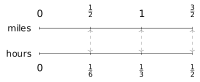
Question: Use the double number line below to find the unit rate of miles per hour. What is the unit rate in miles per hour?
- A. 9 mph
- B. \(\frac{1}{3}\) mph
- C. \(\frac{1}{9}\) mph
- D. 3 mph
- From the double number line, \(\frac{1}{2}\) mile in \(\frac{1}{6}\) hour gives unit rate \(\frac{1/2}{1/6}=\frac{1}{2}\times 6=3\) mph.
Answer: 3 miles per hour
Example 2
Question: The table shows distance and time. Find the unit rate in miles per hour.
| \balancedtablerowDistance (mi) | \(\frac{2}{3}\) | \(1\ \frac{1}{3}\) | \(2\) |
|---|---|---|---|
| \balancedtablerowTime (hr) | \(\frac{1}{5}\) | \(\frac{2}{5}\) | \(\frac{3}{5}\) |
- A. 1 mph
- B. \(\frac{3}{10}\) mph
- C. \(\frac{2}{3}\) mph
- D. \(\frac{10}{3}\) mph
- From the first pair: \(\frac{2/3}{1/5}=\frac{2}{3}\times 5=\frac{10}{3}\) mph.
Answer: \(\frac{10}{3}\) miles per hour
Example 3
Question: Two hikers' speeds are shown below. Who hikes faster?
| \balancedtablerowHiker | Distance | Time |
|---|---|---|
| \balancedtablerow Maya | \(\frac{7}{8}\) mi | \(\frac{1}{4}\) hr |
| \balancedtablerow Alex | \(\frac{5}{6}\) mi | \(\frac{1}{3}\) hr |
- A. Maya at \(\frac{1}{6}\) mph
- B. Alex at \(\frac{5}{2}\) mph
- C. They hike at the same speed
- D. Maya at \(\frac{7}{2}\) mph
- Maya: \(\frac{7/8}{1/4}=\frac{7}{8}\times 4=\frac{7}{2}=3.5\) mph.
- Alex: \(\frac{5/6}{1/3}=\frac{5}{6}\times 3=\frac{5}{2}=2.5\) mph.
- Maya is faster.
Answer: Maya at \(\frac{7}{2}\) mph
Real-World Word Problems
Problem 1
Question: A store sells \(\frac{3}{5}\) pound of cheese for $6. What is the unit price per pound?
- A. $9
- B. $3.60
- C. $4
- D. $10
Why it works: Unit rate \(=\frac{6}{3/5}=6\times\frac{5}{3}=10\) dollars per pound.
Answer: $10 per pound
Problem 2
Question: A recipe requires \(\frac{3}{4}\) cup of milk to make \(\frac{5}{8}\) of a batch. How much milk is needed per full batch?
- A. \(\frac{5}{6}\) cup
- B. \(\frac{15}{32}\) cups
- C. \(\frac{32}{15}\) cups
- D. \(\frac{6}{5}\) cups
Why it works: Unit rate: \(\frac{3/4}{5/8}=\frac{3}{4}\times\frac{8}{5}=\frac{24}{20}=\frac{6}{5}=1\frac{1}{5}\) cups per full batch.
Answer: \(\frac{6}{5}\) cups
Common Mistakes
- Counting unequal parts as if they were equal.
- Forgetting that the denominator tells how many equal parts make the whole.
- Comparing fractions without first checking the size of the whole.
- Placing a fraction on a number line without counting equal intervals.
Strategy Tips
- Draw the whole first, then divide it into equal parts.
- Use number lines when the question asks about order or location.
- Say the fraction out loud to connect numerator and denominator meanings.
- Check whether the answer should be closer to 0, 1/2, or 1.
Practice Questions
Question 1
A runner covers \(\frac{3}{4}\) of a mile in \(\frac{1}{6}\) of an hour. What is the runner's speed in miles per hour?
- A. \(\frac{1}{12}\) mph
- B. \(\frac{1}{8}\) mph
- C. \(\frac{3}{4}\) mph
- D. \(\frac{9}{2}\) mph
Question 2
A cyclist travels \(\frac{1}{2}\) mile in \(\frac{1}{8}\) hour. What is the cyclist's speed in miles per hour?
- A. 8 mph
- B. \(\frac{1}{16}\) mph
- C. \(\frac{3}{8}\) mph
- D. 4 mph
Question 3
A painter completes \(\frac{2}{3}\) of a room in \(\frac{1}{5}\) hour. At this rate, how many rooms will the painter complete in 1 hour?
- A. \(\frac{2}{15}\) room
- B. \(\frac{3}{5}\) room
- C. 1 room
- D. \(\frac{10}{3}\) rooms
Question 4
A train travels \(3\frac{1}{2}\) miles in \(\frac{1}{4}\) hour. What is the train's speed in miles per hour?
- A. \(\frac{7}{8}\) mph
- B. \(\frac{1}{14}\) mph
- C. 7 mph
- D. 14 mph
Question 5
Runner A covers \(\frac{1}{3}\) mile in \(\frac{1}{20}\) hour. Runner B covers \(\frac{2}{5}\) mile in \(\frac{1}{12}\) hour. Which runner is faster?
- A. Runner A at \(\frac{1}{60}\) mph
- B. Runner B at \(\frac{24}{5}\) mph
- C. They run at the same speed
- D. Runner A at \(\frac{20}{3}\) mph
Question 6
Five erasers cost \(\frac{3}{4}\) dollar. What is the cost per eraser?
- A. $1.25
- B. $0.60
- C. $3.75
- D. $0.15
Full Answer Explanations Click to show all answers and explanations
Question 1
Answer: \(\frac{9}{2}\) mph
Unit rate \(=\frac{3/4}{1/6}=\frac{3}{4}\times 6=\frac{18}{4}=\frac{9}{2}=4.5\) mph.
Question 2
Answer: 4 mph
Unit rate \(=\frac{1/2}{1/8}=\frac{1}{2}\times 8=4\) mph.
Question 3
Answer: \(\frac{10}{3}\) rooms
Unit rate \(=\frac{2/3}{1/5}=\frac{2}{3}\times 5=\frac{10}{3}\) rooms per hour.
Question 4
Answer: 14 mph
Convert \(3\frac{1}{2}=\frac{7}{2}\). Unit rate \(=\frac{7/2}{1/4}=\frac{7}{2}\times 4=14\) mph.
Question 5
Answer: Runner A at \(\frac{20}{3}\approx 6.67\) mph
Runner A: \(\frac{1/3}{1/20}=\frac{1}{3}\times 20=\frac{20}{3}\) mph. Runner B: \(\frac{2/5}{1/12}=\frac{2}{5}\times 12=\frac{24}{5}=4.8\) mph. Runner A is faster.
Question 6
Answer: $0.15 per eraser
Unit rate \(=\frac{3/4}{5}=\frac{3}{4}\times\frac{1}{5}=\frac{3}{20}=0.15\) dollars per eraser.
Connection to Standards
This lesson supports Grade 7 math expectations for reasoning, modeling, problem solving, and explaining answers clearly. It connects classroom skills to the kind of questions students see on state math assessments.
Summary
Unit Rates with Fractions becomes easier when students connect the question to a model, use clear steps, and explain why the answer fits.
GOLDEN RULE
Equal parts first, fraction name second.