




Introduction
What Is Probability? is an important Grade 7 math skill because students are moving from simple answers toward explaining how the math works.
In this lesson, students use models, real questions, worked examples, practice problems, and two online quizzes to build confidence with what is probability?.
What Is What Is Probability??
What Is Probability? means choosing a model, naming what each number means, and explaining the strategy.
The goal is not only to get the answer. Students should be able to show the idea, explain the strategy, and check whether the answer makes sense.
Understanding What Is Probability?
Before solving, students should slow down and decide what each number, shape, unit, or label represents.
- Read the question carefully and identify what is being asked.
- Choose a model, equation, table, or diagram that matches the situation.
- Solve one step at a time and keep units or labels attached.
- Use the answer explanation to check that the result makes sense.
Visual Models
Visual Model 1
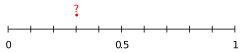
Question: A probability number line is shown below. Which probability is marked on the number line?
- A. \(0.1\)
- B. \(0.2\)
- C. \(0.3\)
- D. \(0.4\)
Why it works: The point is at the third tick mark from \(0\) to \(1\), which represents \(0.3\).
Answer: \(0.3\)
Visual Model 2
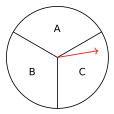
Question: A spinner is divided into 3 equal sections labeled A, B, and C. What is the probability of spinning A?
- A. \(\frac{1}{2}\)
- B. \(\frac{1}{3}\)
- C. \(\frac{2}{3}\)
- D. \(1\)
Why it works: The spinner has 3 equal sections. Probability of landing on A is \(\frac{1}{3}\).
Answer: \(\frac{1}{3}\)
Worked Examples
Example 1
Question: A bag contains 4 red marbles, 3 blue marbles, and 2 yellow marbles. What is the probability of drawing a blue marble?

- A. \(\frac{3}{9}\)
- B. \(\frac{4}{9}\)
- C. \(\frac{2}{9}\)
- D. \(\frac{3}{4}\)
- Total marbles = \(4 + 3 + 2 = 9\).
- Blue marbles = 3.
- Probability = \(\frac{3}{9} = \frac{1}{3}\).
Answer: \(\frac{3}{9}\) or \(\frac{1}{3}\)
Example 2
Question: Which event best represents the probability shown on this scale?

- A. Flipping heads on a fair coin
- B. Rolling a 6 on a standard die
- C. Drawing a spade from a shuffled deck
- D. Rolling an odd number on a standard die
- The marked position is at 0.2.
- Rolling a 6 on a standard die has probability \(\frac{1}{6} \approx 0.167 \approx 0.2\).
Answer: Rolling a 6 on a standard die
Example 3
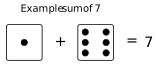
Question: Two standard dice are rolled. Which probability represents rolling two dice and getting a sum of 7?
- A. \(\frac{6}{36}\)
- B. \(\frac{7}{36}\)
- C. \(\frac{6}{12}\)
- D. \(\frac{1}{3}\)
- Pairs summing to 7: (1,6), (2,5), (3,4), (4,3), (5,2), (6,1) = 6 outcomes.
- Total outcomes = \(6 \times 6 = 36\).
- Probability = \(\frac{6}{36}\).
Answer: \(\frac{6}{36}\) or \(\frac{1}{6}\)
Real-World Word Problems
Problem 1
Question: A bag contains 8 red marbles and 12 blue marbles. If you pick one marble without looking, what is the probability of picking a red marble?
- A. \(\frac{8}{20}\)
- B. \(\frac{12}{20}\)
- C. \(\frac{8}{12}\)
- D. \(\frac{20}{8}\)
Why it works: Total marbles = \(8 + 12 = 20\). Probability = \(\frac{\text{red}}{\text{total}} = \frac{8}{20}\).
Answer: \(\frac{8}{20}\)
Problem 2
Question: A student rolled a die 60 times and got the following results: 1 appeared 10 times. Based on this data, what is the experimental probability of rolling a 1?
- A. \(\frac{1}{5}\)
- B. \(\frac{10}{60}\)
- C. \(\frac{1}{60}\)
- D. \(\frac{50}{60}\)
Why it works: Experimental probability = \(\frac{\text{times event occurred}}{\text{total trials}} = \frac{10}{60}\).
Answer: \(\frac{10}{60}\) or \(\frac{1}{6}\)
Common Mistakes
- Rushing before identifying what the numbers represent.
- Choosing an operation that does not match the situation.
- Dropping labels, units, or context from the answer.
- Skipping the estimate or reasonableness check.
Strategy Tips
- Underline the question being asked.
- Use a model before jumping to computation.
- Write an equation that matches the story or picture.
- Explain the final answer in a sentence.
Practice Questions
Question 1
Which value could represent the probability of an event?
- A. \(-0.2\)
- B. \(0.35\)
- C. \(1.5\)
- D. \(200\%\)
Question 2
Which fraction is equivalent to a probability of \(0.75\)?
- A. \(\frac{1}{4}\)
- B. \(\frac{3}{4}\)
- C. \(\frac{1}{2}\)
- D. \(\frac{4}{5}\)
Question 3
Which event has a probability of \(1\) (certain)?
- A. Rolling an even number on a standard die
- B. Flipping a coin and getting heads
- C. Picking a red card from a standard deck
- D. The sun rising tomorrow
Question 4
Which event has a probability of \(0\) (impossible)?
- A. Rolling a 7 on a standard six-sided die
- B. Flipping a coin and getting tails
- C. Drawing a number from 1 to 10
- D. Picking a blue marble from a bag of blue marbles
Question 5
A weather forecast says there is a \(60\%\) chance of rain tomorrow. What is this probability as a decimal?
- A. \(0.06\)
- B. \(0.6\)
- C. \(6.0\)
- D. \(60\)
Question 6
Which likelihood term describes a probability of \(0.1\)?
- A. Certain
- B. Likely
- C. Unlikely
- D. Even chance
Full Answer Explanations Click to show all answers and explanations
Question 1
Answer: \(0.35\)
Probability is always between \(0\) and \(1\) (inclusive). Only \(0.35\) fits.
Question 2
Answer: \(\frac{3}{4}\)
\(\frac{3}{4} = 0.75\). Dividing \(3 \div 4 = 0.75\).
Question 3
Answer: The sun rises every day
The sun rising tomorrow is certain (probability = 1). The other events are uncertain.
Question 4
Answer: Rolling a 7 on a six-sided die
A standard die only has faces 1--6, so rolling a 7 is impossible (probability = 0).
Question 5
Answer: \(0.6\)
\(60\% = \frac{60}{100} = 0.6\).
Question 6
Answer: Unlikely
A probability of \(0.1\) is very low, so the event is unlikely to occur.
Connection to Standards
This lesson supports Grade 7 math expectations for reasoning, modeling, problem solving, and explaining answers clearly. It connects classroom skills to the kind of questions students see on state math assessments.
Summary
What Is Probability? becomes easier when students connect the question to a model, use clear steps, and explain why the answer fits.
GOLDEN RULE
Understand the model before choosing the operation.