Grades 8-10Free, no account needed
Absolute value equation calculator
Solve |ax + b| = c exactly, including coincident roots and constant equations, with substitution checks and a distance model.
Try your problem
Supported inputs and limits
Exact rational inputs, at most 40 characters each; magnitude <= 10000 and reduced numerator/denominator <= 1000000. Engine syntax supports integers, fractions, mixed numbers, up to 9 finite decimal places, and repeating decimals with prefix/block <= 6 digits; engine raw-number caps also apply. c must be nonnegative. Derived fractions stay exact; diagram positions are approximate. Paste absolute(a,b,c), at most 200 characters, with integer, finite-decimal or integer-fraction arguments only.
Step by step
Understand the method
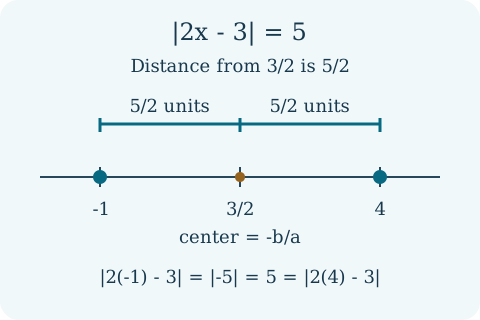
Absolute value measures distance from zero. If |u| = c and c is nonnegative, u can equal c or -c. Apply this to u = ax + b: subtract b in each signed branch and divide by a only when a is nonzero. When c is zero, both branches give the same solution, not two distinct roots.
For nonzero a, the same equation describes distance from the center -b/a: |x - (-b/a)| = c/|a|. The two preimages are equally far from this center even when a is negative. If a is zero, the left side is the fixed number |b|, so every real x works when |b| = c and none works otherwise. Check proposed roots in the original absolute value.
Worked examples
Read the reasoning, or load an example into the calculator.
Two signed branches
2x - 3 = 5 gives x = 4; 2x - 3 = -5 gives x = -1. Both inner values have absolute value 5.
A single zero-distance root
|-3x + 6| = 0 forces the inner expression to zero, giving x = 2 once. The two branches coincide.
An identity with no variable term
|0x - 7/2| = 7/2 is true for every real x because its left side is always 7/2.
A constant contradiction
|0x + 2| = 3 asks 2 to equal 3. No choice of x can change that, so the solution set is empty.
Try it without the calculator
Three questions for practice, not a graded school assessment. Your answers stay on this page and are not saved.
Original Testinar learning content. This local preview is awaiting final review before publication.