Grades 9-12Free, no account needed
Binomial probability calculator
Find exact or cumulative binomial probabilities, inspect every probability mass, and verify the event with its complement and total probability.
Try your problem
Supported inputs and limits
Use whole-number n and k with 0 <= k <= n <= 100; 1-3 digits, no signs, decimals or fractions. p is an exact scalar from 0 to 1: signed integer, finite decimal with 1-6 places, or integer fraction with positive denominator, at most 24 characters and 12 digits per numerator/denominator part; reduced denominator at most 1000000. No expressions, mixed numbers, repeats or exponents. Exact rational probabilities include p=0, p=1 and n=0. Decimal output is exact when marked; otherwise truncated after 12 decimal places, not rounded. Paste binomial(exactly;10;3;1/2), binomial(at-most;10;3;1/2) or binomial(at-least;10;3;1/2), case-sensitive and at most 200 characters. Plot coordinates alone are approximate; tiny masses remain exact in the table.
Step by step
Understand the method
A binomial model counts successes in n independent trials with the same success probability p on every trial. Outcomes must be success or failure. Sampling without replacement generally does not satisfy this fixed-probability model.
Exactly j successes can occupy C(n,j) sets of trial positions. Each such sequence has probability p to the j times (1 - p) to the n - j, so multiply these quantities for P(X=j).
At most k includes k and all smaller counts. At least k includes k and all larger counts. Add the selected discrete probabilities, or subtract the separately summed excluded event from 1. Mean successes is np and variance is np(1 - p).
Worked examples
Read the reasoning, or load an example into the calculator.
Exactly two fair successes
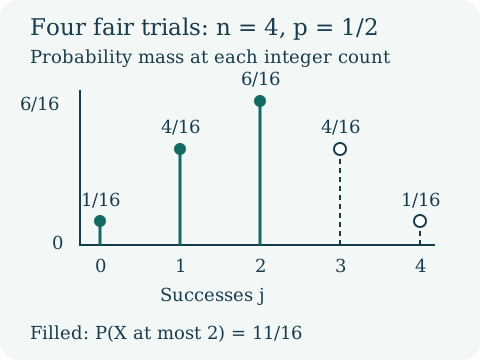
For n=4 and p=1/2, C(4,2) = 6. Each sequence has probability 1/16, so exactly two successes has probability 6/16 = 3/8.
Include all counts up to two
For four fair trials, add P(0)+P(1)+P(2) = (1+4+6)/16 = 11/16. The endpoint two is included.
Complement for at least one
With n=3 and p=1/4, at least one success has probability 1 - (3/4)^3 = 37/64.
Try it without the calculator
Three questions for practice, not a graded school assessment. Your answers stay on this page and are not saved.
Original Testinar learning content. This local preview is awaiting final review before publication.