Grades 7-12Free, no account needed
Combinations & permutations calculator
Count unordered selections or ordered arrangements of distinct objects without replacement, with exact large integers and every selection-stage factor.
Try your problem
Supported inputs and limits
Integers only, 0 <= r <= n <= 100; each integer has 1-3 digits, with leading zeroes allowed but no sign, decimal or fraction syntax. All counts use exact BigInt arithmetic. Distinct objects without replacement only; repeated selections and indistinguishable-object arrangements are unsupported. Paste choose(10,3) or permute(10,3), case-sensitive and at most 200 characters. The live diagram shows available choices per stage, not bar heights proportional to the potentially enormous final counts.
Step by step
Understand the method
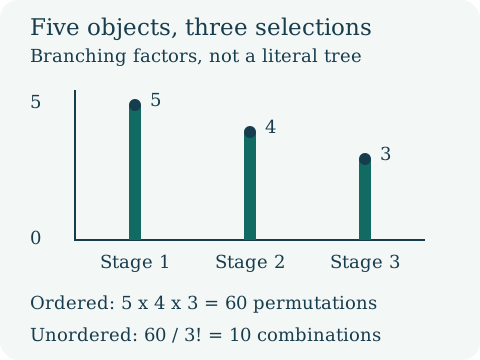
Without replacement, choosing r distinct objects from n gives n choices first, then n - 1, until n - r + 1. Their product counts ordered selections, called permutations.
A set of r selected objects has r! internal orders. Divide the ordered count by r! to count combinations, where order is irrelevant. Choosing the included objects is equivalent to choosing the excluded objects.
There is one empty selection: both C(n,0) and P(n,0) equal 1. The convention 0! = 1 makes the formulas agree with this counting argument. The live plot shows branching factors, not a drawn tree of all outcomes.
Worked examples
Read the reasoning, or load an example into the calculator.
An unordered committee
Choose 3 of 10 people: 10 x 9 x 8 / (3 x 2 x 1) = 120 committees. Reordering one committee does not make a new one.
Three distinct roles
Assign first, second and third positions from 10 people: 10 x 9 x 8 = 720 ordered assignments.
The empty selection
Selecting zero of zero objects has one outcome: the empty selection. C(0,0) = 1, consistent with 0! = 1.
Try it without the calculator
Three questions for practice, not a graded school assessment. Your answers stay on this page and are not saved.
Original Testinar learning content. This local preview is awaiting final review before publication.