Grades 6-12Free, no account needed
Mean absolute deviation calculator
Average exact absolute distances from the arithmetic mean, with each signed deviation, a dotplot and a balance check.
Try your problem
Supported inputs and limits
Use 1-20 comma-separated observations. Singleton and constant data have MAD zero. No frequency or weight mode; repeated observations can be entered separately. The plot uses exact mean-centered offsets before approximate projection. Scalars are signed integers, decimals with 1-6 decimal places, or integer fractions with positive denominator, at most 24 characters and 12 digits per integer part. Magnitude at most 1000000 and reduced denominator at most 1000000. No expressions, mixed numbers, repeating decimals, percent signs or scientific notation. Lists have at most 520 characters. All numerical answers and table values are exact rationals; diagram positions alone are approximate. Named paste commands are case-sensitive and at most 200 characters.
Step by step
Understand the method
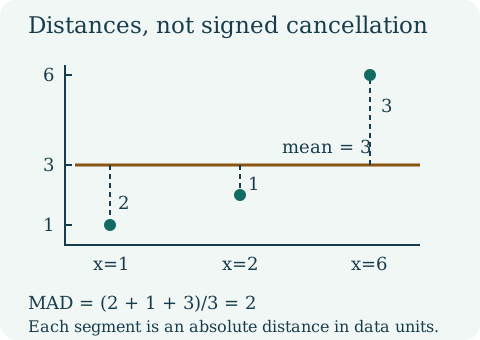
First compute the arithmetic mean: add n observations and divide by n. For each value x, subtract that same mean. Signed deviations sum to zero, so their signed average cannot measure spread.
Take the absolute value of each deviation, then average these nonnegative distances. MAD = sum of |x - mean| divided by n. It has the original data units, unlike variance, which has squared units.
This is mean absolute deviation about the arithmetic mean. Median absolute deviation uses a different center and a median aggregation, and standard deviation squares deviations before averaging. Adding a constant to all values leaves MAD unchanged; scaling by c scales MAD by |c|.
Worked examples
Read the reasoning, or load an example into the calculator.
Unequal distances
For 1,2,6 the mean is 3. Absolute distances 2,1,3 sum to 6, so MAD=6/3=2. Signed deviations still sum to zero.
Exact fractional distances
For 0,1/2,1 the mean is 1/2. Distances 1/2,0,1/2 sum to 1, so MAD=1/3 exactly.
Constant negative data
For -4,-4,-4 the mean is -4 and all distances are zero, so MAD=0. A negative mean cannot make a distance negative.
Try it without the calculator
Three questions for practice, not a graded school assessment. Your answers stay on this page and are not saved.
Original Testinar learning content. This local preview is awaiting final review before publication.