Algebra 1-2Free, no account needed
Polynomial division by a linear divisor
Divide a degree-at-most-five polynomial by dx+e exactly. Follow coefficient flow and verify the quotient and remainder against the original dividend.
Try your problem
Supported inputs and limits
One through six comma-separated coefficients, highest power first: degree <=5. Each coefficient and d,e has magnitude <=1,000 and reduced denominator <=1,000,000; d must be nonzero. Each numeric token <=24 characters, integer/fraction with positive denominator/finite decimal <=6 places. Coefficient field <=520 characters. Constants, zero polynomial and leading zeros supported. Derived exact values are not capped. Diagram nodes may use approximate decimals; exact stage rows remain. Paste <=200 characters: polydiv(1,-6,11,-6;1;-1).
Step by step
Understand the method
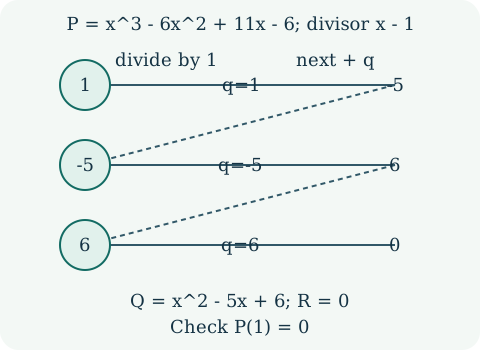
Polynomial division finds Q and R such that P(x)=(dx+e)Q(x)+R. Because the divisor has degree one, R is constant. Write dividend coefficients in descending order and include zeros for missing powers; otherwise every later operation uses the wrong degree.
At each stage divide the leading carry by d to obtain the next quotient coefficient q. Subtract that multiple of the divisor: the leading term cancels, and the next carry is the next dividend coefficient minus e*q. Repeat until only the constant remainder remains. This also works when d is not 1.
The divisor vanishes at r=-e/d, so P(r)=R is an independent remainder check. Re-expanding divisor times quotient plus remainder must recover all original coefficients. A constant dividend, including zero, has quotient zero and itself as remainder. Leading zero input entries are removed; internal zeros are not.
Worked examples
Read the reasoning, or load an example into the calculator.
Exact factor
Dividing x^3-6x^2+11x-6 by x-1 gives Q=x^2-5x+6, R=0. P(1)=0 confirms the remainder.
Nonmonic divisor and a remainder
2x^2+3x+5=(2x+1)(x+1)+4. The divisor root is -1/2 and the dividend there is 4.
A lower-degree dividend
Dividing the constant 7 by 3x-2 gives polynomial quotient 0 and remainder 7. The identity 7=(3x-2)*0+7 is exact for every x.
Try it without the calculator
Three questions for practice, not a graded school assessment. Your answers stay on this page and are not saved.
Original Testinar learning content. This local preview is awaiting final review before publication.