Grades 7-12Free, no account needed
Two-event probability calculator
Validate two event probabilities and their overlap, then find union, disjoint regions and conditionals using a true probability-area partition.
Try your problem
Supported inputs and limits
Enter P(A), P(B) and P(A and B), each from 0 to 1 inclusive, satisfying the exact Frechet bounds. Invalid overlap targets the intersection field. Valid zero marginals are allowed; corresponding conditionals are explicitly undefined. The area model is a four-region rectangle, not a to-scale Venn diagram. Scalars are signed integers, decimals with 1-6 decimal places, or integer fractions with positive denominator, at most 24 characters and 12 digits per integer part. Magnitude at most 1000000 and reduced denominator at most 1000000. No expressions, mixed numbers, repeating decimals, percent signs or scientific notation. Lists have at most 520 characters. All numerical answers and table values are exact rationals; diagram positions alone are approximate. Named paste commands are case-sensitive and at most 200 characters.
Step by step
Understand the method
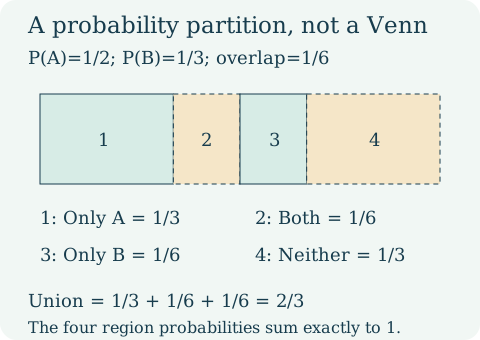
For two events A and B, P(A or B)=P(A)+P(B)-P(A and B). Subtract the overlap once because adding the marginals counts it twice.
The four disjoint regions are only A, both, only B and neither. All must be nonnegative and total 1. Thus max(0,P(A)+P(B)-1) <= P(A and B) <= min(P(A),P(B)); these are the Frechet bounds.
Conditional probability restricts the sample space. P(A given B)=P(A and B)/P(B) only when P(B)>0; reverse the conditioning denominator for P(B given A). A zero conditioning probability makes the conditional undefined. Independence is not assumed.
Worked examples
Read the reasoning, or load an example into the calculator.
An overlapping partition
P(A)=1/2, P(B)=1/3 and overlap=1/6 give only A=1/3, only B=1/6, union=2/3 and neither=1/3. P(A given B)=1/2; P(B given A)=1/3.
Disjoint events
For P(A)=1/4, P(B)=1/2 and overlap 0, union=3/4 and neither=1/4. Both conditionals are zero because their positive conditioning events contain no overlap.
A zero-probability event
For P(A)=0, P(B)=2/5 and overlap 0, union=2/5 and neither=3/5. P(A given B)=0, but P(B given A) is undefined because P(A)=0.
Try it without the calculator
Three questions for practice, not a graded school assessment. Your answers stay on this page and are not saved.
Original Testinar learning content. This local preview is awaiting final review before publication.