Algebra 1-2Free, no account needed
Restricted rational equation calculator
Solve the restricted family a/(x-b)=c exactly, including no-solution and infinitely-many-solution branches, without losing the denominator exclusion.
Try your problem
Supported inputs and limits
Only a/(x-b)=c over real x. a,b,c may be signed or zero, magnitude <=10,000, reduced denominator <=1,000,000. Tokens <=24 characters: integer, fraction with positive denominator, finite decimal <=6 places. No arbitrary expressions, mixed/repeating forms or other rational equation families. All classifications/exclusions exact; number-line offsets approximate and a close root may overlap the hole on screen. Paste <=200 characters: rational(6;2;3).
Step by step
Understand the method
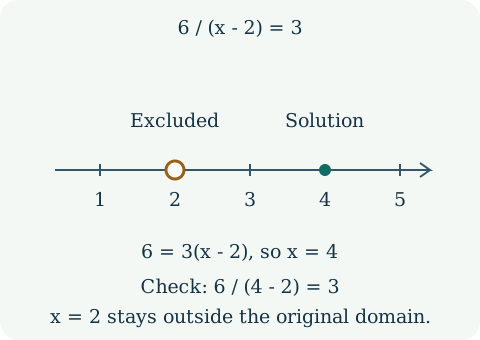
The expression a/(x-b) exists only when x differs from b. Write that exclusion before doing algebra. On the allowed domain, multiplying a/(x-b)=c by x-b gives a=c(x-b); that transformed equation does not restore the missing point.
If c is nonzero, the linear candidate is x=b+a/c. When a is also nonzero, its denominator is a/c, so substitution gives a/(a/c)=c and the candidate is allowed. When a is zero, the candidate is exactly b and must be rejected: no solution remains.
If c is zero and a is nonzero, a nonzero numerator divided by a nonzero denominator cannot equal zero, so there is no solution. If both a and c are zero, every real x except b works. A hollow point on the model always means the same original exclusion, even in an identity.
Worked examples
Read the reasoning, or load an example into the calculator.
One admissible root
6/(x-2)=3 gives x=2+6/3=4. The denominator 4-2=2 is nonzero and 6/2=3 verifies the original equation.
An identity with a hole
0/(x+3)=0 is true for every real x except -3. At x=-3 the original fraction is still 0/0 and undefined.
An excluded candidate
0/(x-5)=2 produces candidate x=5 after multiplication, but that point is forbidden. Every allowed x gives 0 on the left, not 2, so there is no solution.
Try it without the calculator
Three questions for practice, not a graded school assessment. Your answers stay on this page and are not saved.
Original Testinar learning content. This local preview is awaiting final review before publication.