Grades 7-12Free, no account needed
Exact scientific notation arithmetic calculator
Add, subtract, multiply or divide two signed scientific quantities exactly, then normalize and verify their coefficients and exponents.
Try your problem
Supported inputs and limits
Modes: add, subtract, multiply, divide. Each coefficient is a signed integer, finite decimal with at most 6 places or integer fraction with positive denominator. At most 12 integer/numerator digits and 12 denominator digits, at most 24 characters overall; magnitude <=1000000 and reduced denominator <=1000000. Integer exponents m,n from -24 through 24. Coefficients need not start normalized. Results and normalization remain exact fractions/powers. Zero division rejected on b. The diagram plots exact exponent bins, not numeric magnitudes; pixel coordinates are approximate. Paste scientific(add;3;4;7;3), at most 200 characters.
Step by step
Understand the method
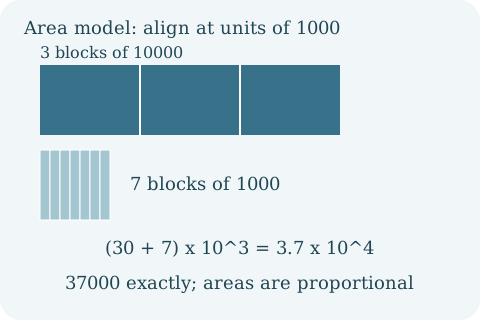
Scientific notation separates a coefficient from an integer power of ten. A nonzero normalized coefficient satisfies 1 <= its absolute value < 10. Addition and subtraction require a common exponent before combining coefficients; 3*10^4 + 7*10^3 is (30+7)*10^3, not 10*10^7.
For multiplication, multiply the coefficients and add exponents. For division, divide nonzero-denominator coefficients and subtract exponents. Normalize afterward by shifting exact powers of ten between coefficient and exponent. Negative coefficients keep their sign; zero is conventionally 0*10^0 here. An exact fractional coefficient can have a repeating decimal, so a fraction is not rounded just to look decimal.
Worked examples
Read the reasoning, or load an example into the calculator.
Align before adding
3*10^4 + 7*10^3 = (30+7)*10^3 = 37*10^3 = (37/10)*10^4 exactly.
Cancellation gives canonical zero
5*10^-3 - 5*10^-3 = 0. The normalized representation is 0*10^0; a nonzero-coefficient condition does not apply.
Multiply a negative quantity
(-4)*10^2 times 3*10^-5 = (-12)*10^-3 = (-6/5)*10^-2. Multiplying the coefficients and adding exponents preserves the negative sign.
Division can leave an exact repeating coefficient
1*10^0 divided by 3*10^0 is 1/3. Its exact normalized form is (10/3)*10^-1, not a rounded 3.333333 coefficient.
Try it without the calculator
Three questions for practice, not a graded school assessment. Your answers stay on this page and are not saved.
Original Testinar learning content. This local preview is awaiting final review before publication.