CH06-12 lesson

Partitioning Shapes into Equal Areas Learning Activity

A focused Grade 3 learning session for Partitioning Shapes into Equal Areas using visual models, worked examples, strategy guidance, and a short mastery check.

15
minutes
6
lesson parts
11
practice items
Learning goal

Students will partition shapes into equal areas and express each part as a unit fraction.

Student goal: I can partition a shape into equal areas and name each part as a fraction.

concept

Learn the Idea

Partitioning Shapes into Equal Areas means measuring how much flat space a figure covers by using equal-sized square units.

  • Use square units that cover the figure without gaps or overlaps.
  • Count rows and columns when the unit squares are arranged in an array.
  • Connect repeated addition to multiplication when finding area.
  • Break complex figures into smaller rectangles when that makes the work clearer.
visual model

See the Math

Visual Model 1

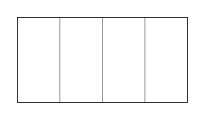
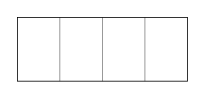
Question: A rectangle is divided into \(4\) equal parts. What fraction of the rectangle is each part?

Grade 3 Partitioning Shapes into Equal Areas figure 1

  • A. \(\frac{1}{2}\)
  • B. \(\frac{1}{3}\)
  • C. \(\frac{1}{4}\)
  • D. \(\frac{4}{4}\)

Why it works: When a shape is divided into \(4\) equal parts, each part is \(\frac{1}{4}\) of the whole.

Answer: \(\frac{1}{4}\)

worked example

Follow a Worked Example

Example 1

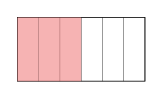
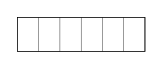
Question: A rectangle is split into \(6\) equal strips. What fraction of the rectangle is \(3\) strips?

Grade 3 Partitioning Shapes into Equal Areas figure 3

  • A. \(\frac{1}{6}\)
  • B. \(\frac{1}{3}\)
  • C. \(\frac{3}{6}\)
  • D. \(\frac{4}{6}\)
  1. Three out of six equal strips make \(\frac{3}{6}\).

Answer: \(\frac{3}{6}\)

Example 2

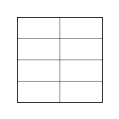
Question: A square is divided into \(8\) equal parts by drawing 1 vertical line and 3 horizontal lines through the middle. What fraction of the square is one part?

Grade 3 Partitioning Shapes into Equal Areas figure 4

  • A. \(\frac{1}{4}\)
  • B. \(\frac{1}{8}\)
  • C. \(\frac{2}{8}\)
  • D. \(\frac{1}{2}\)
  1. When divided into 8 equal parts, each part is \(\frac{1}{8}\) of the whole square.

Answer: \(\frac{1}{8}\)

real world

Connect It to a Real Situation

Problem 1

Question: A student says that this rectangle is divided so each part is \(\frac{1}{4}\). Is the student correct?

Grade 3 Partitioning Shapes into Equal Areas figure 6

  • A. Yes, there are 4 parts
  • B. No, there are 6 parts, so each is \(\frac{1}{6}\)
  • C. No, the parts are unequal
  • D. Yes, each part is \(\frac{1}{4}\)

Why it works: Two horizontal and two vertical lines create 6 equal parts, not 4.

Answer: No, there are 6 equal parts, so each part is \(\frac{1}{6}\)

strategy

Avoid Mistakes and Choose a Strategy

  • Counting only the outside squares instead of all squares inside the figure.
  • Leaving gaps or overlaps when using unit squares.
  • Multiplying side lengths before checking whether the figure is a rectangle.
  • Forgetting to write square units with an area answer.
  • Trace the rectangle or figure before counting.
  • Use rows and columns to organize unit squares.
  • Write an equation after the model makes sense.
  • Check whether the answer needs square units.
summary

Remember the Key Idea

Partitioning Shapes into Equal Areas becomes easier when students connect the question to a model, use clear steps, and explain why the answer fits.

GOLDEN RULE

Area means every square unit inside the figure.

Guided to independent practice

Solve before opening the answer

Use scratch paper. The explanation matters more than simply seeing whether the choice is correct.

warmup

2 questions
G3-C06-T12-Q001 About 1 min

A rectangle is divided into \(4\) equal parts. What fraction of the rectangle is each part?

Partitioning Shapes into Equal Areas visual for G3-C06-T12-Q001
  1. A \(\frac{1}{2}\)
  2. B \(\frac{1}{3}\)
  3. C \(\frac{1}{4}\)
  4. D \(\frac{4}{4}\)
Check answer and explanation

Answer C: \(\frac{1}{4}\)

When a shape is divided into \(4\) equal parts, each part is \(\frac{1}{4}\) of the whole.

G3-C06-T12-Q002 About 1 min

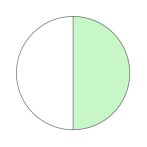
Here is a circle divided into \(2\) equal parts. Each part of the circle is what fraction of the whole circle?

Partitioning Shapes into Equal Areas visual for G3-C06-T12-Q002
  1. A \(\frac{1}{4}\)
  2. B \(\frac{1}{2}\)
  3. C \(\frac{2}{2}\)
  4. D \(\frac{1}{3}\)
Check answer and explanation

Answer B: \(\frac{1}{2}\)

When a circle is divided into 2 equal parts, each part is \(\frac{1}{2}\) of the whole circle.

guided

1 question
G3-C06-T12-Q003 About 1 min

A rectangle is split into \(6\) equal strips. What fraction of the rectangle is \(3\) strips?

Partitioning Shapes into Equal Areas visual for G3-C06-T12-Q003
  1. A \(\frac{1}{6}\)
  2. B \(\frac{1}{3}\)
  3. C \(\frac{3}{6}\)
  4. D \(\frac{4}{6}\)
Check answer and explanation

Answer C: \(\frac{3}{6}\)

Three out of six equal strips make \(\frac{3}{6}\).

practice

5 questions
G3-C06-T12-Q004 About 1 min

A square is divided into \(8\) equal parts by drawing 1 vertical line and 3 horizontal lines through the middle. What fraction of the square is one part?

Partitioning Shapes into Equal Areas visual for G3-C06-T12-Q004
  1. A \(\frac{1}{4}\)
  2. B \(\frac{1}{8}\)
  3. C \(\frac{2}{8}\)
  4. D \(\frac{1}{2}\)
Check answer and explanation

Answer B: \(\frac{1}{8}\)

When divided into 8 equal parts, each part is \(\frac{1}{8}\) of the whole square.

G3-C06-T12-Q005 About 1 min

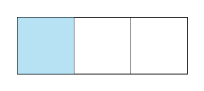
Here is a rectangle divided into \(3\) equal columns. The shaded part is what fraction of the rectangle?

Partitioning Shapes into Equal Areas visual for G3-C06-T12-Q005
  1. A \(\frac{1}{3}\)
  2. B \(\frac{3}{3}\)
  3. C \(\frac{2}{3}\)
  4. D \(\frac{1}{2}\)
Check answer and explanation

Answer A: \(\frac{1}{3}\)

One shaded column out of three equal columns is \(\frac{1}{3}\) of the rectangle.

G3-C06-T12-Q006 About 1 min

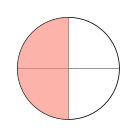
A circle is divided into \(4\) equal parts. If two parts are shaded, what fraction of the circle is shaded?

Partitioning Shapes into Equal Areas visual for G3-C06-T12-Q006
  1. A \(\frac{1}{3}\)
  2. B \(\frac{3}{4}\)
  3. C \(\frac{2}{4}\)
  4. D \(\frac{1}{4}\)
Check answer and explanation

Answer C: \(\frac{2}{4}\)

Two shaded parts out of four equal parts is \(\frac{2}{4}\), which equals \(\frac{1}{2}\).

G3-C06-T12-Q007 About 1 min

A rectangle is divided equally. One part is \(\frac{1}{6}\) of the whole. How many equal parts is the rectangle divided into?

Partitioning Shapes into Equal Areas visual for G3-C06-T12-Q007
  1. A 4 parts
  2. B 8 parts
  3. C 3 parts
  4. D 6 parts
Check answer and explanation

Answer D: 6 parts

If one part is \(\frac{1}{6}\), then the rectangle must be divided into 6 equal parts.

G3-C06-T12-Q008 About 1 min

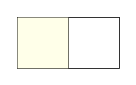
Here is a rectangle divided into \(2\) equal halves by a vertical line. The shaded part is what fraction of the rectangle?

Partitioning Shapes into Equal Areas visual for G3-C06-T12-Q008
  1. A \(\frac{1}{4}\)
  2. B \(\frac{1}{3}\)
  3. C \(\frac{1}{2}\)
  4. D \(\frac{2}{3}\)
Check answer and explanation

Answer C: \(\frac{1}{2}\)

The rectangle is divided into 2 equal parts. One shaded part is \(\frac{1}{2}\).

exit

3 questions
G3-C06-T12-Q009 About 1 min

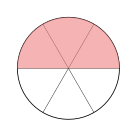
A circle is divided into \(6\) equal parts. Three parts are shaded. Which fraction shows the shaded part?

Partitioning Shapes into Equal Areas visual for G3-C06-T12-Q009
  1. A \(\frac{1}{6}\)
  2. B \(\frac{3}{6}\)
  3. C \(\frac{3}{3}\)
  4. D \(\frac{2}{6}\)
Check answer and explanation

Answer B: \(\frac{3}{6}\)

Three shaded parts out of six equal parts is \(\frac{3}{6}\).

G3-C06-T12-Q010 About 1 min

A rectangle is divided with 3 vertical lines making \(4\) equal columns. How many parts is the rectangle divided into?

Partitioning Shapes into Equal Areas visual for G3-C06-T12-Q010
  1. A 2 parts
  2. B 5 parts
  3. C 3 parts
  4. D 4 parts
Check answer and explanation

Answer D: 4 parts

Three vertical lines create 4 equal columns, so the rectangle is divided into 4 parts.

G3-C06-T12-Q011 About 1 min

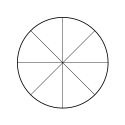
A circle is divided by lines from the center to make \(8\) equal parts (like pizza slices). What fraction is one slice?

Partitioning Shapes into Equal Areas visual for G3-C06-T12-Q011
  1. A \(\frac{2}{8}\)
  2. B \(\frac{1}{6}\)
  3. C \(\frac{1}{4}\)
  4. D \(\frac{1}{8}\)
Check answer and explanation

Answer D: \(\frac{1}{8}\)

Eight equal slices mean each slice is \(\frac{1}{8}\) of the whole circle.

Page UP