CH03-01 lesson

Integers and Their Opposites Learning Activity

A focused Grade 7 learning session for Integers and Their Opposites using visual models, worked examples, strategy guidance, and a short mastery check.

15
minutes
6
lesson parts
11
practice items
Learning goal

Students will build Grade 7 mastery of integers and their opposites using models, equations, and test-style reasoning.

Student goal: I can solve problems involving integers and their opposites.

concept

Learn the Idea

Integers and Their Opposites is part of Grade 7 The Number System. This activity focuses on the central idea students need before they move into independent practice.

Students will build Grade 7 mastery of integers and their opposites using models, equations, and test-style reasoning.

visual model

See the Math

What to noticeHow to use it
Numbers, units, labels, diagrams, or graphsIdentify what each part represents before calculating.
The relationship in the problemConnect the model to an equation, comparison, or explanation.

Use the figures and worked questions in the practice set below as the visual model for this skill.

worked example

Follow a Worked Example

Read the first practice question slowly. Decide what the question is asking, choose a strategy, solve, and then compare your reasoning with the answer explanation.

For Integers and Their Opposites, a strong worked example should show the setup, the calculation or model, and a final answer that matches the context.

real world

Connect It to a Real Situation

Many Grade 7 test questions use real situations. Look for quantities, units, rates, measures, expressions, or data values that connect the math to the story.

After solving, explain what the answer means in the situation, not just the number you calculated.

strategy

Avoid Mistakes and Choose a Strategy

  • Underline the exact question before solving.
  • Label units, variables, or graph axes when they appear.
  • Estimate first so unreasonable answers are easier to catch.
  • Review missed questions and write the reason for each mistake.
summary

Remember the Key Idea

I can solve problems involving integers and their opposites.

Use the warmup, guided question, practice set, and exit questions below to check whether this skill is ready or needs more practice.

Guided to independent practice

Solve before opening the answer

Use scratch paper. The explanation matters more than simply seeing whether the choice is correct.

warmup

2 questions
G7-C03-T01-Q001 About 1 min

What is the opposite of \(-15\)?

  1. A \(15\) (correct)
  2. B \(-15\) (no sign change)
  3. C \(0\) (neither opposite nor equal)
  4. D \(|{-15}|\) (absolute value, not opposite)
Check answer and explanation

Answer A: \(15\) (correct)

The opposite of a number reverses its sign. The opposite of \(-15\) is \(15\). Note: the absolute value \(|-15| = 15\) looks the same but represents distance, not the additive inverse.

G7-C03-T01-Q002 About 1 min

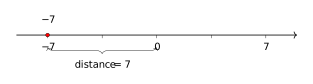
What is \(|-7|\)?

Integers and Their Opposites visual for G7-C03-T01-Q002
  1. A \(-7\) (confuses absolute value with the original number)
  2. B \(-14\) (incorrectly applies a sign reversal)
  3. C \(0\) (misplaces absolute value at the origin)
  4. D \(7\) (correct; distance is always non-negative)
Check answer and explanation

Answer D: \(7\) (correct; distance is always non-negative)

The absolute value of any number is its distance from zero, which is always non-negative. \(|-7| = 7\).

guided

1 question
G7-C03-T01-Q003 About 1 min

Marcus walks \(12\) meters east. To return to his starting point, he must walk \(12\) meters west. Which number represents his westward walk?

  1. A \(-12\) (opposite direction)
  2. B \(12\) (same direction as eastward walk)
  3. C \(0\) (no displacement)
  4. D \(-24\) (double the distance in opposite direction)
Check answer and explanation

Answer A: \(-12\) (opposite direction)

If east is positive, then west is negative. Walking \(12\) meters west is represented by \(-12\).

practice

5 questions
G7-C03-T01-Q004 About 1 min

A bank account starts with a credit of $50. After a debit of $50, what is the account balance?

  1. A \($100\) (adds both amounts instead of subtracting)
  2. B \($50\) (ignores the debit)
  3. C \(-$50\) (records only the debit)
  4. D \($0\) (correct; opposites sum to zero)
Check answer and explanation

Answer D: \($0\) (correct; opposites sum to zero)

The credit of \(+50\) and debit of \(-50\) are opposites and sum to zero. This demonstrates the additive inverse property: \(50 + (-50) = 0\).

G7-C03-T01-Q005 About 1 min

What is \((-9) + 9\)?

Integers and Their Opposites visual for G7-C03-T01-Q005
  1. A \(18\) (adds absolute values)
  2. B \(9\) (ignores the negative sign)
  3. C \(0\) (opposites sum to zero)
  4. D \(-18\) (doubles negative)
Check answer and explanation

Answer C: \(0\) (opposites sum to zero)

Opposites sum to zero: \(a + (-a) = 0\).

G7-C03-T01-Q006 About 1 min

Temperature drops \(20\) degrees from \(10\) degrees. Express the drop (change) as a signed number.

  1. A \(20\) (ignores the direction of change)
  2. B \(30\) (adds instead of subtracts)
  3. C \(-10\) (starting temperature)
  4. D \(-20\) (correct; drop is negative change)
Check answer and explanation

Answer D: \(-20\) (correct; drop is negative change)

A decrease or drop is represented by a negative number. A \(20\)-degree drop is \(-20\).

G7-C03-T01-Q007 About 1 min

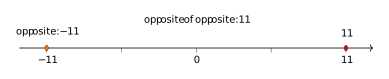
What is the opposite of the opposite of \(11\)?

Integers and Their Opposites visual for G7-C03-T01-Q007
  1. A \(-11\)
  2. B \(22\)
  3. C \(0\)
  4. D \(11\)
Check answer and explanation

Answer D: \(11\)

The opposite of \(11\) is \(-11\). The opposite of \(-11\) is \(11\). So the opposite of the opposite returns you to the original number.

G7-C03-T01-Q008 About 1 min

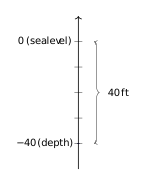
A scuba diver descends \(40\) feet below sea level. Which integer represents this depth?

Integers and Their Opposites visual for G7-C03-T01-Q008
  1. A \(40\) (ignores direction/below sea level)
  2. B \(-80\) (double the depth)
  3. C \(0\) (at sea level, not below)
  4. D \(-40\) (correct; below is negative)
Check answer and explanation

Answer D: \(-40\) (correct; below is negative)

Descending (going down) below sea level is represented by a negative number. A descent of \(40\) feet is \(-40\).

exit

3 questions
G7-C03-T01-Q009 About 1 min

A stock loses \(15\) points. Express this as a signed number.

  1. A \(-15\) (correct; loss is negative)
  2. B \(0\) (no change)
  3. C \(15\) (ignores the loss/negative direction)
  4. D \(-30\) (double the loss)
Check answer and explanation

Answer A: \(-15\) (correct; loss is negative)

A loss is represented by a negative number. A loss of \(15\) points is \(-15\).

G7-C03-T01-Q010 About 1 min

What is the opposite of \(0\)?

  1. A \(-1\)
  2. B \(1\)
  3. C \(0\)
  4. D Undefined
Check answer and explanation

Answer C: \(0\)

Zero is its own opposite. The opposite of \(0\) is \(0\), since \(0 = -0\).

G7-C03-T01-Q011 About 1 min

A bank account has a balance of \(-$75\) (overdrawn). To bring it to zero, you must deposit:

  1. A \($75\)
  2. B \($150\)
  3. C \(-$75\)
  4. D \($0\)
Check answer and explanation

Answer A: \($75\)

To cancel out a debt of \(-75\), you must add \(+75\). Their sum is zero: \(-75 + 75 = 0\).

Page UP