

CH09-07 lesson

Simulating Compound Events Learning Activity

A focused Grade 7 learning session for Simulating Compound Events using visual models, worked examples, strategy guidance, and a short mastery check.

18
minutes
6
lesson parts
11
practice items
Learning goal

Students will build Grade 7 mastery of simulating compound events using models, equations, and test-style reasoning.

Student goal: I can solve problems involving simulating compound events.

concept

Learn the Idea

Simulating Compound Events is part of Grade 7 Probability. This activity focuses on the central idea students need before they move into independent practice.

Students will build Grade 7 mastery of simulating compound events using models, equations, and test-style reasoning.

visual model

See the Math

What to noticeHow to use it
Numbers, units, labels, diagrams, or graphsIdentify what each part represents before calculating.
The relationship in the problemConnect the model to an equation, comparison, or explanation.

Use the figures and worked questions in the practice set below as the visual model for this skill.

worked example

Follow a Worked Example

Read the first practice question slowly. Decide what the question is asking, choose a strategy, solve, and then compare your reasoning with the answer explanation.

For Simulating Compound Events, a strong worked example should show the setup, the calculation or model, and a final answer that matches the context.

real world

Connect It to a Real Situation

Many Grade 7 test questions use real situations. Look for quantities, units, rates, measures, expressions, or data values that connect the math to the story.

After solving, explain what the answer means in the situation, not just the number you calculated.

strategy

Avoid Mistakes and Choose a Strategy

  • Underline the exact question before solving.
  • Label units, variables, or graph axes when they appear.
  • Estimate first so unreasonable answers are easier to catch.
  • Review missed questions and write the reason for each mistake.
summary

Remember the Key Idea

I can solve problems involving simulating compound events.

Use the warmup, guided question, practice set, and exit questions below to check whether this skill is ready or needs more practice.

Guided to independent practice

Solve before opening the answer

Use scratch paper. The explanation matters more than simply seeing whether the choice is correct.

warmup

2 questions
G7-C09-T07-Q001 About 1 min

To simulate the probability of guessing a true/false question correctly \(3\) times in a row, which tool best models this compound event?

  1. A Rolling a six-sided die once
  2. B Flipping a coin \(3\) times
  3. C Spinning a spinner with \(3\) equal sections once
  4. D Drawing a card from a deck of \(52\) once
Check answer and explanation

Answer B: Flipping a coin \(3\) times

Each true/false question has \(2\) equally likely outcomes (like a coin). The compound event is three consecutive guesses, so three flips simulate this.
G7-C09-T07-Q002 About 1 min

A spinner has \(6\) equal sections. To simulate rolling a standard die once, how many trials are needed if we spin once per trial?

  1. A \(1\) trial
  2. B \(2\) trials
  3. C \(6\) trials
  4. D \(36\) trials
Check answer and explanation

Answer A: \(1\) trial

A spinner with \(6\) equal sections directly models one roll of a die (one outcome per spin).

guided

1 question
G7-C09-T07-Q003 About 1 min

Which simulation tool best models the probability of selecting a red marble or a blue marble from a bag with equal numbers of red and blue marbles?

  1. A Rolling a standard die once
  2. B Flipping a coin
  3. C Spinning a spinner with \(10\) equal sections
  4. D Drawing two cards from a deck without replacing the first
Check answer and explanation

Answer B: Flipping a coin

Two equally likely outcomes (red or blue, heads or tails) match perfectly.

practice

5 questions
G7-C09-T07-Q004 About 1 min

A bag contains \(3\) red marbles, \(2\) blue marbles, and \(5\) green marbles. To simulate drawing one marble, which probability does rolling a standard die best represent?

  1. A Probability of drawing red
  2. B Probability of drawing blue
  3. C Probability of drawing green
  4. D Probability of drawing blue or green
Check answer and explanation

Answer C: Probability of drawing green

There are \(5\) green marbles out of \(10\) total, giving probability \(\frac{5}{10} = \frac{1}{2}\). Rolling \(1\)--\(3\) on a die simulates this (or rolling odd/even).

G7-C09-T07-Q005 About 1 min

To simulate drawing a card from a standard deck and finding whether it is a heart (probability \(\frac{1}{4}\)), which spinner design is best?

  1. A Spinner with \(2\) equal sections (one shaded, one not)
  2. B Spinner with \(4\) equal sections (one shaded, three not)
  3. C Spinner with \(6\) equal sections (two shaded, four not)
  4. D Spinner with \(13\) equal sections (one shaded, twelve not)
Check answer and explanation

Answer B: Spinner with \(4\) equal sections (one shaded, three not)

Probability \(\frac{1}{4}\) means \(1\) favorable outcome out of \(4\) equally likely ones.

G7-C09-T07-Q006 About 1 min

A spinner with \(4\) equal sections (Red, Blue, Green, Yellow) is spun twice to simulate a compound event. If "success" is defined as "the first spin is Red and the second spin is Blue," how many outcomes in the sample space represent a success?

  1. A \(1\)
  2. B \(2\)
  3. C \(4\)
  4. D \(8\)
Check answer and explanation

Answer A: \(1\)

The sample space has \(4 \times 4 = 16\) equally likely outcomes. Only one outcome satisfies the condition: "first spin Red, second spin Blue."

G7-C09-T07-Q007 About 1 min

Two fair dice are rolled as a simulation of a compound event. If "success" is rolling a sum of \(7\), which of the following correctly identifies all successful outcomes?

  1. A \((1,7), (2,7), (3,7), (4,7), (5,7), (6,7)\) — six outcomes
  2. B \((1,6), (2,5), (3,4), (4,3), (5,2), (6,1)\) — six outcomes
  3. C \((1,6), (2,5), (3,4)\) — three outcomes
  4. D Any roll where one die shows \(7\) — multiple outcomes
Check answer and explanation

Answer B: \((1,6), (2,5), (3,4), (4,3), (5,2), (6,1)\) — six outcomes

Each standard die shows \(1\)--\(6\), so \((1,7)\) is impossible. To get a sum of \(7\), identify all pairs \((a, b)\) where \(a + b = 7\) and \(1 \leq a, b \leq 6\). These are the six outcomes listed. The probability is thus \(\frac{6}{36} = \frac{1}{6}\).

G7-C09-T07-Q008 About 1 min

A spinner is spun \(60\) times, and section A appears \(18\) times. What is the experimental probability of landing on section A?

  1. A \(0.20\)
  2. B \(0.25\)
  3. C \(0.30\)
  4. D \(0.35\)
Check answer and explanation

Answer C: \(0.30\)

Relative frequency \(= \frac{18}{60} = 0.30\).

exit

3 questions
G7-C09-T07-Q009 About 1 min

A coin is flipped \(100\) times. Heads appears \(48\) times. Based on this simulation, which is the estimated probability of flipping heads?

  1. A \(0.40\)
  2. B \(0.48\)
  3. C \(0.50\)
  4. D \(0.52\)
Check answer and explanation

Answer B: \(0.48\)

Relative frequency from the simulation is \(\frac{48}{100} = 0.48\), which estimates the probability.

G7-C09-T07-Q010 About 1 min

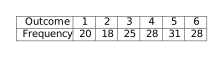
A die is rolled \(150\) times. The results are shown in the table below. Which outcome has the highest estimated probability based on this simulation?

Simulating Compound Events visual for G7-C09-T07-Q010
  1. A \(2\)
  2. B \(4\)
  3. C \(5\)
  4. D \(6\)
Check answer and explanation

Answer C: \(5\)

Outcome \(5\) has the highest frequency (\(31\) out of \(150\)), so \(P(5) \approx \frac{31}{150} \approx 0.207\).

G7-C09-T07-Q011 About 1 min

A coin is flipped twice to simulate a compound event. How many outcomes involve "at least one heads"?

  1. A \(1\)
  2. B \(2\)
  3. C \(3\)
  4. D \(4\)
Check answer and explanation

Answer C: \(3\)

Sample space: HH, HT, TH, TT (four equally likely outcomes). Outcomes with at least one heads: HH, HT, TH (three outcomes). So \(P(\text{at least one heads}) = \frac{3}{4} = 0.75\).

Page UP