Which value could represent the probability of an event?
- A \(-0.2\)
- B \(0.35\)
- C \(1.5\)
- D \(200\%\)
Check answer and explanation
Answer B: \(0.35\)
Probability is always between \(0\) and \(1\) (inclusive). Only \(0.35\) fits.


A focused Grade 7 learning session for What Is Probability? using visual models, worked examples, strategy guidance, and a short mastery check.
Student goal: I can solve problems involving what is probability?.
What Is Probability? is part of Grade 7 Probability. This activity focuses on the central idea students need before they move into independent practice.
Students will build Grade 7 mastery of what is probability? using models, equations, and test-style reasoning.
| What to notice | How to use it |
|---|---|
| Numbers, units, labels, diagrams, or graphs | Identify what each part represents before calculating. |
| The relationship in the problem | Connect the model to an equation, comparison, or explanation. |
Use the figures and worked questions in the practice set below as the visual model for this skill.
Read the first practice question slowly. Decide what the question is asking, choose a strategy, solve, and then compare your reasoning with the answer explanation.
For What Is Probability?, a strong worked example should show the setup, the calculation or model, and a final answer that matches the context.
Many Grade 7 test questions use real situations. Look for quantities, units, rates, measures, expressions, or data values that connect the math to the story.
After solving, explain what the answer means in the situation, not just the number you calculated.
I can solve problems involving what is probability?.
Use the warmup, guided question, practice set, and exit questions below to check whether this skill is ready or needs more practice.
Use scratch paper. The explanation matters more than simply seeing whether the choice is correct.
Which value could represent the probability of an event?
Answer B: \(0.35\)
Probability is always between \(0\) and \(1\) (inclusive). Only \(0.35\) fits.
A probability number line is shown below. Which probability is marked on the number line?
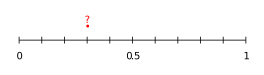
Answer C: \(0.3\)
The point is at the third tick mark from \(0\) to \(1\), which represents \(0.3\).
Which fraction is equivalent to a probability of \(0.75\)?
Answer B: \(\frac{3}{4}\)
\(\frac{3}{4} = 0.75\). Dividing \(3 \div 4 = 0.75\).
Which event has a probability of \(1\) (certain)?
Answer D: The sun rising tomorrow
The sun rising tomorrow is certain (probability = 1). The other events are uncertain.
Which event has a probability of \(0\) (impossible)?
Answer A: Rolling a 7 on a standard six-sided die
A standard die only has faces 1--6, so rolling a 7 is impossible (probability = 0).
A weather forecast says there is a \(60\%\) chance of rain tomorrow. What is this probability as a decimal?
Answer B: \(0.6\)
\(60\% = \frac{60}{100} = 0.6\).
A bag contains 8 red marbles and 12 blue marbles. If you pick one marble without looking, what is the probability of picking a red marble?
Answer A: \(\frac{8}{20}\)
Total marbles = \(8 + 12 = 20\). Probability = \(\frac{\text{red}}{\text{total}} = \frac{8}{20}\).
Which likelihood term describes a probability of \(0.1\)?
Answer C: Unlikely
A probability of \(0.1\) is very low, so the event is unlikely to occur.
Which probability best matches the phrase "even chance"?
Answer B: \(0.5\)
An even chance means equally likely to happen or not, which is \(P = 0.5 = 50\%\).
A student rolled a die 60 times and got the following results: 1 appeared 10 times. Based on this data, what is the experimental probability of rolling a 1?
Answer B: \(\frac{10}{60}\)
Experimental probability = \(\frac{\text{times event occurred}}{\text{total trials}} = \frac{10}{60}\).
Which list orders the probabilities from least likely to most likely?
Answer A: \(0.2, 0.5, 0.9, 1\)
Lower probabilities represent less likely events. Ordering: \(0.2 < 0.5 < 0.9 < 1\).
