






A triangle has interior angles totaling 180 degrees, and its area is half of a base times the perpendicular height. Choose the rule that matches the quantity requested.
Free practice resources: additional practice PDF; PDF set 1; PDF set 2; PDF set 3. The original questions below have step-by-step solutions; the downloads are separate resources.
Method and restrictions
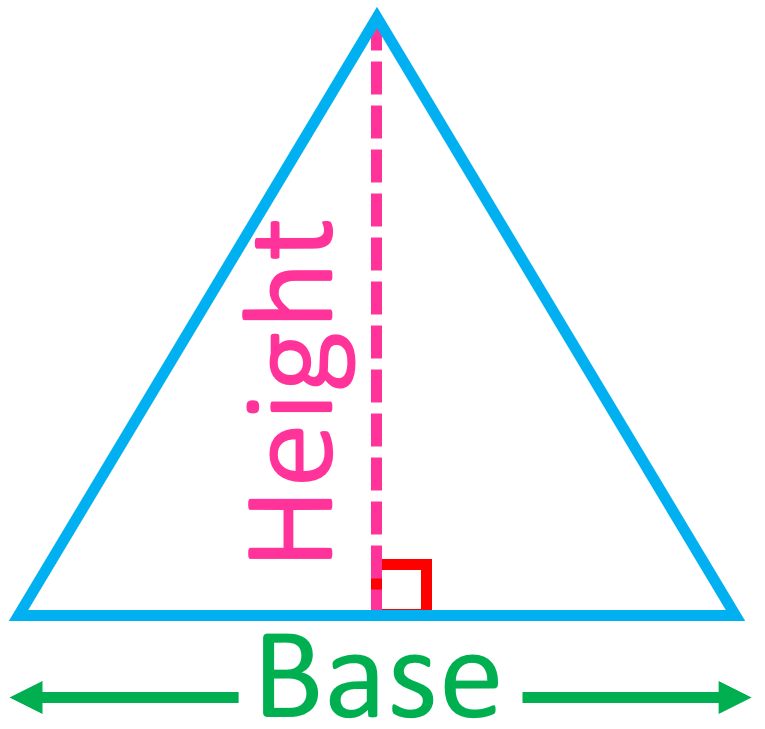
For area, use \(A=\frac12 bh\). Any side can be the base if its matching perpendicular height is known. In a right triangle, the legs are perpendicular, so they can serve as base and height. In an obtuse triangle, a height may be outside the triangle.
For an unknown angle, write \(x=180^\circ-(a+b)\). Equal sides in an isosceles triangle have equal opposite angles. Area uses square units; angles use degrees. These are different measurements.
Worked examples
Example 1
Find the area of a triangle with base \(8\) cm and perpendicular height \(5\) cm.
- Choose \(A=\frac12 bh\); the height meets the base at a right angle.
- Multiply: \(8\times5=40\). Take half: \(40/2=20\).
- The area is \(20\) square cm.
Example 2
These are the three interior angles of a triangle. Known angle measures: \(45^\circ\), \(65^\circ\). Find the remaining angle.
- The stated relationship gives a total of \(180^\circ\).
- Add known measures: \(45+65=110\). Subtract from the total: \(180-110=70\).
- The remaining angle is \(70^\circ\); all measures add to \(180^\circ\).
Try these first
- A triangle has area \(48\) square cm and base \(12\) cm. Find its perpendicular height.
- These are the interior angles of a right triangle. Known angle measures: \(35^\circ\), \(90^\circ\). Find the remaining angle.
- Find the area of a triangle with base \(7.5\) cm and perpendicular height \(4\) cm.
Show step-by-step solutions
Practice 1
- Write \(48=\frac12(12)h\).
- Isolate height: \(h=2(48)/12=8\) cm.
- Check by substituting: \(12(8)/2=48\) square cm.
Practice 2
- The stated relationship gives a total of \(180^\circ\).
- Add known measures: \(35+90=125\). Subtract from the total: \(180-125=55\).
- The remaining angle is \(55^\circ\); all measures add to \(180^\circ\).
Practice 3
- Choose \(A=\frac12 bh\); the height meets the base at a right angle.
- Multiply: \(7.5\times4=30\). Take half: \(30/2=15\).
- The area is \(15\) square cm.
Common mistakes
- The one-half factor applies to triangle area, not the angle sum.
- A slanted edge is not automatically a perpendicular height.
Related skills
Angle relationships; Right-triangle side lengths.
More from the original topic collection: Free printable Worksheets; How to Find the Perimeter of Polygons; How to Find the Area of Squares, Rectangles, and Parallelograms; How to Calculate the Area of Trapezoids; How to Find the Area and Circumference of Circles.

