






These free triangle angles and area worksheets provide printable practice. Use the guide and worked questions below to choose a method and check your reasoning before working independently.
Free practice resources: additional practice PDF; PDF set 1; PDF set 2; PDF set 3. The original questions below have step-by-step solutions; the downloads are separate resources.
Method and restrictions
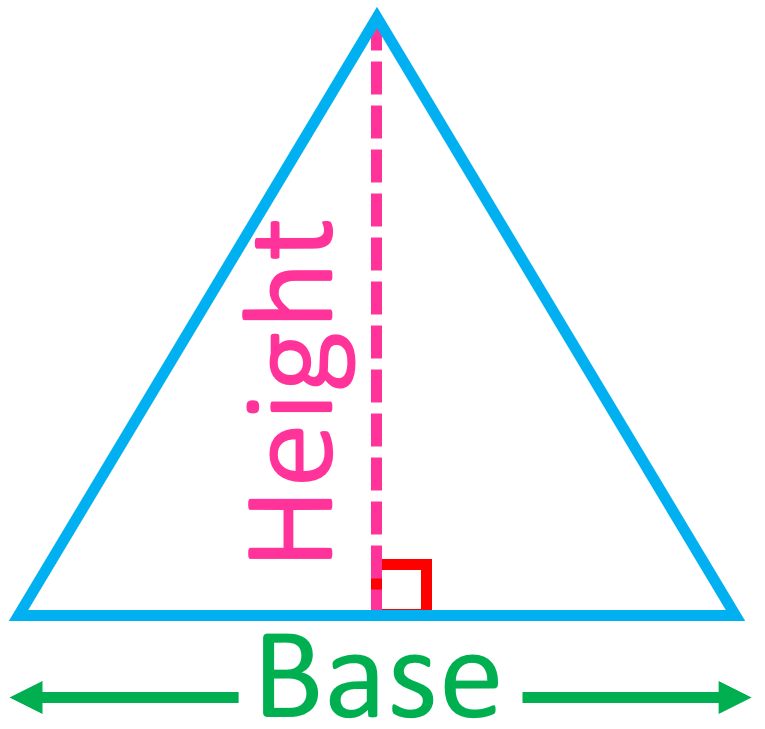
Sort PDF items into angle questions and area questions before calculating. For area, mark the right angle between base and height; for an angle question, mark the known interior angles.
For area, use \(A=\frac12 bh\). Any side can be the base if its matching perpendicular height is known. In a right triangle, the legs are perpendicular, so they can serve as base and height. In an obtuse triangle, a height may be outside the triangle.
For an unknown angle, write \(x=180^\circ-(a+b)\). Equal sides in an isosceles triangle have equal opposite angles. Area uses square units; angles use degrees. These are different measurements.
Model the work before using the PDFs
Example 1
These are the interior angles of a triangle. Known angle measures: \(52^\circ\), \(63^\circ\). Find the remaining angle.
- The stated relationship gives a total of \(180^\circ\).
- Add known measures: \(52+63=115\). Subtract from the total: \(180-115=65\).
- The remaining angle is \(65^\circ\); all measures add to \(180^\circ\).
Example 2
Find the area of a triangle with base \(14\) cm and perpendicular height \(9\) cm.
- Choose \(A=\frac12 bh\); the height meets the base at a right angle.
- Multiply: \(14\times9=126\). Take half: \(126/2=63\).
- The area is \(63\) square cm.
Try these first
- Find the area of a triangle with base \(9\) cm and perpendicular height \(4\) cm.
- A triangle has area \(60\) square cm and base \(15\) cm. Find its perpendicular height.
- These are the interior angles of a triangle. Known angle measures: \(48^\circ\), \(67^\circ\). Find the remaining angle.
Show step-by-step solutions
Practice 1
- Choose \(A=\frac12 bh\); the height meets the base at a right angle.
- Multiply: \(9\times4=36\). Take half: \(36/2=18\).
- The area is \(18\) square cm.
Practice 2
- Write \(60=\frac12(15)h\).
- Isolate height: \(h=2(60)/15=8\) cm.
- Check by substituting: \(15(8)/2=60\) square cm.
Practice 3
- The stated relationship gives a total of \(180^\circ\).
- Add known measures: \(48+67=115\). Subtract from the total: \(180-115=65\).
- The remaining angle is \(65^\circ\); all measures add to \(180^\circ\).
Common mistakes
- The one-half factor applies to triangle area, not the angle sum.
- A slanted edge is not automatically a perpendicular height.
Related skills
Angle relationships; Right-triangle side lengths.
More from the original topic collection: Perimeter of Polygons; Area of Squares, Rectangles, and Parallelograms; The Pythagorean Theorem; Area of Trapezoids; Area and Circumference of Circles; Angles.

