






These free circle area and circumference worksheets provide printable practice. Use the guide and worked questions below to choose a method and check your reasoning before working independently.
Free practice resources: additional practice PDF; PDF set 1; PDF set 2; PDF set 3. The original questions below have step-by-step solutions; the downloads are separate resources.
Method and restrictions
Write A or C beside the requested quantity on each PDF item. Circle any diameter that must be halved. Keep exact pi answers separate from rounded decimal answers.
The diameter is \(d=2r\). Use \(C=2\pi r=\pi d\) for circumference and \(A=\pi r^2\) for area. If given diameter, divide it by 2 before using a radius formula. Circumference has length units; area has square units.
Leave \(\pi\) exact unless a decimal is requested. When approximating, use the stated value of \(\pi\) or your calculator's pi key and round only the final result. A semicircle's curved arc is half a circumference, but its complete perimeter also includes the diameter.
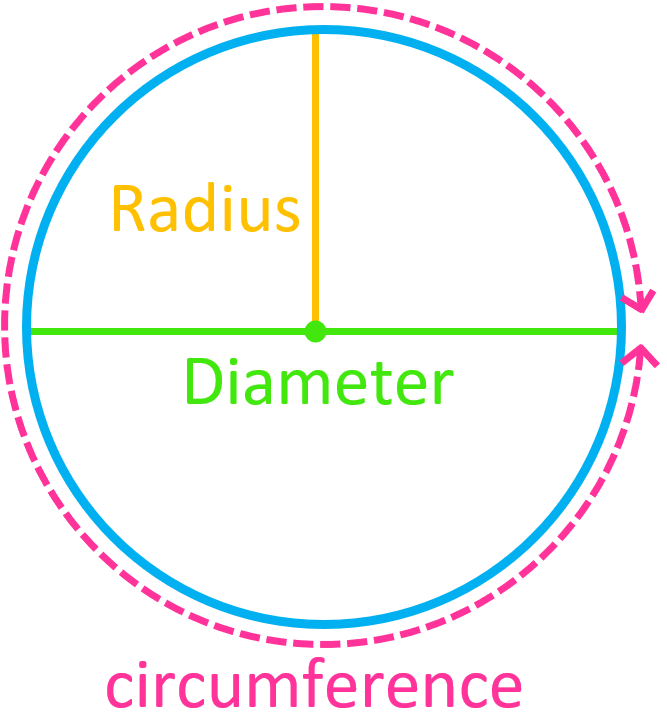
Model the work before using the PDFs
Example 1
Find the circumference of a circle with diameter \(12\) cm. Give an exact answer.
- Halve the diameter: \(r=12/2=6\) cm.
- Use \(C=2\pi r\): \(C=2\pi(6)=12\pi\).
- The answer is \(12\pi\) cm. Keep \(\pi\) exact until rounding is requested.
Example 2
A circle has area \(49\pi\) square cm. Find its radius.
- Substitute into \(A=\pi r^2\): \(49\pi=\pi r^2\).
- Divide by \(\pi\): \(r^2=49\). Take the positive root: \(r=7\) cm.
- A radius is a positive length; the negative algebraic root is not a geometric answer.
Try these first
- Find the area of a circle with diameter \(14\) cm. Give an exact answer.
- Find the circumference of a circle with radius \(2.5\) cm. Give an exact answer.
- Find the area of a circle with radius \(6\) cm. Give an exact answer.
Show step-by-step solutions
Practice 1
- Halve the diameter: \(r=14/2=7\) cm.
- Use \(A=\pi r^2\): \(A=\pi(7)^2=49\pi\).
- The answer is \(49\pi\) square cm. Keep \(\pi\) exact until rounding is requested.
Practice 2
- The radius is already \(2.5\) cm.
- Use \(C=2\pi r\): \(C=2\pi(2.5)=5\pi\).
- The answer is \(5\pi\) cm. Keep \(\pi\) exact until rounding is requested.
Practice 3
- The radius is already \(6\) cm.
- Use \(A=\pi r^2\): \(A=\pi(6)^2=36\pi\).
- The answer is \(36\pi\) square cm. Keep \(\pi\) exact until rounding is requested.
Common mistakes
- Squaring the diameter instead of the radius makes area four times too large.
- Doubling radius doubles circumference but multiplies area by four.
Related skills
Circle word problems; Cylinder volume.
More from the original topic collection: Perimeter of Polygons; Angle and Area of Triangles; Area of Squares, Rectangles, and Parallelograms; The Pythagorean Theorem; Area of Trapezoids; Angles.

