






Circumference is the distance around a circle, while area is the space inside it. Use twice pi times the radius for circumference and pi times radius squared for area.
Free practice resources: additional practice PDF; PDF set 1; PDF set 2; PDF set 3. The original questions below have step-by-step solutions; the downloads are separate resources.
Method and restrictions
The diameter is \(d=2r\). Use \(C=2\pi r=\pi d\) for circumference and \(A=\pi r^2\) for area. If given diameter, divide it by 2 before using a radius formula. Circumference has length units; area has square units.
Leave \(\pi\) exact unless a decimal is requested. When approximating, use the stated value of \(\pi\) or your calculator's pi key and round only the final result. A semicircle's curved arc is half a circumference, but its complete perimeter also includes the diameter.
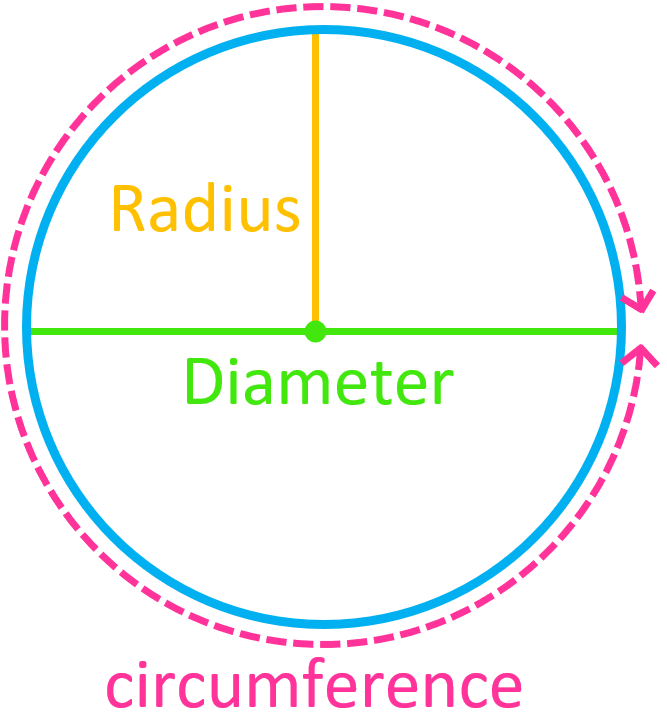
Worked examples
Example 1
Find the area of a circle with diameter \(10\) cm. Give an exact answer.
- Halve the diameter: \(r=10/2=5\) cm.
- Use \(A=\pi r^2\): \(A=\pi(5)^2=25\pi\).
- The answer is \(25\pi\) square cm. Keep \(\pi\) exact until rounding is requested.
Example 2
Find the circumference of a circle with radius \(7\) cm. Give an exact answer.
- The radius is already \(7\) cm.
- Use \(C=2\pi r\): \(C=2\pi(7)=14\pi\).
- The answer is \(14\pi\) cm. Keep \(\pi\) exact until rounding is requested.
Try these first
- Find the area of a circle with radius \(3\) cm. Give an exact answer.
- Find the circumference of a circle with diameter \(9\) cm. Give an exact answer.
- A circle has area \(81\pi\) square cm. Find its radius.
Show step-by-step solutions
Practice 1
- The radius is already \(3\) cm.
- Use \(A=\pi r^2\): \(A=\pi(3)^2=9\pi\).
- The answer is \(9\pi\) square cm. Keep \(\pi\) exact until rounding is requested.
Practice 2
- Halve the diameter: \(r=9/2=4.5\) cm.
- Use \(C=2\pi r\): \(C=2\pi(4.5)=9\pi\).
- The answer is \(9\pi\) cm. Keep \(\pi\) exact until rounding is requested.
Practice 3
- Substitute into \(A=\pi r^2\): \(81\pi=\pi r^2\).
- Divide by \(\pi\): \(r^2=81\). Take the positive root: \(r=9\) cm.
- A radius is a positive length; the negative algebraic root is not a geometric answer.
Common mistakes
- Squaring the diameter instead of the radius makes area four times too large.
- Doubling radius doubles circumference but multiplies area by four.
Related skills
Circle word problems; Cylinder volume.
More from the original topic collection: Free printable Worksheets; How to Find the Perimeter of Polygons; How to Find the Area of a triangle; How to Find the Area of Squares, Rectangles, and Parallelograms; What is The Pythagorean Theorem; How to Calculate the Area of Trapezoids; What is an angle?.

