






In a right triangle, the sum of the squared leg lengths equals the squared hypotenuse. Add squares to find the hypotenuse, or subtract a leg square to find the other leg.
Free practice resources: additional practice PDF; PDF set 2; PDF set 3. The original questions below have step-by-step solutions; the downloads are separate resources.
Method and restrictions
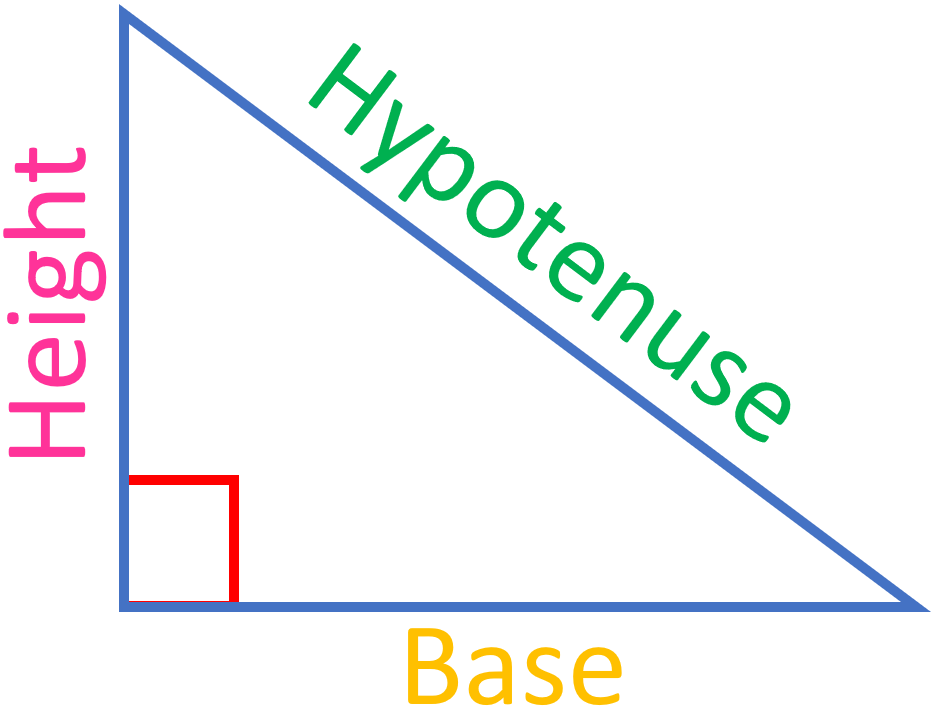
Use \(a^2+b^2=c^2\), with c opposite the right angle. Thus \(c=\sqrt{a^2+b^2}\), while \(a=\sqrt{c^2-b^2}\). All dimensions must use the same unit, and lengths are positive.
To test whether three positive side lengths form a right triangle, square the largest and compare it with the sum of the other two squares. The theorem does not apply directly to a triangle without a right angle. A rectangle's diagonal forms a right triangle with two adjacent sides.
Worked examples
Example 1
A right triangle has legs 6 cm and 8 cm. Find its hypotenuse exactly.
- The hypotenuse is opposite the right angle. Write \(c^2=6^2+8^2\).
- Compute the squares: \(c^2=36+64=100\).
- Take the positive square root: \(c=10\) cm. The hypotenuse is longer than either leg.
Example 2
A right triangle has hypotenuse 13 cm and one leg 5 cm. Find the other leg exactly.
- Let the missing leg be \(x\). Then \(x^2+5^2=13^2\).
- Compute the squares: \(x^2=169-25=144\).
- Take the positive square root: \(x=12\) cm. The leg is shorter than the hypotenuse.
Try these first
- A right triangle has legs 5 cm and 7 cm. Find its hypotenuse exactly.
- A right triangle has hypotenuse 17 cm and one leg 8 cm. Find the other leg exactly.
- A right triangle has legs 9 cm and 12 cm. Find its hypotenuse exactly.
Show step-by-step solutions
Practice 1
- The hypotenuse is opposite the right angle. Write \(c^2=5^2+7^2\).
- Compute the squares: \(c^2=25+49=74\).
- Take the positive square root: \(c=\sqrt{74}\) cm. The hypotenuse is longer than either leg.
Practice 2
- Let the missing leg be \(x\). Then \(x^2+8^2=17^2\).
- Compute the squares: \(x^2=289-64=225\).
- Take the positive square root: \(x=15\) cm. The leg is shorter than the hypotenuse.
Practice 3
- The hypotenuse is opposite the right angle. Write \(c^2=9^2+12^2\).
- Compute the squares: \(c^2=81+144=225\).
- Take the positive square root: \(c=15\) cm. The hypotenuse is longer than either leg.
Common mistakes
- Do not add the side lengths before squaring: the square of a sum is different from a sum of squares.
- Finding a leg requires subtraction; always take a square root at the end.
Related skills
Triangle angles and area; Height and slant height in solids.
More from the original topic collection: Free printable Worksheets; How to Find the Perimeter of Polygons; How to Find the Area of Squares, Rectangles, and Parallelograms; How to Calculate the Area of Trapezoids; How to Find the Area and Circumference of Circles; What is an angle?.

