





A closed rectangular prism has three pairs of matching rectangular faces. Add the areas of one face from each pair, then double the sum to find total surface area.
Free practice resources: additional practice PDF; PDF set 1; PDF set 2; PDF set 3; existing skill quiz. The original questions below have step-by-step solutions; the downloads are separate resources.
Method and restrictions
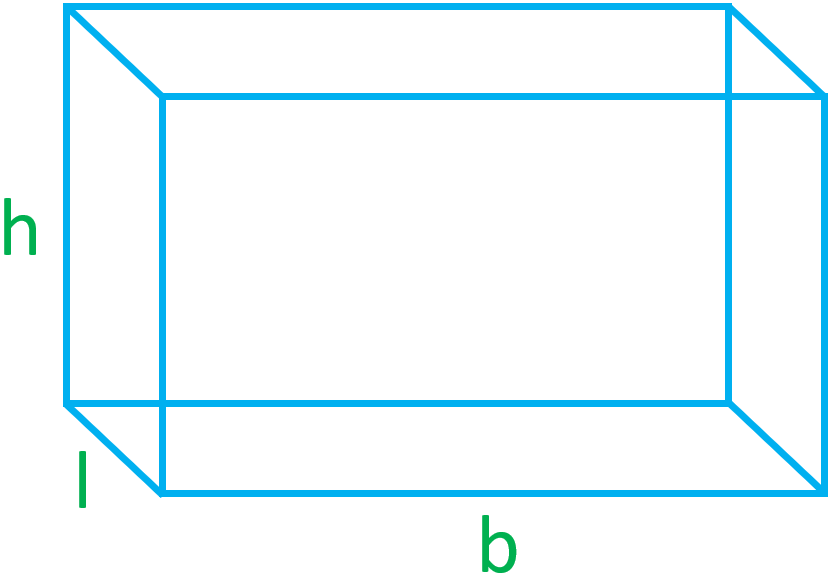
Use \(S=2(lw+lh+wh)\) for a closed prism. The areas \(lw\), \(lh\), and \(wh\) each occur twice. A net makes those six faces visible. For an open-top box, omit the lid: \(S=lw+2lh+2wh\).
Match the formula to the surfaces actually covered. Painting only the four side walls uses \(2lh+2wh\); a floor or lid must be included only if requested. Convert dimensions to a common length unit, then report square units, not cubic units.
Worked examples
Example 1
A rectangular prism has length 3 cm, width 4 cm, and height 5 cm. Find its surface area. For surface area, include all six faces.
- The three face areas are \(lw=12\), \(lh=15\), and \(wh=20\) square cm.
- Count the faces: \(S=2(12+15+20)=94\) square cm.
- Opposite faces are congruent, so each of the three areas is counted twice.
Example 2
A rectangular open-top box has length 8 cm, width 2 cm, and height 7 cm. Find its surface area. Include the base and four walls, not a lid.
- The three face areas are \(lw=16\), \(lh=56\), and \(wh=14\) square cm.
- Count the faces: \(S=16+2(56)+2(14)=156\) square cm.
- The missing lid removes one base-sized rectangle from a closed box.
Try these first
- A rectangular prism has length 6 cm, width 5 cm, and height 4 cm. Find its surface area. For surface area, include all six faces.
- A rectangular open-top box has length 9 cm, width 3 cm, and height 2 cm. Find its surface area. Include the base and four walls, not a lid.
- A rectangular prism has length 2.5 cm, width 4 cm, and height 3 cm. Find its surface area. For surface area, include all six faces.
Show step-by-step solutions
Practice 1
- The three face areas are \(lw=30\), \(lh=24\), and \(wh=20\) square cm.
- Count the faces: \(S=2(30+24+20)=148\) square cm.
- Opposite faces are congruent, so each of the three areas is counted twice.
Practice 2
- The three face areas are \(lw=27\), \(lh=18\), and \(wh=6\) square cm.
- Count the faces: \(S=27+2(18)+2(6)=75\) square cm.
- The missing lid removes one base-sized rectangle from a closed box.
Practice 3
- The three face areas are \(lw=10\), \(lh=7.5\), and \(wh=12\) square cm.
- Count the faces: \(S=2(10+7.5+12)=59\) square cm.
- Opposite faces are congruent, so each of the three areas is counted twice.
Common mistakes
- Multiplying all three dimensions gives volume, not surface area.
- Do not count an opening as a covered face, or omit the second face in a matching pair.
Related skills
Rectangular-prism volume; Cube area and volume.
More from the original topic collection: Free printable Worksheets; How to Find the Volume of a Cylinder; How to Find the Surface Area of a Cylinder; How to Find the Volume of a Cube; How to Find Volume and Surface Area of Pyramids and Cone.

