





These free rectangular-prism surface area worksheets provide printable practice. Use the guide and worked questions below to choose a method and check your reasoning before working independently.
Free practice resources: additional practice PDF; PDF set 1; PDF set 2; PDF set 3. The original questions below have step-by-step solutions; the downloads are separate resources.
Method and restrictions
Label the three different rectangular face areas before using a shortcut. On each PDF question, check whether the solid is closed; compare it with the open-top examples below rather than assuming every object has a lid.
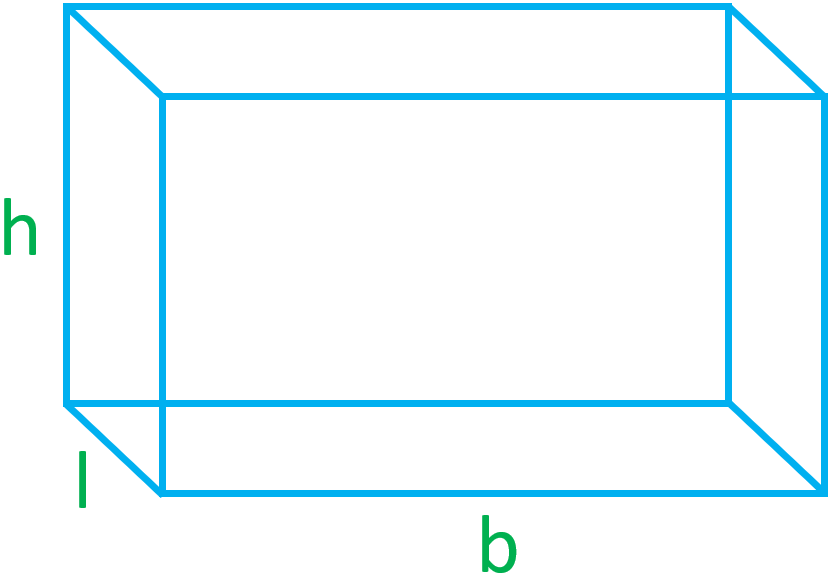
Use \(S=2(lw+lh+wh)\) for a closed prism. The areas \(lw\), \(lh\), and \(wh\) each occur twice. A net makes those six faces visible. For an open-top box, omit the lid: \(S=lw+2lh+2wh\).
Match the formula to the surfaces actually covered. Painting only the four side walls uses \(2lh+2wh\); a floor or lid must be included only if requested. Convert dimensions to a common length unit, then report square units, not cubic units.
Model the work before using the PDFs
Example 1
A rectangular prism has length 8 cm, width 2 cm, and height 7 cm. Find its surface area. For surface area, include all six faces.
- The three face areas are \(lw=16\), \(lh=56\), and \(wh=14\) square cm.
- Count the faces: \(S=2(16+56+14)=172\) square cm.
- Opposite faces are congruent, so each of the three areas is counted twice.
Example 2
A rectangular open-top box has length 10 cm, width 6 cm, and height 4 cm. Find its surface area. Include the base and four walls, not a lid.
- The three face areas are \(lw=60\), \(lh=40\), and \(wh=24\) square cm.
- Count the faces: \(S=60+2(40)+2(24)=188\) square cm.
- The missing lid removes one base-sized rectangle from a closed box.
Try these first
- A rectangular prism has length 5 cm, width 3 cm, and height 2 cm. Find its surface area. For surface area, include all six faces.
- A rectangular open-top box has length 4 cm, width 4 cm, and height 6 cm. Find its surface area. Include the base and four walls, not a lid.
- A rectangular prism has length 7 cm, width 5 cm, and height 3 cm. Find its surface area. For surface area, include all six faces.
Show step-by-step solutions
Practice 1
- The three face areas are \(lw=15\), \(lh=10\), and \(wh=6\) square cm.
- Count the faces: \(S=2(15+10+6)=62\) square cm.
- Opposite faces are congruent, so each of the three areas is counted twice.
Practice 2
- The three face areas are \(lw=16\), \(lh=24\), and \(wh=24\) square cm.
- Count the faces: \(S=16+2(24)+2(24)=112\) square cm.
- The missing lid removes one base-sized rectangle from a closed box.
Practice 3
- The three face areas are \(lw=35\), \(lh=21\), and \(wh=15\) square cm.
- Count the faces: \(S=2(35+21+15)=142\) square cm.
- Opposite faces are congruent, so each of the three areas is counted twice.
Common mistakes
- Multiplying all three dimensions gives volume, not surface area.
- Do not count an opening as a covered face, or omit the second face in a matching pair.
Related skills
Rectangular-prism volume; Cube area and volume.
More from the original topic collection: Volume of Rectangle Prisms; Volume of a Cylinder; Surface Area of a Cylinder; volume and Surface Area of Cubes; Volume of Cubes; Pyramids and Cone.
