





The volume of a cube is its edge length multiplied by itself three times. Use a cube root to recover an edge from volume, and report volume in cubic units.
Free practice resources: additional practice PDF; PDF set 1; PDF set 2; PDF set 3; existing skill quiz. The original questions below have step-by-step solutions; the downloads are separate resources.
Method and restrictions
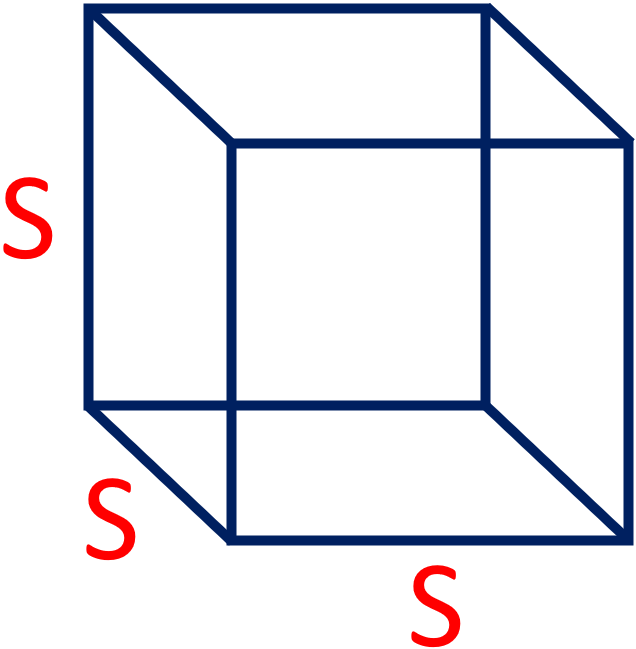
A cube has three equal perpendicular dimensions, so \(V=s^3=s\cdot s\cdot s\). If volume is known, \(s=\sqrt[3]{V}\). Convert edge lengths before cubing: a 10 cm edge gives \(10^3=1000\) cubic cm, not 10 cubic cm.
For capacity, use the interior edge dimensions. Surface area measures the covering and uses \(6s^2\), a different formula. Scaling an edge by k multiplies volume by \(k^3\).
Worked examples
Example 1
Find the volume of a cube with edge length 3 cm.
- Use \(V=s^3\): multiply three perpendicular edge lengths.
- Substitute: \(V=3^3=3\times3\times3=27\).
- The answer is \(27\) cubic cm.
Example 2
A cube has volume 125 cubic cm. Find its edge length.
- Write \(s^3=125\).
- Take the cube root: \(s=\sqrt[3]{125}=5\) cm.
- Check all three dimensions: \(5\times5\times5=125\) cubic cm.
Try these first
- Find the volume of a cube with edge length 4 cm.
- A cube has volume 216 cubic cm. Find its edge length.
- Find the volume of a cube with edge length 1.5 cm.
Show step-by-step solutions
Practice 1
- Use \(V=s^3\): multiply three perpendicular edge lengths.
- Substitute: \(V=4^3=4\times4\times4=64\).
- The answer is \(64\) cubic cm.
Practice 2
- Write \(s^3=216\).
- Take the cube root: \(s=\sqrt[3]{216}=6\) cm.
- Check all three dimensions: \(6\times6\times6=216\) cubic cm.
Practice 3
- Use \(V=s^3\): multiply three perpendicular edge lengths.
- Substitute: \(V=1.5^3=1.5\times1.5\times1.5=3.375\).
- The answer is \(3.375\) cubic cm.
Common mistakes
- Cubing an edge is not the same as multiplying it by 3.
- Do not confuse a cube root with a square root when finding an edge.
Related skills
Cube surface area versus volume; Rectangular-prism volume.
More from the original topic collection: Free printable Worksheets; How to Find the Volume of a Cylinder; How to Find the Surface Area of a Cylinder; How to Find the Surface Area of a Rectangular Prism; How to Find Volume and Surface Area of Pyramids and Cone.

