





These free volume of cubes worksheets provide printable practice. Use the guide and worked questions below to choose a method and check your reasoning before working independently.
Free practice resources: additional practice PDF; PDF set 1; PDF set 2; PDF set 3. The original questions below have step-by-step solutions; the downloads are separate resources.
Method and restrictions
Use one PDF for calculating volumes and another for a later independent attempt. On reverse problems, write an edge-times-edge-times-edge check after taking a cube root.
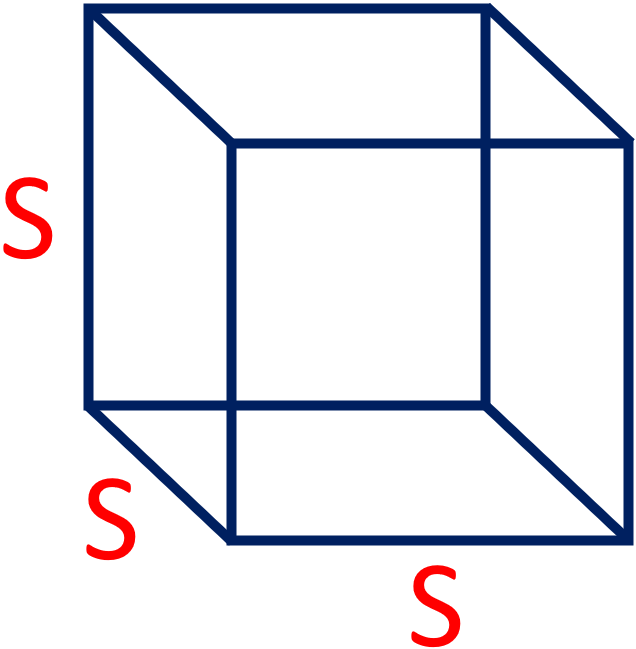
A cube has three equal perpendicular dimensions, so \(V=s^3=s\cdot s\cdot s\). If volume is known, \(s=\sqrt[3]{V}\). Convert edge lengths before cubing: a 10 cm edge gives \(10^3=1000\) cubic cm, not 10 cubic cm.
For capacity, use the interior edge dimensions. Surface area measures the covering and uses \(6s^2\), a different formula. Scaling an edge by k multiplies volume by \(k^3\).
Model the work before using the PDFs
Example 1
Find the volume of a cube with edge length 5 cm.
- Use \(V=s^3\): multiply three perpendicular edge lengths.
- Substitute: \(V=5^3=5\times5\times5=125\).
- The answer is \(125\) cubic cm.
Example 2
A cube has volume 343 cubic cm. Find its edge length.
- Write \(s^3=343\).
- Take the cube root: \(s=\sqrt[3]{343}=7\) cm.
- Check all three dimensions: \(7\times7\times7=343\) cubic cm.
Try these first
- Find the volume of a cube with edge length 2.5 cm.
- A cube has volume 64 cubic cm. Find its edge length.
- Find the volume of a cube with edge length 8 cm.
Show step-by-step solutions
Practice 1
- Use \(V=s^3\): multiply three perpendicular edge lengths.
- Substitute: \(V=2.5^3=2.5\times2.5\times2.5=15.625\).
- The answer is \(15.625\) cubic cm.
Practice 2
- Write \(s^3=64\).
- Take the cube root: \(s=\sqrt[3]{64}=4\) cm.
- Check all three dimensions: \(4\times4\times4=64\) cubic cm.
Practice 3
- Use \(V=s^3\): multiply three perpendicular edge lengths.
- Substitute: \(V=8^3=8\times8\times8=512\).
- The answer is \(512\) cubic cm.
Common mistakes
- Cubing an edge is not the same as multiplying it by 3.
- Do not confuse a cube root with a square root when finding an edge.
Related skills
Cube surface area versus volume; Rectangular-prism volume.
More from the original topic collection: Volume of Rectangle Prisms; Volume of a Cylinder; Surface Area of a Cylinder; Surface Area of a Rectangle Prism; volume and Surface Area of Cubes; Pyramids and Cone.
