





These free surface area of a cylinder worksheets provide printable practice. Use the guide and worked questions below to choose a method and check your reasoning before working independently.
Free practice resources: additional practice PDF; PDF set 1; PDF set 2; PDF set 3. The original questions below have step-by-step solutions; the downloads are separate resources.
Method and restrictions
For each PDF item, list the required surfaces before adding. Use the closed-cylinder questions for the full formula and the open-top examples below to practice omitting exactly one base.
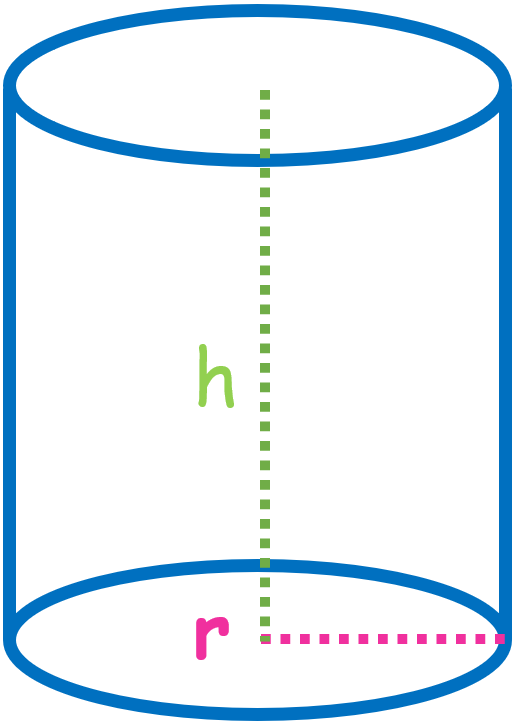
The curved side unwraps into a rectangle with width \(2\pi r\) and height h. Its lateral area is \(L=2\pi rh\). A closed cylinder adds two circular bases: \(S=2\pi rh+2\pi r^2\). An open-top cylinder with a base uses \(S=2\pi rh+\pi r^2\).
A label around a can covers only the curved side. A pipe with no ends may likewise need lateral area only. Decide which surfaces are included, halve diameter if necessary, and use square units. These formulas assume a right circular cylinder.
Model the work before using the PDFs
Example 1
A closed right cylinder has radius 5 cm and height 4 cm. Find its surface area exactly.
- Use the radius \(r=5\) cm.
- The curved side has area \(2\pi rh=2\pi(5)(4)=40\pi\). Two bases contribute \(2\pi(5)^2=50\pi\) square cm.
- Add the included surfaces: \(40\pi+50\pi=90\pi\) square cm.
Example 2
A cylindrical container without a lid has diameter 6 cm and height 8 cm. Find its surface area exactly.
- Convert diameter to radius: \(r=6/2=3\) cm.
- The curved side has area \(2\pi rh=2\pi(3)(8)=48\pi\). One base contributes \(1\pi(3)^2=9\pi\) square cm.
- Add the included surfaces: \(48\pi+9\pi=57\pi\) square cm.
Try these first
- A closed right cylinder has radius 4 cm and height 6 cm. Find its surface area exactly.
- A cylindrical container without a lid has radius 2 cm and height 5 cm. Find its surface area exactly.
- A closed right cylinder has radius 1.5 cm and height 4 cm. Find its surface area exactly.
Show step-by-step solutions
Practice 1
- Use the radius \(r=4\) cm.
- The curved side has area \(2\pi rh=2\pi(4)(6)=48\pi\). Two bases contribute \(2\pi(4)^2=32\pi\) square cm.
- Add the included surfaces: \(48\pi+32\pi=80\pi\) square cm.
Practice 2
- Use the radius \(r=2\) cm.
- The curved side has area \(2\pi rh=2\pi(2)(5)=20\pi\). One base contributes \(1\pi(2)^2=4\pi\) square cm.
- Add the included surfaces: \(20\pi+4\pi=24\pi\) square cm.
Practice 3
- Use the radius \(r=1.5\) cm.
- The curved side has area \(2\pi rh=2\pi(1.5)(4)=12\pi\). Two bases contribute \(2\pi(1.5)^2=4.5\pi\) square cm.
- Add the included surfaces: \(12\pi+4.5\pi=16.5\pi\) square cm.
Common mistakes
- An open top removes one circle, not the entire curved wall.
- The side rectangle has width equal to circumference, not diameter.
Related skills
Cylinder volume; Circle circumference and area.
More from the original topic collection: Volume of Rectangle Prisms; Volume of a Cylinder; Surface Area of a Rectangle Prism; volume and Surface Area of Cubes; Volume of Cubes; Pyramids and Cone.
