





These free volume of rectangular prisms worksheets provide printable practice. Use the guide and worked questions below to choose a method and check your reasoning before working independently.
Free practice resources: additional practice PDF; PDF set 1; PDF set 2; PDF set 3. The original questions below have step-by-step solutions; the downloads are separate resources.
Method and restrictions
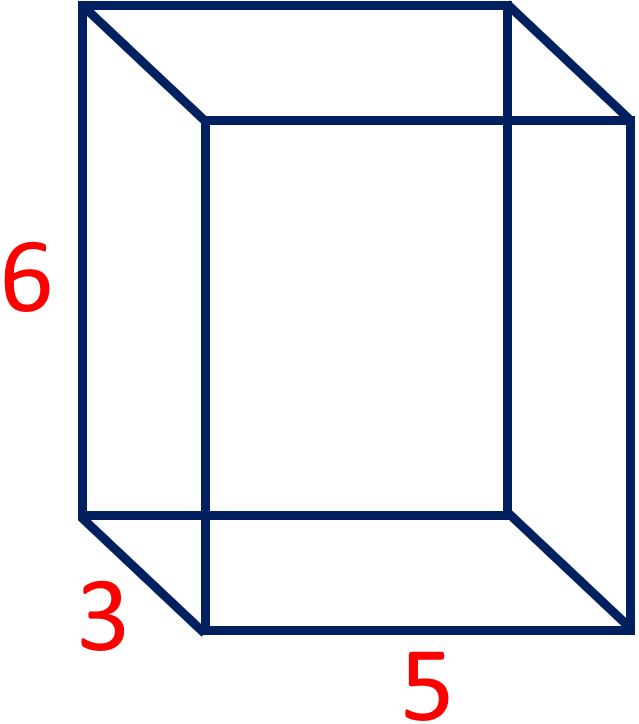
Write the three dimensions beside each PDF diagram. If a question mixes feet and inches, convert first. Use the reverse problems below to check that you can recover a missing height.
Use \(V=lwh=Bh\), where \(B=lw\) is base area. To find an unknown dimension, divide volume by the product of the other two dimensions. All lengths must be in one unit before multiplying.
A 2 cm by 3 cm by 4 cm prism contains four layers of 6 unit cubes, for 24 cubic cm. For a tank, use internal dimensions and the actual liquid depth, not automatically the full height. One cubic centimeter equals one milliliter; 1000 cubic centimeters equal one liter.
Model the work before using the PDFs
Example 1
A rectangular prism has length 8 cm, width 2 cm, and height 7 cm. Find its volume.
- The base area is \(lw=8(2)=16\) square cm.
- Multiply base area by height: \(V=16(7)=112\) cubic cm.
- The product uses three lengths, so the units are cubed.
Example 2
A rectangular prism has volume 960 cubic cm and base 15 cm by 8 cm. Find its height.
- Find base area: \(15(8)=120\) square cm.
- Since \(V=lwh\), \(h=960/120=8\) cm.
- Check: \(15(8)(8)=960\) cubic cm.
Try these first
- A rectangular prism has length 9 cm, width 3 cm, and height 2 cm. Find its volume.
- A rectangular prism has length 2.5 cm, width 6 cm, and height 4 cm. Find its volume.
- A rectangular prism has volume 450 cubic cm and base 10 cm by 6 cm. Find its height.
Show step-by-step solutions
Practice 1
- The base area is \(lw=9(3)=27\) square cm.
- Multiply base area by height: \(V=27(2)=54\) cubic cm.
- The product uses three lengths, so the units are cubed.
Practice 2
- The base area is \(lw=2.5(6)=15\) square cm.
- Multiply base area by height: \(V=15(4)=60\) cubic cm.
- The product uses three lengths, so the units are cubed.
Practice 3
- Find base area: \(10(6)=60\) square cm.
- Since \(V=lwh\), \(h=450/60=7.5\) cm.
- Check: \(10(6)(7.5)=450\) cubic cm.
Common mistakes
- Adding the dimensions does not measure enclosed space.
- Use interior measurements for capacity; wall thickness may make exterior volume larger.
Related skills
Prism surface area; Cube volume.
More from the original topic collection: Volume of a Cylinder; Surface Area of a Cylinder; Surface Area of a Rectangle Prism; volume and Surface Area of Cubes; Volume of Cubes; Pyramids and Cone.
