





These free volume of a cylinder worksheets provide printable practice. Use the guide and worked questions below to choose a method and check your reasoning before working independently.
Free practice resources: additional practice PDF; PDF set 1; PDF set 2; PDF set 3. The original questions below have step-by-step solutions; the downloads are separate resources.
Method and restrictions
On the PDF diagrams, distinguish radius from diameter before squaring. Give exact multiples of pi unless the question requests an approximation or supplies a particular value of pi.
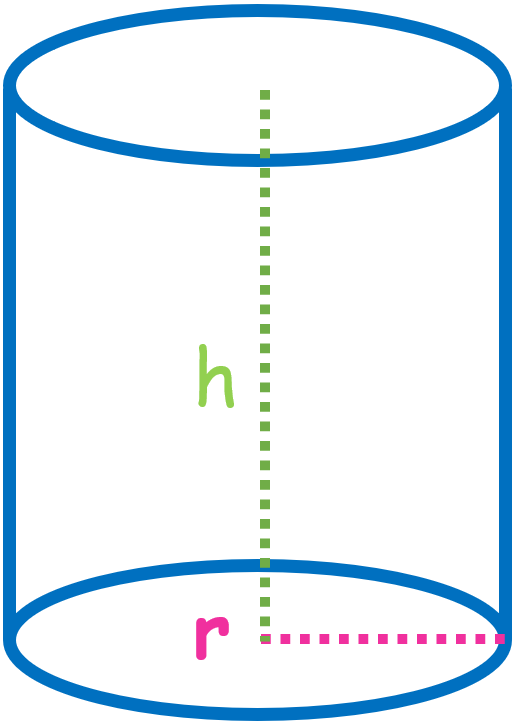
For a right circular cylinder, \(V=\pi r^2h\). The radius r runs from a base center to its edge; height h is perpendicular to the bases. To find height, use \(h=V/(\pi r^2)\); to find radius, use \(r=\sqrt{V/(\pi h)}\).
Use positive dimensions in matching units. Volume has cubic units. For container capacity, use inside radius and the filled depth. Doubling the radius at fixed height multiplies volume by four, while doubling height multiplies volume by two.
Model the work before using the PDFs
Example 1
A closed right cylinder has diameter 10 cm and height 4 cm. Find its volume exactly.
- Convert diameter to radius: \(r=10/2=5\) cm.
- The base area is \(\pi(5)^2=25\pi\) square cm. Multiply by height: \(V=25\pi(4)=100\pi\) cubic cm.
- Volume counts enclosed space, not the material covering the surface.
Example 2
A right cylinder has volume \(108\pi\) cubic cm and radius 3 cm. Find its height.
- Use \(V=\pi r^2h\): \(108\pi=\pi(3)^2h\).
- Cancel \(\pi\) and divide by 9: \(h=108/9=12\) cm.
- Check the volume: \(\pi(3)^2(12)=108\pi\) cubic cm.
Try these first
- A closed right cylinder has radius 1.5 cm and height 8 cm. Find its volume exactly.
- A right cylinder has volume \(100\pi\) cubic cm and radius 2 cm. Find its height.
- A closed right cylinder has radius 6 cm and height 5 cm. Find its volume exactly.
Show step-by-step solutions
Practice 1
- Use the radius \(r=1.5\) cm.
- The base area is \(\pi(1.5)^2=2.25\pi\) square cm. Multiply by height: \(V=2.25\pi(8)=18\pi\) cubic cm.
- Volume counts enclosed space, not the material covering the surface.
Practice 2
- Use \(V=\pi r^2h\): \(100\pi=\pi(2)^2h\).
- Cancel \(\pi\) and divide by 4: \(h=100/4=25\) cm.
- Check the volume: \(\pi(2)^2(25)=100\pi\) cubic cm.
Practice 3
- Use the radius \(r=6\) cm.
- The base area is \(\pi(6)^2=36\pi\) square cm. Multiply by height: \(V=36\pi(5)=180\pi\) cubic cm.
- Volume counts enclosed space, not the material covering the surface.
Common mistakes
- Do not square the height in the cylinder-volume formula.
- Surface area formulas count material covering the cylinder, not the space it holds.
Related skills
Cylinder surface area; Circle area.
More from the original topic collection: Volume of Rectangle Prisms; Surface Area of a Cylinder; Surface Area of a Rectangle Prism; volume and Surface Area of Cubes; Volume of Cubes; Pyramids and Cone.
