





These free pyramids and cones: volume and surface area worksheets provide printable practice. Use the guide and worked questions below to choose a method and check your reasoning before working independently.
Free practice resources: pyramid-volume practice PDF; PDF set 1; pyramid-volume PDF set 2; pyramid-volume PDF set 3. The original questions below have step-by-step solutions; the downloads are separate resources.
Method and restrictions
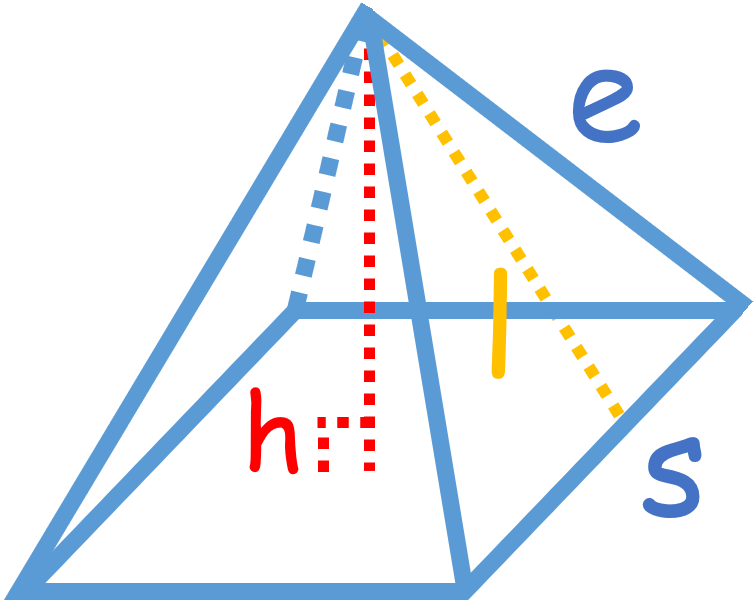
The legacy downloads focus on volume; PDF set 1 includes pyramids and cones, while sets 2 and 3 and the additional sheet focus on pyramids. Surface-area cases below are separate original practice. Mark perpendicular h or slant height beside each given measurement.
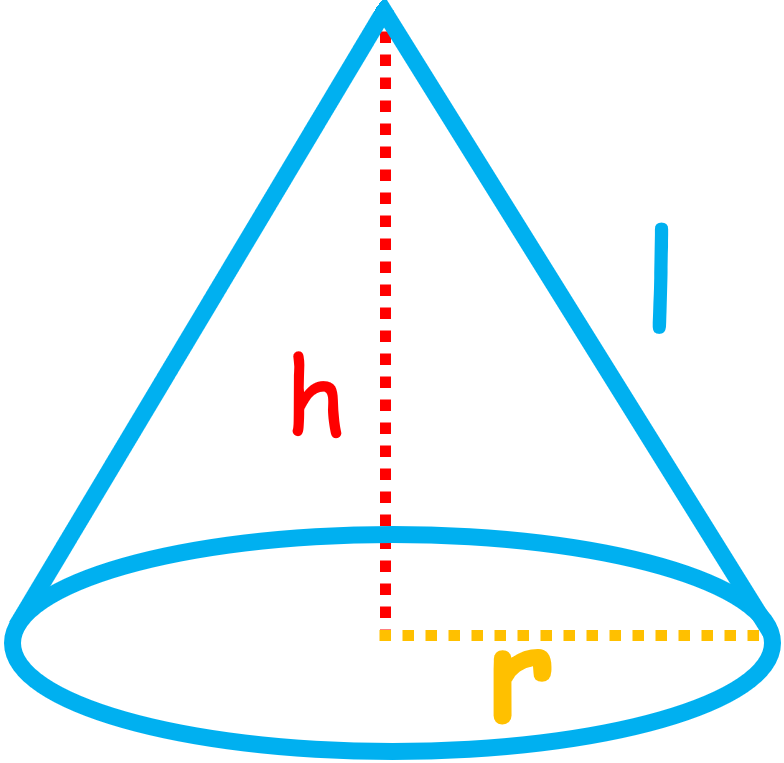
For either solid, \(V=\frac13 Bh\), where B is base area. For a cone, \(B=\pi r^2\). For a right circular cone with slant height \(\ell\), total surface area is \(S=\pi r^2+\pi r\ell\).
A regular pyramid with base perimeter p and a common triangular-face slant height \(\ell\) has \(S=B+\frac12p\ell\). For an irregular pyramid, add individual triangular-face areas instead. Perpendicular height h goes to the base plane; slant height lies along a face. For a right cone, \(\ell^2=r^2+h^2\).
Model the work before using the PDFs
Example 1
A right circular cone has radius 3 cm and perpendicular height 8 cm. Find its volume exactly.
- Use \(V=\frac13\pi r^2h\); perpendicular height measures from apex to base plane.
- Calculate base area times height: \(\pi(3)^2(8)=72\pi\).
- Divide by 3: \(V=72\pi/3=24\pi\) cubic cm.
Example 2
A regular square pyramid has base edge 8 cm and triangular-face slant height 5 cm. Find its total surface area.
- The square base has area \(8^2=64\) square cm.
- Each triangular face has area \(\frac12(8)(5)=20\) square cm; four faces total \(80\) square cm.
- Include the base: \(S=64+80=144\) square cm.
Try these first
- A right circular cone has radius 6 cm and perpendicular height 8 cm. Find its volume exactly.
- A regular square pyramid has base edge 9 cm and perpendicular height 12 cm. Find its volume.
- A right circular cone has radius 4 cm and slant height 5 cm. Find its total surface area, including the base exactly.
Show step-by-step solutions
Practice 1
- Use \(V=\frac13\pi r^2h\); perpendicular height measures from apex to base plane.
- Calculate base area times height: \(\pi(6)^2(8)=288\pi\).
- Divide by 3: \(V=288\pi/3=96\pi\) cubic cm.
Practice 2
- The square base has area \(9^2=81\) square cm.
- Multiply base area by perpendicular height: \(81(12)=972\).
- A pyramid fills one-third of the corresponding prism: \(V=972/3=324\) cubic cm.
Practice 3
- Use \(S=\pi r^2+\pi r\ell\); slant height measures along the curved side.
- The base area is \(16\pi\) and lateral area is \(20\pi\) square cm.
- Add: \(S=16\pi+20\pi=36\pi\) square cm.
Common mistakes
- Using slant height in the volume formula overestimates volume.
- The regular-pyramid surface formula requires one common face slant height.
Related skills
Finding slant height; Comparing cone and cylinder volumes.
More from the original topic collection: Volume of Rectangle Prisms; Volume of a Cylinder; Surface Area of a Cylinder; Surface Area of a Rectangle Prism; volume and Surface Area of Cubes; Volume of Cubes.
