





A closed cylinder has two circular bases and a curved side. Add twice pi times radius squared to twice pi times radius times height to find its total surface area.
Free practice resources: additional practice PDF; PDF set 1; PDF set 2; PDF set 3; existing skill quiz. The original questions below have step-by-step solutions; the downloads are separate resources.
Method and restrictions
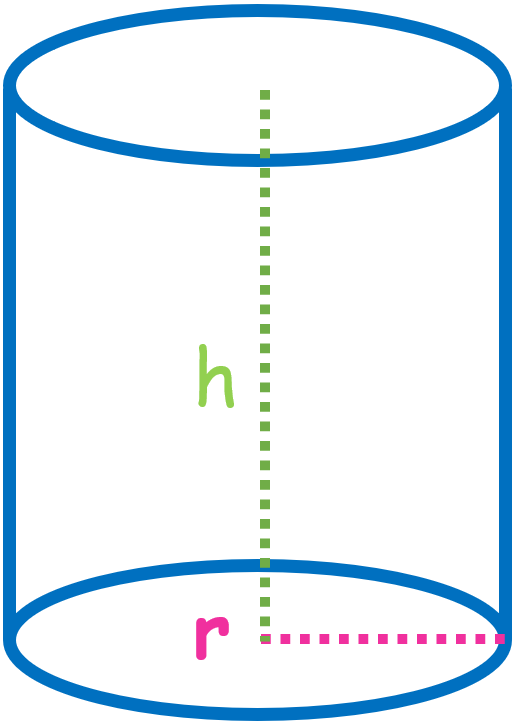
The curved side unwraps into a rectangle with width \(2\pi r\) and height h. Its lateral area is \(L=2\pi rh\). A closed cylinder adds two circular bases: \(S=2\pi rh+2\pi r^2\). An open-top cylinder with a base uses \(S=2\pi rh+\pi r^2\).
A label around a can covers only the curved side. A pipe with no ends may likewise need lateral area only. Decide which surfaces are included, halve diameter if necessary, and use square units. These formulas assume a right circular cylinder.
Worked examples
Example 1
A closed right cylinder has radius 3 cm and height 7 cm. Find its surface area exactly.
- Use the radius \(r=3\) cm.
- The curved side has area \(2\pi rh=2\pi(3)(7)=42\pi\). Two bases contribute \(2\pi(3)^2=18\pi\) square cm.
- Add the included surfaces: \(42\pi+18\pi=60\pi\) square cm.
Example 2
A cylindrical container without a lid has radius 5 cm and height 4 cm. Find its surface area exactly.
- Use the radius \(r=5\) cm.
- The curved side has area \(2\pi rh=2\pi(5)(4)=40\pi\). One base contributes \(1\pi(5)^2=25\pi\) square cm.
- Add the included surfaces: \(40\pi+25\pi=65\pi\) square cm.
Try these first
- A closed right cylinder has radius 2 cm and height 9 cm. Find its surface area exactly.
- A cylindrical container without a lid has diameter 8 cm and height 6 cm. Find its surface area exactly.
- A closed right cylinder has radius 6 cm and height 5 cm. Find its surface area exactly.
Show step-by-step solutions
Practice 1
- Use the radius \(r=2\) cm.
- The curved side has area \(2\pi rh=2\pi(2)(9)=36\pi\). Two bases contribute \(2\pi(2)^2=8\pi\) square cm.
- Add the included surfaces: \(36\pi+8\pi=44\pi\) square cm.
Practice 2
- Convert diameter to radius: \(r=8/2=4\) cm.
- The curved side has area \(2\pi rh=2\pi(4)(6)=48\pi\). One base contributes \(1\pi(4)^2=16\pi\) square cm.
- Add the included surfaces: \(48\pi+16\pi=64\pi\) square cm.
Practice 3
- Use the radius \(r=6\) cm.
- The curved side has area \(2\pi rh=2\pi(6)(5)=60\pi\). Two bases contribute \(2\pi(6)^2=72\pi\) square cm.
- Add the included surfaces: \(60\pi+72\pi=132\pi\) square cm.
Common mistakes
- An open top removes one circle, not the entire curved wall.
- The side rectangle has width equal to circumference, not diameter.
Related skills
Cylinder volume; Circle circumference and area.
More from the original topic collection: Free printable Worksheets; How to Find the Volume of a Rectangular Prism; How to Find the Surface Area of a Rectangular Prism; How to Find Volume and Surface Area of Cubes; How to Find the Volume of a Cube; How to Find Volume and Surface Area of Pyramids and Cone.

