





The volume of a rectangular prism is length times width times perpendicular height. Multiply the base area by height, using consistent units, to measure the space inside.
Free practice resources: additional practice PDF; PDF set 1; PDF set 2; PDF set 3; existing skill quiz. The original questions below have step-by-step solutions; the downloads are separate resources.
Method and restrictions
Use \(V=lwh=Bh\), where \(B=lw\) is base area. To find an unknown dimension, divide volume by the product of the other two dimensions. All lengths must be in one unit before multiplying.
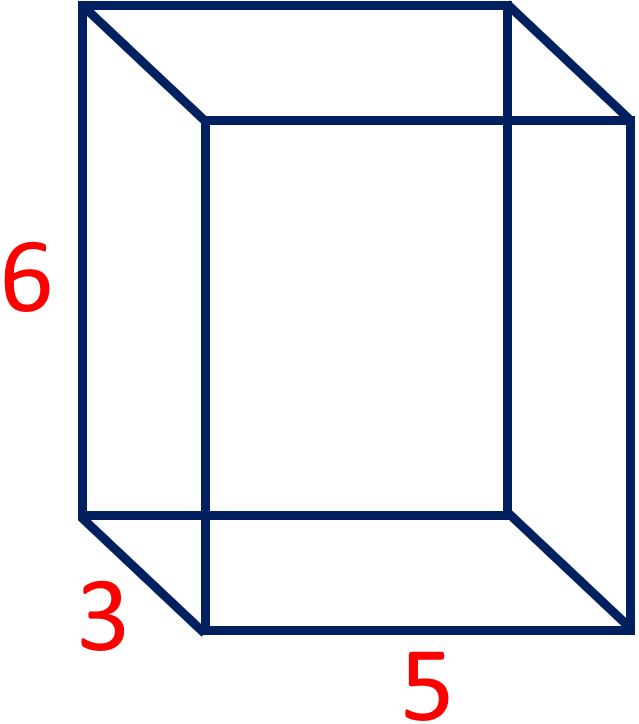
A 2 cm by 3 cm by 4 cm prism contains four layers of 6 unit cubes, for 24 cubic cm. For a tank, use internal dimensions and the actual liquid depth, not automatically the full height. One cubic centimeter equals one milliliter; 1000 cubic centimeters equal one liter.
Worked examples
Example 1
A rectangular prism has length 3 cm, width 4 cm, and height 5 cm. Find its volume.
- The base area is \(lw=3(4)=12\) square cm.
- Multiply base area by height: \(V=12(5)=60\) cubic cm.
- The product uses three lengths, so the units are cubed.
Example 2
A rectangular prism has volume 120 cubic cm and base 8 cm by 3 cm. Find its height.
- Find base area: \(8(3)=24\) square cm.
- Since \(V=lwh\), \(h=120/24=5\) cm.
- Check: \(8(3)(5)=120\) cubic cm.
Try these first
- A rectangular prism has length 6 cm, width 5 cm, and height 4 cm. Find its volume.
- A rectangular prism has volume 216 cubic cm and base 9 cm by 4 cm. Find its height.
- A rectangular prism has length 1.5 cm, width 4 cm, and height 8 cm. Find its volume.
Show step-by-step solutions
Practice 1
- The base area is \(lw=6(5)=30\) square cm.
- Multiply base area by height: \(V=30(4)=120\) cubic cm.
- The product uses three lengths, so the units are cubed.
Practice 2
- Find base area: \(9(4)=36\) square cm.
- Since \(V=lwh\), \(h=216/36=6\) cm.
- Check: \(9(4)(6)=216\) cubic cm.
Practice 3
- The base area is \(lw=1.5(4)=6\) square cm.
- Multiply base area by height: \(V=6(8)=48\) cubic cm.
- The product uses three lengths, so the units are cubed.
Common mistakes
- Adding the dimensions does not measure enclosed space.
- Use interior measurements for capacity; wall thickness may make exterior volume larger.
Related skills
Prism surface area; Cube volume.
More from the original topic collection: Free printable Worksheets; How to Find the Volume of a Cylinder; How to Find the Surface Area of a Cylinder; How to Find Volume and Surface Area of Cubes; How to Find Volume and Surface Area of Pyramids and Cone.

