





Cylinder volume is circular base area times perpendicular height. Square the radius, multiply by pi, then multiply by height; halve a given diameter before substituting.
Free practice resources: additional practice PDF; PDF set 1; PDF set 2; PDF set 3; existing skill quiz. The original questions below have step-by-step solutions; the downloads are separate resources.
Method and restrictions
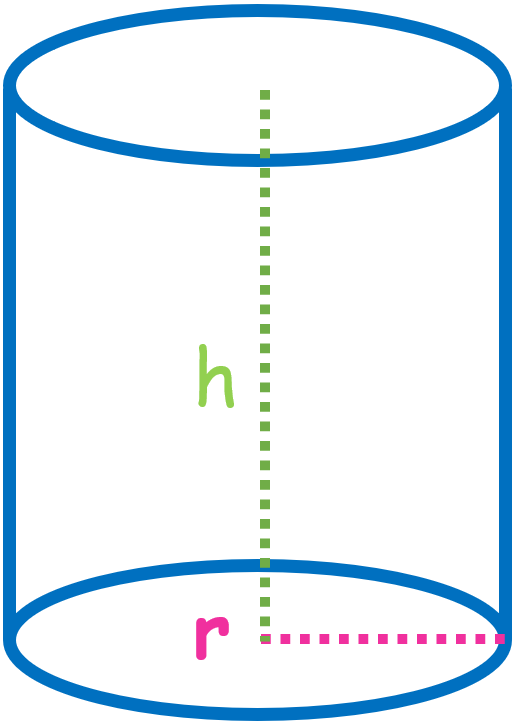
For a right circular cylinder, \(V=\pi r^2h\). The radius r runs from a base center to its edge; height h is perpendicular to the bases. To find height, use \(h=V/(\pi r^2)\); to find radius, use \(r=\sqrt{V/(\pi h)}\).
Use positive dimensions in matching units. Volume has cubic units. For container capacity, use inside radius and the filled depth. Doubling the radius at fixed height multiplies volume by four, while doubling height multiplies volume by two.
Worked examples
Example 1
A closed right cylinder has radius 3 cm and height 7 cm. Find its volume exactly.
- Use the radius \(r=3\) cm.
- The base area is \(\pi(3)^2=9\pi\) square cm. Multiply by height: \(V=9\pi(7)=63\pi\) cubic cm.
- Volume counts enclosed space, not the material covering the surface.
Example 2
A right cylinder has volume \(144\pi\) cubic cm and radius 6 cm. Find its height.
- Use \(V=\pi r^2h\): \(144\pi=\pi(6)^2h\).
- Cancel \(\pi\) and divide by 36: \(h=144/36=4\) cm.
- Check the volume: \(\pi(6)^2(4)=144\pi\) cubic cm.
Try these first
- A closed right cylinder has radius 2 cm and height 9 cm. Find its volume exactly.
- A closed right cylinder has diameter 8 cm and height 7 cm. Find its volume exactly.
- A right cylinder has volume \(200\pi\) cubic cm and radius 5 cm. Find its height.
Show step-by-step solutions
Practice 1
- Use the radius \(r=2\) cm.
- The base area is \(\pi(2)^2=4\pi\) square cm. Multiply by height: \(V=4\pi(9)=36\pi\) cubic cm.
- Volume counts enclosed space, not the material covering the surface.
Practice 2
- Convert diameter to radius: \(r=8/2=4\) cm.
- The base area is \(\pi(4)^2=16\pi\) square cm. Multiply by height: \(V=16\pi(7)=112\pi\) cubic cm.
- Volume counts enclosed space, not the material covering the surface.
Practice 3
- Use \(V=\pi r^2h\): \(200\pi=\pi(5)^2h\).
- Cancel \(\pi\) and divide by 25: \(h=200/25=8\) cm.
- Check the volume: \(\pi(5)^2(8)=200\pi\) cubic cm.
Common mistakes
- Do not square the height in the cylinder-volume formula.
- Surface area formulas count material covering the cylinder, not the space it holds.
Related skills
Cylinder surface area; Circle area.
More from the original topic collection: Free printable Worksheets; How to Find the Volume of a Rectangular Prism; How to Find the Surface Area of a Rectangular Prism; How to Find Volume and Surface Area of Cubes; How to Find the Volume of a Cube; How to Find Volume and Surface Area of Pyramids and Cone.

