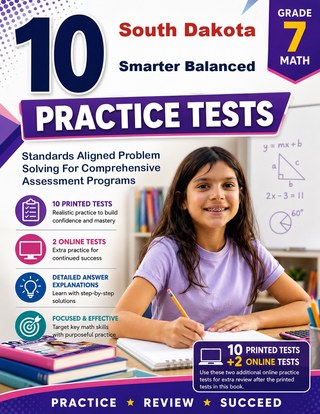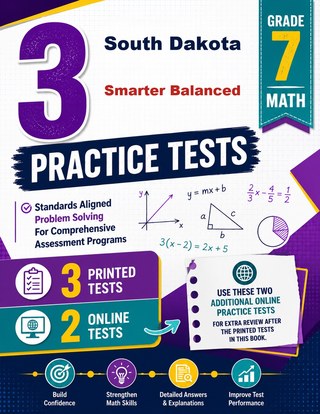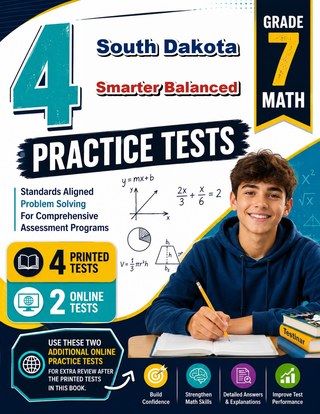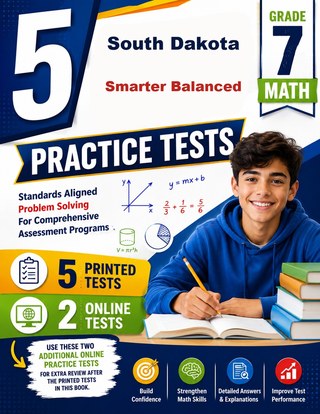




A standards practice map turns a long Grade 7 math standards list into a clear study route. Instead of wondering what to review next, families can choose a skill area, open the matching lesson, try a quiz, and then move into mixed Smarter Balanced practice.
Use this South Dakota Smarter Balanced Grade 7 Math Standards Practice Map to connect the big standards clusters to Testinar lessons, quiz checkpoints, practice questions, and study resources.
Standards to practice map
South Dakota Smarter Balanced Grade 7 math preparation should connect skills, lessons, quizzes, and test practice.
This page is not an official state standards document. It is a practical study map for parents, tutors, and teachers who want to turn standards into weekly practice.
How to Use This Practice Map
Start with the area where your child loses points most often. Read the connected lesson first, then use one quiz as a checkpoint. If the quiz is difficult, do not jump ahead. Review the explanation, solve two similar problems, and try another quiz or mixed practice later.
- Step 1 Pick one standards cluster.
- Step 2 Study the linked lesson.
- Step 3 Take a short quiz in a new tab.
- Step 4 Review mistakes and repeat.
South Dakota Smarter Balanced Grade 7 Math Standards Practice Map
The sections below organize Grade 7 math into parent-friendly standards areas. Each area includes the student goal, the practice path, a readiness check, lesson links, and quiz checkpoints.
Proportional Relationships and Unit Rates
Student Goal
Recognize proportional relationships, find constants of proportionality, write equations, and interpret tables and graphs.
Practice Path
Start with unit rates and tables, then connect each relationship to a graph and equation.
Readiness Check
A student is ready when they can explain what k means in y = kx and identify whether a relationship is proportional.
Lessons to Use
Quiz Checkpoints
Percents and Financial Applications
Student Goal
Solve percent increase, percent decrease, discounts, markups, tax, tips, commission, interest, and percent error.
Practice Path
Use real shopping, savings, and price-change contexts before moving into mixed word problems.
Readiness Check
A student is ready when they can identify the original amount, percent change, and final amount without mixing them up.
Lessons to Use
Quiz Checkpoints
Rational Number Operations
Student Goal
Add, subtract, multiply, and divide integers, fractions, decimals, and mixed numbers in real-world contexts.
Practice Path
Use number lines, temperature, bank balances, elevation, recipes, and signed-value word problems.
Readiness Check
A student is ready when they can predict the sign of an answer and estimate whether the value is reasonable.
Lessons to Use
Quiz Checkpoints
Expressions, Equations, and Inequalities
Student Goal
Write, evaluate, simplify, and solve expressions, two-step equations, and inequalities from real situations.
Practice Path
Translate short word situations into expressions or equations, solve, and substitute the answer back to check.
Readiness Check
A student is ready when they can explain what the variable means and why the solution makes the statement true.
Lessons to Use
Quiz Checkpoints
Scale Drawings, Geometry, and Angle Relationships
Student Goal
Use scale drawings, angle relationships, similar figures, circumference, area, surface area, and volume.
Practice Path
Use maps, room layouts, circle diagrams, nets, composite figures, and real measurement contexts.
Readiness Check
A student is ready when they can choose the correct formula, label units, and explain the role of scale factor.
Lessons to Use
Quiz Checkpoints
Statistics, Samples, and Comparing Populations
Student Goal
Use random samples, compare populations, interpret data displays, and describe center, variability, and overlap.
Practice Path
Use surveys, sports data, class data, weather records, dot plots, box plots, and circle graphs.
Readiness Check
A student is ready when they can explain what a sample suggests and compare two data sets using evidence.
Lessons to Use
Quiz Checkpoints
Probability and Compound Events
Student Goal
Find theoretical and experimental probability, list outcomes, build sample spaces, and reason about compound events.
Practice Path
Use dice, cards, spinners, colored tiles, organized lists, and tree-style thinking.
Readiness Check
A student is ready when they can count favorable outcomes and total outcomes carefully, then simplify the probability.
Lessons to Use
Quiz Checkpoints
Multi-Step Word Problems and Test Reasoning
Student Goal
Combine number, algebra, geometry, statistics, and probability skills while explaining the strategy and checking units.
Practice Path
Use mixed review problems, ask for a plan before calculation, and require a reasonableness check after solving.
Readiness Check
A student is ready when they can identify the skill, write a model or equation, solve, and explain the answer in context.
Lessons to Use
Quiz Checkpoints
Study rhythm
A Simple Weekly Review Plan
Use this page as a repeatable routine. The goal is not to finish every link in one sitting. The goal is steady practice that builds skill accuracy and confidence.
- Monday: Review one lesson and write down three important ideas.
- Tuesday: Solve five practice problems from the same skill area.
- Wednesday: Take one quiz checkpoint and mark missed questions by skill.
- Thursday: Fix mistakes and explain the correct method in words.
- Friday: Try mixed review from another standards cluster.
Timed practice test
South Dakota Smarter Balanced Grade 7 Math Practice Test 1
After using the standards map, try one mixed practice test to check pacing, stamina, and readiness.
South Dakota Smarter Balanced Grade 7 Math Practice Test 1 40 questions - 120 minutesPractice resources
Recommended South Dakota Grade 7 Math Resources
Next step
Move from Standards to Test Readiness
After students understand the standards map, they should learn what appears on the state test, try practice questions, and follow a focused preparation guide.
What is on the test? Practice questions Preparation guide Parent standards guideSummary
The strongest South Dakota Smarter Balanced Grade 7 math preparation connects standards to action. Students should know the skill, study a clear lesson, practice with a quiz, review mistakes, and return to mixed practice until they can explain their work with confidence.
FAQ
What is a South Dakota Smarter Balanced Grade 7 math standards practice map?
It is a parent-friendly planning page that connects major Grade 7 math skill areas to lessons, quizzes, and practice resources so students can review with a clear path.
Does this page list official South Dakota standard codes?
No. This page uses clear standards clusters instead of official code lists. Families should always confirm official wording with their school or state education agency.
How does this map help with Smarter Balanced preparation?
It helps students identify a weak skill, open the matching lesson, take a short quiz, review mistakes, and then move into mixed state-test practice.
What should students do after missing a question?
They should identify the skill, reread the connected lesson, solve two or three similar problems, and explain the correction in words.
How often should Grade 7 students use the map?
Two or three short sessions each week works well. Use one standards cluster at a time, then add mixed review before the test.
Can standards and test rules change?
Yes. State standards, test names, tools, and rules can change. Use this page as a study guide and confirm official details locally.