




Introduction
Comparing Fractions with Same Numerator or Denominator is an important Grade 3 math skill because students are moving from simple answers toward explaining how the math works.
In this lesson, students use models, real questions, worked examples, practice problems, and two online quizzes to build confidence with comparing fractions with same numerator or denominator.
What Is Comparing Fractions with Same Numerator or Denominator?
Comparing Fractions with Same Numerator or Denominator means using equal parts, number lines, and clear fraction language to describe parts of a whole.
The goal is not only to get the answer. Students should be able to show the idea, explain the strategy, and check whether the answer makes sense.
Understanding Comparing Fractions with Same Numerator or Denominator
Before solving, students should slow down and decide what each number, shape, unit, or label represents.
- Identify the whole before naming a fraction.
- Make sure each part is equal in size.
- Use a number line or model to show where the fraction belongs.
- Explain whether two fractions have the same size or different sizes.
Visual Models
Visual Model 1
Question: Compare \(\frac{2}{3}\) and \(\frac{2}{4}\). Which is true?
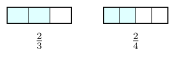
- A. \(\frac{2}{3}<\frac{2}{4}\) (bigger denominator = bigger fraction)
- B. \(\frac{2}{3}=\frac{2}{4}\) (both have numerator 2)
- C. \(\frac{2}{3}>\frac{2}{4}\)
- D. \(\frac{2}{4}>\frac{2}{3}\) (4 > 3, so \(\frac{2}{4}\) is larger)
Why it works: Strategy: same numerator (2), so compare denominators. Thirds are bigger pieces than fourths (a whole divided by 3 gives bigger parts than divided by 4). Visual check: the blue bar (2/3) covers more area than the bar would if it were 2/4. Rule: when numerators match, smaller denominator wins.
Answer: \(\frac{2}{3}>\frac{2}{4}\)
Visual Model 2
Question: The bars show two fractions. Which is larger?
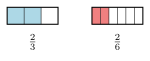
- A. \(\frac{2}{6}\) (6 > 3)
- B. \(\frac{2}{3}\) (shaded area is larger)
- C. They are equal
- D. Cannot tell from the bars
Why it works: Visual reasoning: same numerator (2), so both take 2 pieces. But \(\frac{2}{3}\) divides the whole into 3 parts (each third is large), while \(\frac{2}{6}\) divides into 6 parts (each sixth is small). Comparing shaded amounts: 2 large pieces > 2 small pieces, so \(\frac{2}{3} > \frac{2}{6}\).
Answer: \(\frac{2}{3}\) is larger
Worked Examples
Example 1
Question: Using the bars, which is true?
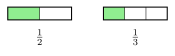
- A. \(\frac{1}{2}>\frac{1}{3}\) (halves are larger pieces)
- B. \(\frac{1}{2}<\frac{1}{3}\) (2 < 3)
- C. \(\frac{1}{2}=\frac{1}{3}\)
- D. \(\frac{1}{3}>\frac{1}{2}\) (1 out of 3 is more than 1 out of 2)
- Same numerator (1): both fractions take 1 piece from their bar.
- But the first bar is divided in half (larger piece), the second in thirds (smaller piece).
- One half > one third.
- Visually: the green shaded area is larger in the first bar.
Answer: \(\frac{1}{2}>\frac{1}{3}\)
Example 2
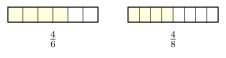
Question: Compare \(\frac{4}{6}\) and \(\frac{4}{8}\). Which is true?
- A. \(\frac{4}{6}>\frac{4}{8}\) (same numerator, 6 > 8)
- B. \(\frac{4}{6}<\frac{4}{8}\) (8 > 6)
- C. \(\frac{4}{6}=\frac{4}{8}\)
- D. \(\frac{4}{8}>\frac{4}{6}\) (more pieces means more amount)
- Same numerator (4): sixths are bigger pieces than eighths.
- Comparing the shaded areas: 4 sixths covers more than 4 eighths.
- The fewer pieces the denominator divides into, the bigger each piece.
Answer: \(\frac{4}{6}>\frac{4}{8}\)
Example 3
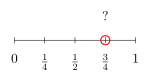
Question: On the number line, the red dot is at the same position as which label?
- A. \(\frac{1}{2}\)
- B. \(\frac{3}{4}\)
- C. \(\frac{1}{4}\)
- D. Between \(\frac{1}{2}\) and \(\frac{3}{4}\)
- The dot is positioned at the third quarter mark on the number line, which is \(\frac{3}{4}\).
- This is greater than \(\frac{1}{2}\).
Answer: \(\frac{3}{4}\)
Real-World Word Problems
Problem 1
Question: Which comparison is true?
- A. \(\frac{3}{5}>\frac{3}{4}\)
- B. \(\frac{3}{5}<\frac{3}{4}\)
- C. \(\frac{3}{4}<\frac{3}{5}\)
- D. \(\frac{3}{5}=\frac{3}{4}\)
Why it works: When comparing fractions with the same numerator (3), look at the denominator: fifths are bigger pieces than fourths. So \(\frac{3}{5}\) (3 large pieces) is less than \(\frac{3}{4}\) (3 slightly larger pieces). Key rule: smaller denominator = bigger pieces.
Answer: \(\frac{3}{5}<\frac{3}{4}\)
Problem 2
Question: Which comparison is true?
- A. \(\frac{3}{4}<\frac{3}{6}\)
- B. \(\frac{3}{4}=\frac{3}{6}\)
- C. \(\frac{3}{4}>\frac{3}{6}\) (same numerator, 4 < 6)
- D. \(\frac{3}{6}>\frac{3}{4}\) (6 > 4, so sixths are bigger)
Why it works: Same numerator (3), different denominators: fourths are bigger pieces than sixths (the bar is cut into fewer, larger pieces). Three fourths covers more area than three sixths.
Answer: \(\frac{3}{4}>\frac{3}{6}\)
Common Mistakes
- Counting unequal parts as if they were equal.
- Forgetting that the denominator tells how many equal parts make the whole.
- Comparing fractions without first checking the size of the whole.
- Placing a fraction on a number line without counting equal intervals.
Strategy Tips
- Draw the whole first, then divide it into equal parts.
- Use number lines when the question asks about order or location.
- Say the fraction out loud to connect numerator and denominator meanings.
- Check whether the answer should be closer to 0, 1/2, or 1.
Practice Questions
Question 1
Which comparison is true?
- A. \(\frac{2}{2}<\frac{2}{3}\)
- B. \(\frac{2}{2}>\frac{2}{3}\) (2/2 = whole, 2/3 < whole)
- C. \(\frac{2}{3}>\frac{2}{2}\) (3 > 2)
- D. \(\frac{2}{3}=\frac{2}{2}\)
Question 2
Lily has \(\frac{3}{8}\) of a chocolate bar. Noah has \(\frac{3}{4}\) of the same size chocolate bar. Who has more?
- A. Lily (8 > 4)
- B. Noah (3/4 is larger)
- C. They have the same amount
- D. Cannot tell without the bar's size
Question 3
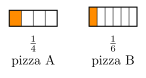
The bars show \(\frac{1}{4}\) of pizza A and \(\frac{1}{6}\) of pizza B. Pizza B is bigger than pizza A. Can you say \(\frac{1}{4}>\frac{1}{6}\)?
- A. Yes, because fourths are always bigger than sixths
- B. No, we can only compare when the wholes are the same size
- C. Yes, the picture shows it
- D. No, because 6 is bigger than 4
Question 4
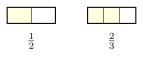
Using the bars, which fraction is larger?
- A. \(\frac{1}{2}\)
- B. \(\frac{2}{3}\)
- C. They are equal
- D. Cannot tell
Question 5
Compare \(\frac{5}{6}\) and \(\frac{5}{8}\). Which is true?
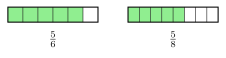
- A. \(\frac{5}{6}<\frac{5}{8}\)
- B. \(\frac{5}{6}>\frac{5}{8}\)
- C. \(\frac{5}{6}=\frac{5}{8}\)
- D. \(\frac{5}{8}>\frac{5}{6}\)
Question 6
Which symbol makes this true? \(\frac{2}{4}\) \_\_\_ \(\frac{2}{2}\)
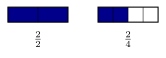
- A. \(<\)
- B. \(>\)
- C. \(=\)
- D. \(\neq\)
Full Answer Explanations Click to show all answers and explanations
Question 1
Answer: \(\frac{2}{2}>\frac{2}{3}\)
Same numerator (2): two halves = 1 whole, two thirds = part of a whole. Halves are bigger pieces than thirds. Rule: same numerator, smaller denominator (2 < 3) means bigger pieces, so \(\frac{2}{2} > \frac{2}{3}\).
Question 2
Answer: Noah
Same numerator (3), different denominators, same chocolate bar: fourths are larger pieces than eighths. So \(\frac{3}{4}\) is more than \(\frac{3}{8}\). Noah has more because he has 3 larger pieces.
Question 3
Answer: No, we can only compare when the wholes are the same size
CRITICAL: Fraction comparisons are ONLY valid when both fractions describe the same-size whole. Since pizza B is bigger than pizza A, \(\frac{1}{4}\) of the smaller pizza may actually be bigger than \(\frac{1}{6}\) of the larger pizza. We cannot compare them. Standard 3.NF.A.3.d requires recognizing that comparisons are valid only when the two fractions refer to the same whole.
Question 4
Answer: \(\frac{2}{3}\) is larger
Comparing the shaded areas: two thirds covers more of the bar than one half does.
Question 5
Answer: \(\frac{5}{6}>\frac{5}{8}\)
Same numerator: sixths are bigger pieces than eighths. Five sixths is greater than five eighths.
Question 6
Answer: \(\frac{2}{4}<\frac{2}{2}\)
Two halves equals 1. Two fourths is less than 1. So \(\frac{2}{4}<\frac{2}{2}\).
Connection to Standards
This lesson supports Grade 3 math expectations for reasoning, modeling, problem solving, and explaining answers clearly. It connects classroom skills to the kind of questions students see on state math assessments.
Summary
Comparing Fractions with Same Numerator or Denominator becomes easier when students connect the question to a model, use clear steps, and explain why the answer fits.
GOLDEN RULE
Equal parts first, fraction name second.