




Introduction
Covering Shapes with Unit Squares is an important Grade 3 math skill because students are moving from simple answers toward explaining how the math works.
In this lesson, students use models, real questions, worked examples, practice problems, and two online quizzes to build confidence with covering shapes with unit squares.
What Is Covering Shapes with Unit Squares?
Covering Shapes with Unit Squares means measuring how much flat space a figure covers by using equal-sized square units.
The goal is not only to get the answer. Students should be able to show the idea, explain the strategy, and check whether the answer makes sense.
Understanding Covering Shapes with Unit Squares
Before solving, students should slow down and decide what each number, shape, unit, or label represents.
- Use square units that cover the figure without gaps or overlaps.
- Count rows and columns when the unit squares are arranged in an array.
- Connect repeated addition to multiplication when finding area.
- Break complex figures into smaller rectangles when that makes the work clearer.
Visual Models
Visual Model 1
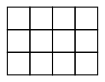
Question: Look at this rectangle covered exactly by unit squares: Count the unit squares. What is the area?
- A. \(7\) sq units
- B. \(12\) sq units
- C. \(14\) sq units
- D. \(24\) sq units
Why it works: Count the rows: \(3\) rows. Count across: \(4\) unit squares per row. Total: \(3 \times 4 = 12\) unit squares cover the rectangle, so area is \(12\) square units.
Answer: \(12\) sq units
Visual Model 2
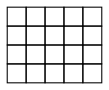
Question: Here is a rectangle with \(5\) unit squares across and \(4\) unit squares down: If you count all the unit squares, how many are there?
- A. \(9\) unit squares
- B. \(18\) unit squares
- C. \(20\) unit squares
- D. \(20\) square cm
Why it works: Count the rows: \(4\) rows with \(5\) unit squares in each row. Total: \(5 + 5 + 5 + 5 = 20\) unit squares. Area is \(20\) square units.
Answer: \(20\) unit squares
Worked Examples
Example 1
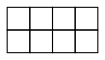
Question: Here is a shape made of unit squares arranged in a grid. The shape has \(8\) unit squares. What is the area?
- A. \(4\) sq units
- B. \(8\) sq units
- C. \(12\) sq units
- D. \(16\) sq units
- Counting the \(8\) unit squares in the grid gives an area of \(8\) square units.
Answer: \(8\) sq units
Example 2
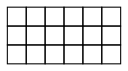
Question: Ben's garden is a rectangle. Looking at this grid, each square is one unit square tile: How many unit square tiles does Ben need to cover his garden?
- A. \(9\) tiles
- B. \(18\) tiles
- C. \(12\) tiles
- D. \(17\) tiles
- Count the rows: \(3\) rows.
- Count across each row: \(6\) tiles.
- Total: \(6 + 6 + 6 = 18\) unit square tiles are needed.
Answer: \(18\) tiles
Example 3
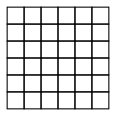
Question: Maya is laying square tiles on her kitchen floor. The floor is shaped like a large square with \(6\) tiles along one edge. Here is the layout: How many square tiles cover the entire floor?
- A. \(12\) tiles
- B. \(24\) tiles
- C. \(36\) tiles
- D. \(48\) tiles
- Count the rows: \(6\) rows.
- Count down: \(6\) tiles in each row.
- Total: \(6 + 6 + 6 + 6 + 6 + 6 = 36\) square tiles.
Answer: \(36\) tiles
Real-World Word Problems
Problem 1
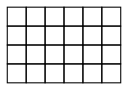
Question: A rectangle is made of \(4\) rows of unit squares. The total area is \(24\) square units. Look at the grid: How many unit squares are in each row?
- A. \(4\) unit squares per row
- B. \(8\) unit squares per row
- C. \(6\) unit squares per row
- D. \(12\) unit squares per row
Why it works: Count one row of unit squares: \(6\) squares. Check: \(4\) rows \(\times\) \(6\) per row \(= 24\) total. So there are \(6\) unit squares in each row.
Answer: \(6\) unit squares per row
Problem 2
Question: A square garden is covered with unit square tiles. Each side of the garden is \(5\) units long. How many unit square tiles are needed?
- A. \(25\) tiles
- B. \(20\) tiles
- C. \(10\) tiles
- D. \(30\) tiles
Why it works: \(5 \times 5 = 25\) unit square tiles.
Answer: \(25\) tiles
Common Mistakes
- Counting only the outside squares instead of all squares inside the figure.
- Leaving gaps or overlaps when using unit squares.
- Multiplying side lengths before checking whether the figure is a rectangle.
- Forgetting to write square units with an area answer.
Strategy Tips
- Trace the rectangle or figure before counting.
- Use rows and columns to organize unit squares.
- Write an equation after the model makes sense.
- Check whether the answer needs square units.
Practice Questions
Question 1
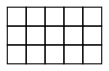
Look at this rectangle made of unit squares: How many unit squares are there?
- A. \(8\) unit squares
- B. \(12\) unit squares
- C. \(15\) unit squares
- D. \(20\) unit squares
Question 2
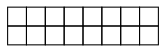
Mia covers a \(2\) by \(8\) rectangle with unit square tiles. Here is the grid: Count the unit squares. How many are there?
- A. \(10\) unit squares (the perimeter)
- B. \(16\) unit squares
- C. \(8\) unit squares
- D. \(20\) unit squares
Question 3
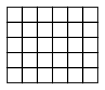
Noah is tiling a floor. He needs to cover a space that is \(6\) units long and \(5\) units wide. Here is the layout: How many unit square tiles does Noah need?
- A. \(11\) tiles (just the perimeter)
- B. \(22\) tiles (counted twice)
- C. \(30\) tiles
- D. \(60\) tiles
Question 4
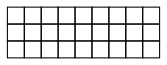
Eli's rectangular carpet is \(9\) units long and \(3\) units wide. Here is the grid: Count all the unit squares. What is the area?
- A. \(12\) sq units (just the edge)
- B. \(18\) sq units
- C. \(27\) sq units
- D. \(36\) sq units
Question 5
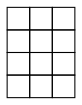
Ava is looking at this shape made of unit squares: How many unit squares cover this shape?
- A. \(7\) unit squares
- B. \(10\) unit squares
- C. \(12\) unit squares
- D. \(15\) unit squares
Question 6
A rectangle is \(9\) unit squares long and \(2\) unit squares wide. How many unit squares cover it?
- A. \(9\) unit squares
- B. \(18\) unit squares
- C. \(6\) units
- D. \(16\) units
Full Answer Explanations Click to show all answers and explanations
Question 1
Answer: \(15\) unit squares
Counting rows and columns: \(5\) units wide and \(3\) units tall gives \(5 \times 3 = 15\) unit squares.
Question 2
Answer: \(16\) unit squares
Count the rows: \(2\) rows. Count across: \(8\) unit squares per row. Total: \(8 + 8 = 16\) unit squares cover the rectangle.
Question 3
Answer: \(30\) tiles
Count the rows: \(5\) rows. Count across: \(6\) tiles in each row. Total: \(6 + 6 + 6 + 6 + 6 = 30\) unit square tiles are needed.
Question 4
Answer: \(27\) sq units
Count the rows: \(3\) rows. Count across: \(9\) unit squares per row. Total: \(9 + 9 + 9 = 27\) square units cover the carpet.
Question 5
Answer: \(12\) unit squares
\(3\) columns and \(4\) rows: \(3 \times 4 = 12\) unit squares.
Question 6
Answer: \(18\) unit squares
There are \(2\) rows with \(9\) unit squares in each row: \(9 \times 2 = 18\) unit squares.
Connection to Standards
This lesson supports Grade 3 math expectations for reasoning, modeling, problem solving, and explaining answers clearly. It connects classroom skills to the kind of questions students see on state math assessments.
Summary
Covering Shapes with Unit Squares becomes easier when students connect the question to a model, use clear steps, and explain why the answer fits.
GOLDEN RULE
Area means every square unit inside the figure.