




Introduction
Shape Categories is an important Grade 3 math skill because students are moving from simple answers toward explaining how the math works.
In this lesson, students use models, real questions, worked examples, practice problems, and two online quizzes to build confidence with shape categories.
What Is Shape Categories?
Shape Categories means looking at attributes such as sides, angles, equal parts, and shape categories.
The goal is not only to get the answer. Students should be able to show the idea, explain the strategy, and check whether the answer makes sense.
Understanding Shape Categories
Before solving, students should slow down and decide what each number, shape, unit, or label represents.
- Look for attributes such as side count, equal sides, angles, and parallel sides.
- Classify shapes using evidence instead of only how the shape looks.
- Remember that one shape can belong to more than one category.
- Use drawings to test whether the attributes really match the name.
Visual Models
Visual Model 1
Question: Which property do all squares and all rhombuses share?

- A. All have 4 right angles
- B. All have 4 equal sides
- C. All have no parallel sides
- D. All have 5 sides
Why it works: Both squares and rhombuses have 4 sides that are all equal in length. Squares also have 4 right angles, but rhombuses do not necessarily have them.
Answer: All have 4 equal sides
Visual Model 2
Question: Which statement about parallel sides is true?

- A. All triangles have parallel sides
- B. All rectangles have parallel sides
- C. No quadrilaterals have parallel sides
- D. Only circles have parallel sides
Why it works: Rectangles have opposite sides that are parallel (they never meet). Triangles have no parallel sides, and not all quadrilaterals have them.
Answer: All rectangles have parallel sides
Worked Examples
Example 1
Question: Shape R is a quadrilateral with one pair of parallel sides. What is Shape R called?

- A. Square
- B. Rectangle
- C. Trapezoid
- D. Rhombus
- A trapezoid has exactly one pair of parallel sides.
- The other quadrilaterals shown have two pairs of parallel sides or other properties.
Answer: Trapezoid
Example 2
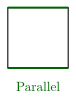
Question: The shape shows two sides that are parallel. If this is a rectangle, which other pair of sides is also parallel?
- A. The left and right sides
- B. The diagonal sides
- C. Only one pair in a rectangle
- D. No other sides are parallel
- A rectangle has two pairs of parallel sides: the top and bottom sides are parallel, and the left and right sides are parallel to each other.
Answer: The left and right sides
Example 3
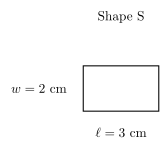
Question: Shape S is a rectangle with length 3 cm and width 2 cm. How many pairs of equal sides does it have?
- A. 1 pair
- B. 2 pairs
- C. 3 pairs
- D. 4 pairs
- The rectangle has two sides that are 3 cm (the length) and two sides that are 2 cm (the width).
- This makes 2 pairs of equal sides.
Answer: 2 pairs
Real-World Word Problems
Problem 1
Question: A student drew four shapes: a square, a rhombus, a rectangle, and a trapezoid. How many of these shapes are always parallelograms?
- A. 1
- B. 2
- C. 3
- D. 4
Why it works: A square, rhombus, and rectangle are all parallelograms (opposite sides parallel and equal). A trapezoid has only one pair of parallel sides, so it is not a parallelogram.
Answer: 3
Problem 2
Question: Which statement is true about rectangles and rhombuses?
- A. All rectangles are rhombuses
- B. All rhombuses are rectangles
- C. Both are quadrilaterals (4-sided figures)
- D. Rectangles have equal sides like rhombuses do
Why it works: A rectangle has \(4\) right angles, and a rhombus has \(4\) equal sides; both are quadrilaterals. They share the attribute of having four sides, even though they differ in other properties.
Answer: Both are quadrilaterals (4-sided figures)
Common Mistakes
- Naming a shape from appearance instead of attributes.
- Forgetting that squares are also rectangles and quadrilaterals.
- Mixing up sides and angles.
- Assuming a rotated shape changed its category.
Strategy Tips
- List attributes before naming the shape.
- Use examples and non-examples to test a category.
- Look for shared attributes across shape groups.
- Draw a quick sketch when the wording feels abstract.
Practice Questions
Question 1
Which shape is NOT a quadrilateral?
- A. Parallelogram
- B. Triangle
- C. Rhombus
- D. Square
Question 2
Which shape has 4 equal sides and 4 right angles?
- A. Rectangle
- B. Rhombus
- C. Square
- D. Trapezoid
Question 3
A rectangle has opposite sides that are equal. How many pairs of equal sides does a rectangle have?
- A. 1 pair
- B. 2 pairs
- C. 3 pairs
- D. 4 pairs
Question 4
Is every square also a rectangle?
- A. Yes, because a square has 4 sides and 4 right angles
- B. No, because a square has equal sides
- C. No, because a square has more sides
- D. Yes, only if it is very large
Question 5
Which of the following is true about a square?
- A. It is a rectangle and a rhombus
- B. It is a trapezoid
- C. It is a triangle
- D. It has no right angles
Question 6
What do all quadrilaterals have in common?
- A. They all have right angles
- B. They all have equal sides
- C. They all have parallel sides
- D. They all have 4 sides
Full Answer Explanations Click to show all answers and explanations
Question 1
Answer: Triangle
A triangle has 3 sides. A quadrilateral has 4 sides, so a parallelogram, rhombus, and square are all quadrilaterals, but a triangle is not.
Question 2
Answer: Square
A square has all 4 sides equal in length and all 4 angles are right angles (90 degrees). This makes it both a rectangle and a rhombus.
Question 3
Answer: 2 pairs
A rectangle has two pairs of opposite equal sides: one pair of long sides and one pair of short sides.
Question 4
Answer: Yes, because a square has 4 sides and 4 right angles
A square is a special kind of rectangle that also has all sides equal. Every square has the properties of a rectangle (4 sides, 4 right angles), so every square is a rectangle.
Question 5
Answer: It is a rectangle and a rhombus
A square has 4 equal sides (making it a rhombus) and 4 right angles (making it a rectangle). So a square is both.
Question 6
Answer: They all have 4 sides
The word "quadrilateral" means "four sides." All quadrilaterals, whether squares, rectangles, or trapezoids, have exactly 4 sides.
Connection to Standards
This lesson supports Grade 3 math expectations for reasoning, modeling, problem solving, and explaining answers clearly. It connects classroom skills to the kind of questions students see on state math assessments.
Summary
Shape Categories becomes easier when students connect the question to a model, use clear steps, and explain why the answer fits.
GOLDEN RULE
Attributes prove the shape name.