




Introduction
Decimal Notation for Fractions is an important Grade 4 math skill because students are moving from simple answers toward explaining how the math works.
In this lesson, students use models, real questions, worked examples, practice problems, and two online quizzes to build confidence with decimal notation for fractions.
What Is Decimal Notation for Fractions?
Decimal Notation for Fractions means using equal parts, number lines, and clear fraction language to describe parts of a whole.
The goal is not only to get the answer. Students should be able to show the idea, explain the strategy, and check whether the answer makes sense.
Understanding Decimal Notation for Fractions
Before solving, students should slow down and decide what each number, shape, unit, or label represents.
- Identify the whole before naming a fraction.
- Make sure each part is equal in size.
- Use a number line or model to show where the fraction belongs.
- Explain whether two fractions have the same size or different sizes.
Visual Models
Visual Model 1
Question: Where does \(0.5\) belong on this number line?

- A. At mark A
- B. At mark B
- C. At mark C
- D. Beyond mark C
Why it works: \(0.5\) represents half. The number line goes from \(0\) to \(1\), so \(0.5\) sits exactly in the middle at mark B.
Answer: \(0.5\) is at the middle
Visual Model 2
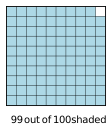
Question: What decimal is shown by the shaded part of the hundredths grid?
- A. \(0.01\)
- B. \(0.10\)
- C. \(0.99\)
- D. \(0.90\)
Why it works: The picture shows a hundredths grid with just one square left blank. That means \(99\) out of \(100\) are shaded: \(\frac{99}{100} = 0.99\).
Answer: \(0.99\)
Worked Examples
Example 1
Question: Use the place-value chart below to find the decimal for \(\frac{6}{10}\).
| Ones | Tenths | Hundredths |
|---|---|---|
- A. \(0.6\)
- B. \(0.06\)
- C. \(6.0\)
- D. \(60.0\)
- The place-value chart shows where each digit belongs. \(\frac{6}{10}\) means six tenths, so we place \(6\) in the tenths column: \(0.6\).
Answer: \(0.6\)
Example 2
Question: Where does \(0.2\) belong on this number line?

- A. At position A
- B. At position B
- C. At position C
- D. At position D
- The number line counts by tenths: \(0.2\) is the very first mark to the right of \(0\), so it's at position A.
Answer: At position A
Example 3
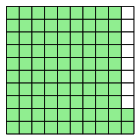
Question: How many hundredths are shaded in this grid?
- A. \(8\) hundredths or \(0.08\)
- B. \(80\) hundredths or \(0.80\)
- C. \(92\) hundredths or \(0.92\)
- D. \(20\) hundredths or \(0.20\)
- The grid shows \(92\) shaded squares out of \(100\) total.
- That's \(\frac{92}{100} = 0.92\).
Answer: \(92\) hundredths or \(0.92\)
Real-World Word Problems
Problem 1
Question: A ribbon is \(0.75\) meters long. Which fraction is equivalent to this length?
- A. \(\frac{7}{10}\)
- B. \(\frac{75}{100}\)
- C. \(\frac{75}{10}\)
- D. \(\frac{750}{100}\)
Why it works: A ribbon \(0.75\) meters long is \(\frac{75}{100}\) of a meter (or three quarters of a meter).
Answer: \(\frac{75}{100}\)
Problem 2
Question: Ava's eraser costs \($0.32\). Which fraction shows this price?
- A. \(\frac{32}{10}\)
- B. \(\frac{3}{2}\)
- C. \(\frac{32}{100}\)
- D. \(\frac{32}{1000}\)
Why it works: The cost is \($0.32\), which equals thirty-two cents or \(\frac{32}{100}\) of a dollar.
Answer: \(\frac{32}{100}\)
Common Mistakes
- Counting unequal parts as if they were equal.
- Forgetting that the denominator tells how many equal parts make the whole.
- Comparing fractions without first checking the size of the whole.
- Placing a fraction on a number line without counting equal intervals.
Strategy Tips
- Draw the whole first, then divide it into equal parts.
- Use number lines when the question asks about order or location.
- Say the fraction out loud to connect numerator and denominator meanings.
- Check whether the answer should be closer to 0, 1/2, or 1.
Practice Questions
Question 1
Write \(\frac{47}{100}\) as a decimal.
- A. \(0.047\)
- B. \(0.47\)
- C. \(4.7\)
- D. \(47.0\)
Question 2
Write \(\frac{6}{10}\) as a decimal.
- A. \(0.06\)
- B. \(0.6\)
- C. \(6.0\)
- D. \(60.0\)
Question 3
Which decimal is equal to \(\frac{35}{100}\)?
- A. \(0.035\)
- B. \(0.35\)
- C. \(3.5\)
- D. \(35.0\)
Question 4
Write \(0.7\) as a fraction with denominator \(10\).
- A. \(\frac{7}{100}\)
- B. \(\frac{70}{100}\)
- C. \(\frac{7}{10}\)
- D. \(\frac{70}{10}\)
Question 5
Express \(0.23\) as a fraction.
- A. \(\frac{23}{10}\)
- B. \(\frac{23}{100}\)
- C. \(\frac{2}{3}\)
- D. \(\frac{23}{1000}\)
Question 6
Which of these is NOT equivalent to \(0.3\)?
- A. \(\frac{3}{10}\)
- B. \(0.30\)
- C. \(\frac{30}{100}\)
- D. \(\frac{3}{100}\)
Full Answer Explanations Click to show all answers and explanations
Question 1
Answer: \(0.47\)
Hundredths fill the second decimal place. \(\frac{47}{100} = 0.47\), so the answer is \(\mathbf{0.47}\).
Question 2
Answer: \(0.6\)
Tenths fill the first decimal place. \(\frac{6}{10} = 0.6\), so the answer is \(\mathbf{0.6}\).
Question 3
Answer: \(0.35\)
Thirty-five hundredths uses both decimal places: \(\frac{35}{100} = 0.35\), so the answer is \(\mathbf{0.35}\).
Question 4
Answer: \(\frac{7}{10}\)
\(0.7\) is zero point seven, which is read as seven tenths. That means \(0.7 = \frac{7}{10}\).
Question 5
Answer: \(\frac{23}{100}\)
When you see \(0.23\), you're looking at twenty-three hundredths: \(0.23 = \frac{23}{100}\).
Question 6
Answer: \(\frac{3}{100} = 0.03\)
Three tenths can be written as \(0.3\), \(0.30\), \(\frac{3}{10}\), or \(\frac{30}{100}\). But \(\frac{3}{100} = 0.03\) is only 3 hundredths, so it doesn't match.
Connection to Standards
This lesson supports Grade 4 math expectations for reasoning, modeling, problem solving, and explaining answers clearly. It connects classroom skills to the kind of questions students see on state math assessments.
Summary
Decimal Notation for Fractions becomes easier when students connect the question to a model, use clear steps, and explain why the answer fits.
GOLDEN RULE
Equal parts first, fraction name second.