




Introduction
Fraction Word Problems is an important Grade 4 math skill because students are moving from simple answers toward explaining how the math works.
In this lesson, students use models, real questions, worked examples, practice problems, and two online quizzes to build confidence with fraction word problems.
What Is Fraction Word Problems?
Fraction Word Problems means using equal parts, number lines, and clear fraction language to describe parts of a whole.
The goal is not only to get the answer. Students should be able to show the idea, explain the strategy, and check whether the answer makes sense.
Understanding Fraction Word Problems
Before solving, students should slow down and decide what each number, shape, unit, or label represents.
- Identify the whole before naming a fraction.
- Make sure each part is equal in size.
- Use a number line or model to show where the fraction belongs.
- Explain whether two fractions have the same size or different sizes.
Visual Models
Visual Model 1
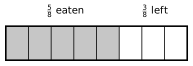
Question: A candy bar is divided into 8 equal parts. The shaded part shows \(\frac{5}{8}\) of the bar that Maya ate. How much of the candy bar is left?
- A. \(\frac{3}{8}\)
- B. \(\frac{5}{8}\)
- C. \(\frac{8}{8}\)
- D. \(\frac{13}{8}\)
Why it works: The picture shows the candy bar is divided into 8 equal parts with 5 shaded (what Maya ate). Subtract the shaded part from the whole bar: \(\frac{8}{8}-\frac{5}{8}=\frac{3}{8}\) of the candy bar is left.
Answer: \(\frac{3}{8}\)
Visual Model 2
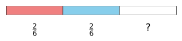
Question: A fabric strip shows three equal parts. The red part is \(\frac{2}{6}\) and the blue part is \(\frac{2}{6}\). What fraction is white?
- A. \(\frac{2}{6}\)
- B. \(\frac{4}{6}\)
- C. \(\frac{1}{6}\)
- D. \(\frac{3}{6}\)
Why it works: The fabric strip shows three parts. Red and blue are filled, white is empty. Step 1: Add the colored parts: \(\frac{2}{6}+\frac{2}{6}=\frac{4}{6}\). Step 2: Subtract from the whole: \(\frac{6}{6}-\frac{4}{6}=\frac{2}{6}\) is white.
Answer: \(\frac{2}{6}\)
Worked Examples
Example 1
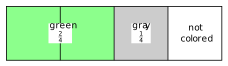
Question: A yard is divided into 4 equal parts. Green shows \(\frac{2}{4}\) and gray shows \(\frac{1}{4}\). What fraction is not colored?
- A. \(\frac{3}{4}\)
- B. \(\frac{1}{4}\)
- C. \(\frac{2}{4}\)
- D. \(\frac{4}{4}\)
- The yard has green and yellow sections.
- Step 1: Add the colored parts: \(\frac{2}{4}+\frac{1}{4}=\frac{3}{4}\).
- Step 2: Subtract from the whole yard: \(\frac{4}{4}-\frac{3}{4}=\frac{1}{4}\) is not colored.
Answer: \(\frac{1}{4}\)
Example 2
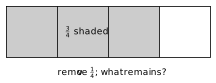
Question: A rectangle divided into 4 equal parts has 3 parts shaded (showing \(\frac{3}{4}\)). If one shaded part is removed, what fraction remains shaded?
- A. \(\frac{1}{4}\)
- B. \(\frac{2}{4}\)
- C. \(\frac{3}{4}\)
- D. \(\frac{4}{4}\)
- The picture shows a rectangle with 3 out of 4 parts shaded.
- When one shaded part is removed, subtract: \(\frac{3}{4}-\frac{1}{4}=\frac{2}{4}\) remains shaded.
Answer: \(\frac{2}{4}\)
Example 3
Question: A number line from 0 to 1 shows \(\frac{4}{10}\) in red and \(\frac{2}{10}\) in yellow. What fraction is unmarked?

- A. \(\frac{4}{10}\)
- B. \(\frac{2}{10}\)
- C. \(\frac{6}{10}\)
- D. \(\frac{8}{10}\)
- The number line shows marked and unmarked sections.
- Step 1: Add the marked fractions: \(\frac{4}{10}+\frac{2}{10}=\frac{6}{10}\).
- Step 2: Subtract from the whole: \(\frac{10}{10}-\frac{6}{10}=\frac{4}{10}\) is unmarked.
Answer: \(\frac{4}{10}\)
Real-World Word Problems
Problem 1
Question: Mia had a ribbon that was \(\frac{7}{10}\) meter long. She cut off \(\frac{3}{10}\) meter for a craft project. How much ribbon was left?
- A. \(\frac{4}{10}\)
- B. \(\frac{10}{10}\)
- C. \(\frac{3}{10}\)
- D. \(\frac{10}{20}\)
Why it works: The ribbon was cut, so we subtract the cut part from the total. \(\frac{7}{10}-\frac{3}{10}=\frac{4}{10}\) meter of ribbon left.
Answer: \(\frac{4}{10}\)
Problem 2
Question: A recipe calls for \(\frac{5}{4}\) cups of flour. Noah only has \(\frac{3}{4}\) cup. How much more flour does Noah need?
- A. \(\frac{1}{4}\)
- B. \(\frac{2}{4}\)
- C. \(\frac{8}{4}\)
- D. \(\frac{3}{4}\)
Why it works: The recipe needs more flour than Noah has. Find the difference: \(\frac{5}{4}-\frac{3}{4}=\frac{2}{4}\) cups more flour needed.
Answer: \(\frac{2}{4}\)
Common Mistakes
- Counting unequal parts as if they were equal.
- Forgetting that the denominator tells how many equal parts make the whole.
- Comparing fractions without first checking the size of the whole.
- Placing a fraction on a number line without counting equal intervals.
Strategy Tips
- Draw the whole first, then divide it into equal parts.
- Use number lines when the question asks about order or location.
- Say the fraction out loud to connect numerator and denominator meanings.
- Check whether the answer should be closer to 0, 1/2, or 1.
Practice Questions
Question 1
Carmen ate \(\frac{3}{8}\) of a pizza. Her brother ate \(\frac{2}{8}\) of the same pizza. What fraction of the pizza did they eat altogether?
- A. \(\frac{1}{8}\)
- B. \(\frac{5}{8}\)
- C. \(\frac{6}{8}\)
- D. \(\frac{5}{16}\)
Question 2
Diego and his friend made a pie. Diego ate \(\frac{2}{6}\) of the pie and his friend ate \(\frac{1}{6}\) of the pie. What fraction of the pie did they eat together?
- A. \(\frac{3}{6}\)
- B. \(\frac{2}{12}\)
- C. \(\frac{1}{6}\)
- D. \(\frac{3}{12}\)
Question 3
Ava read \(\frac{4}{5}\) of her book on Monday and \(\frac{1}{5}\) on Tuesday. What fraction of the book did she read in both days?
- A. \(\frac{5}{5}\)
- B. \(\frac{3}{5}\)
- C. \(\frac{4}{10}\)
- D. \(\frac{6}{10}\)
Question 4
A flower bed had \(\frac{8}{12}\) of its space planted with roses. \(\frac{3}{12}\) of the space was planted with tulips. How much of the flower bed was planted with roses or tulips?
- A. \(\frac{5}{12}\)
- B. \(\frac{11}{12}\)
- C. \(\frac{11}{24}\)
- D. \(\frac{10}{12}\)
Question 5
Sam had \(2\frac{2}{4}\) meters of string. He used \(1\frac{1}{4}\) meters for a project. How much string does he have left?
- A. \(1\frac{3}{4}\)
- B. \(1\frac{1}{4}\)
- C. \(2\frac{1}{4}\)
- D. \(3\frac{3}{4}\)
Question 6
A baker had \(3\frac{3}{5}\) cups of sugar. She used \(2\frac{1}{5}\) cups for a cake. How much sugar is left?
- A. \(1\frac{2}{5}\)
- B. \(1\frac{1}{5}\)
- C. \(5\frac{4}{5}\)
- D. \(2\frac{2}{5}\)
Full Answer Explanations Click to show all answers and explanations
Question 1
Answer: \(\frac{5}{8}\)
They both ate pieces from the same pizza! Add them with like denominators: \(\frac{3}{8}+\frac{2}{8}=\frac{5}{8}\) of the pizza altogether.
Question 2
Answer: \(\frac{3}{6}\)
Both friends shared from the same pie, so add the fractions: \(\frac{2}{6}+\frac{1}{6}=\frac{3}{6}\) of the pie they ate together.
Question 3
Answer: \(\frac{5}{5}\)
Ava read parts on two different days. Add the fractions: \(\frac{4}{5}+\frac{1}{5}=\frac{5}{5}\), which means she read the whole book!
Question 4
Answer: \(\frac{11}{12}\)
The flower bed has two types of flowers. Add the parts with like denominators: \(\frac{8}{12}+\frac{3}{12}=\frac{11}{12}\) of the flower bed was planted.
Question 5
Answer: \(1\frac{1}{4}\)
Sam used some string, so subtract the amount used from what he started with: \(2\frac{2}{4}-1\frac{1}{4}=1\frac{1}{4}\) meters of string remains.
Question 6
Answer: \(1\frac{2}{5}\)
The baker used some sugar for the cake. Subtract the amount used from the starting amount: \(3\frac{3}{5}-2\frac{1}{5}=1\frac{2}{5}\) cups of sugar left.
Connection to Standards
This lesson supports Grade 4 math expectations for reasoning, modeling, problem solving, and explaining answers clearly. It connects classroom skills to the kind of questions students see on state math assessments.
Summary
Fraction Word Problems becomes easier when students connect the question to a model, use clear steps, and explain why the answer fits.
GOLDEN RULE
Equal parts first, fraction name second.