




Introduction
Line of Symmetry is an important Grade 4 math skill because students are moving from simple answers toward explaining how the math works.
In this lesson, students use models, real questions, worked examples, practice problems, and two online quizzes to build confidence with line of symmetry.
What Is Line of Symmetry?
Line of Symmetry means choosing a model, naming what each number means, and explaining the strategy.
The goal is not only to get the answer. Students should be able to show the idea, explain the strategy, and check whether the answer makes sense.
Understanding Line of Symmetry
Before solving, students should slow down and decide what each number, shape, unit, or label represents.
- Read the question carefully and identify what is being asked.
- Choose a model, equation, table, or diagram that matches the situation.
- Solve one step at a time and keep units or labels attached.
- Use the answer explanation to check that the result makes sense.
Visual Models
Visual Model 1
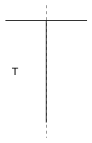
Question: Look at the letter \(T\) with a dashed line shown. Is this a line of symmetry?
- A. No, it is not symmetric
- B. Yes, this is a line of symmetry
- C. Only the right half is symmetric
- D. The line is in the wrong place
Why it works: The letter \(T\) has a horizontal bar across the top and a vertical stem down the middle. The vertical dashed line splits it perfectly so the left and right halves match. The answer is \(\mathbf{\text{Yes, this is a line of symmetry}}\).
Answer: Yes, this is a line of symmetry
Visual Model 2
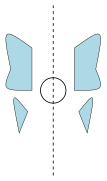
Question: A butterfly wing is drawn below with a vertical dashed line down the middle. How many lines of symmetry does a butterfly have?
- A. \(0\)
- B. \(1\)
- C. \(2\)
- D. Many
Why it works: A butterfly is nature's perfect example of symmetry! The left and right wings mirror each other, so a vertical line down the middle is exactly a line of symmetry. The answer is \(\mathbf{1}\) line of symmetry.
Answer: \(1\)
Worked Examples
Example 1
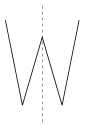
Question: How many lines of symmetry does the letter \(W\) shown below have?
- A. \(0\) lines
- B. \(1\) line
- C. \(2\) lines
- D. \(3\) lines
- The letter \(W\) has a series of peaks and valleys.
- A vertical line down the middle divides it so each side looks identical.
- The answer is \(\mathbf{1}\) line of symmetry.
Answer: \(1\) line
Example 2
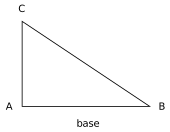
Question: Look at this right triangle. Does it have any lines of symmetry?
- A. Yes, it has \(1\) line
- B. Yes, it has \(2\) lines
- C. No, it has \(0\) lines
- D. Yes, it has \(3\) lines
- This right triangle has legs of different lengths, making it lopsided.
- No fold line can create two matching halves because one side is longer than the other.
- The answer is \(\mathbf{\text{No, it has 0 lines}}\).
Answer: No, it has \(0\) lines
Example 3
Question: This is a right isosceles triangle (two equal legs). How many lines of symmetry does it have?

- A. \(0\) lines
- B. \(1\) line
- C. \(2\) lines
- D. \(3\) lines
- A right isosceles triangle has two equal legs meeting at the right angle.
- The diagonal dashed line from that right angle to the middle of the opposite side is exactly the line of symmetry.
- The answer is \(\mathbf{1}\) line of symmetry.
Answer: \(1\) line
Real-World Word Problems
Problem 1
Question: How many lines of symmetry does a square have?
- A. \(1\)
- B. \(2\)
- C. \(3\)
- D. \(4\)
Why it works: A square is perfectly balanced! Imagine folding it in half four different ways: vertically through the center, horizontally through the center, and diagonally both directions—each fold creates matching halves. The answer is \(\mathbf{4}\) lines of symmetry.
Answer: \(4\)
Problem 2
Question: Which letter has a line of symmetry?
- A. \(F\)
- B. \(L\)
- C. \(A\)
- D. \(G\)
Why it works: The letter \(A\) looks the same on both sides of a vertical line running down its middle. Fold it along that line and both sides match perfectly! The answer is letter \(\mathbf{A}\).
Answer: Letter \(A\)
Common Mistakes
- Rushing before identifying what the numbers represent.
- Choosing an operation that does not match the situation.
- Dropping labels, units, or context from the answer.
- Skipping the estimate or reasonableness check.
Strategy Tips
- Underline the question being asked.
- Use a model before jumping to computation.
- Write an equation that matches the story or picture.
- Explain the final answer in a sentence.
Practice Questions
Question 1
How many lines of symmetry does a circle have?
- A. \(0\)
- B. \(1\)
- C. Infinitely many
- D. \(4\)
Question 2
Which figure does not have a line of symmetry?
- A. Equilateral triangle
- B. Rectangle
- C. Scalene triangle
- D. Isosceles triangle
Question 3
The letter \(H\) has how many lines of symmetry?
- A. \(0\)
- B. \(1\)
- C. \(2\)
- D. \(4\)
Question 4
Which block letter diagram has exactly one line of symmetry?
- A.

- B.

- C.

- D.

Question 5
A regular hexagon (6-sided polygon) has how many lines of symmetry?
- A. \(3\)
- B. \(4\)
- C. \(6\)
- D. \(8\)
Question 6
How many lines of symmetry does a regular pentagon (5-sided polygon) have?
- A. \(3\)
- B. \(4\)
- C. \(5\)
- D. \(10\)
Full Answer Explanations Click to show all answers and explanations
Question 1
Answer: Infinitely many
A circle is super special! No matter which direction you draw a line through its center, both sides match perfectly. You could draw infinitely many such lines, so a circle has \(\mathbf{\text{infinitely many}}\) lines of symmetry.
Question 2
Answer: Scalene triangle
A scalene triangle has three different side lengths and three different angles. Since nothing matches on either side, no fold line can make the two halves fit together perfectly. The answer is \(\mathbf{\text{scalene triangle}}\).
Question 3
Answer: \(2\)
The letter \(H\) is balanced in two directions! A vertical line down the middle splits it into matching left and right halves, and a horizontal line across the middle splits it into matching top and bottom halves. So \(H\) has \(\mathbf{2}\) lines of symmetry.
Question 4
Answer: Block letter T
The block letter T has one vertical line of symmetry down the center. The left and right halves match, but the top and bottom halves do not. The answer is choice \(\mathbf{C}\).
Question 5
Answer: \(6\)
A regular hexagon (6 equal sides) is perfectly balanced in six ways. Lines can pass through opposite corners, or through the middle of opposite sides—each creates matching halves. The answer is \(\mathbf{6}\) lines of symmetry.
Question 6
Answer: \(5\)
A regular pentagon (5 equal sides) has five lines of balance. Each line passes through one corner and the middle of the opposite side. The answer is \(\mathbf{5}\) lines of symmetry.
Connection to Standards
This lesson supports Grade 4 math expectations for reasoning, modeling, problem solving, and explaining answers clearly. It connects classroom skills to the kind of questions students see on state math assessments.
Summary
Line of Symmetry becomes easier when students connect the question to a model, use clear steps, and explain why the answer fits.
GOLDEN RULE
Understand the model before choosing the operation.