




Introduction
Measuring Angles with a Protractor is an important Grade 4 math skill because students are moving from simple answers toward explaining how the math works.
In this lesson, students use models, real questions, worked examples, practice problems, and two online quizzes to build confidence with measuring angles with a protractor.
What Is Measuring Angles with a Protractor?
Measuring Angles with a Protractor means choosing a model, naming what each number means, and explaining the strategy.
The goal is not only to get the answer. Students should be able to show the idea, explain the strategy, and check whether the answer makes sense.
Understanding Measuring Angles with a Protractor
Before solving, students should slow down and decide what each number, shape, unit, or label represents.
- Read the question carefully and identify what is being asked.
- Choose a model, equation, table, or diagram that matches the situation.
- Solve one step at a time and keep units or labels attached.
- Use the answer explanation to check that the result makes sense.
Visual Models
Visual Model 1
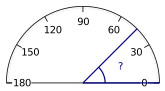
Question: What is the measure of the angle shown in blue?
- A. 45 degrees
- B. 30 degrees
- C. 60 degrees
- D. 90 degrees
Why it works: The baseline of the angle starts at \(0\degree\) on the right. Follow the second ray until it crosses the degree scale—it lines up perfectly with the 45-degree mark. The answer is \(\mathbf{45}\) degrees.
Answer: 45 degrees
Visual Model 2
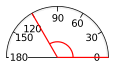
Question: A student measures an angle with a protractor. The angle opens to the 120-degree mark. What type of angle is this?
- A. Acute angle
- B. Right angle
- C. Obtuse angle
- D. Straight angle
Why it works: An obtuse angle opens wider than a right angle (more than \(90\degree\)) but is not a straight line (less than \(180\degree\)). Since \(120\degree\) fits perfectly between these benchmarks, the answer is \(\mathbf{\text{obtuse}}\).
Answer: Obtuse angle
Worked Examples
Example 1
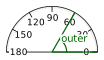
Question: When using a protractor, you have two scale choices (inner and outer). If the angle is opened towards the right side of the protractor, which scale should you use?
- A. Always use the inner scale
- B. Use the outer scale
- C. Use the scale that starts at 180 on the side where the angle opens
- D. It does not matter which scale you use
- The key to reading a protractor is to use the scale that starts at \(0\degree\) on the same side where your angle opens.
- When an angle opens toward the right, that side shows \(0\degree\)—read the outer scale.
- This matches where the angle is heading.
- The answer is \(\mathbf{\text{use the outer scale}}\).
Answer: Use the outer scale
Example 2
Question: What is the measure of the angle shown?

- A. 30 degrees
- B. 45 degrees
- C. 60 degrees
- D. 90 degrees
- One ray sits on the baseline at \(0\degree\), and the other ray points to the \(30\degree\) mark.
- Since \(30\degree < 90\degree\), this is an acute angle.
- The answer is \(\mathbf{30}\) degrees.
Answer: 30 degrees
Example 3
Question: Sam uses a protractor to measure an angle. The angle lines up exactly with the 90-degree mark. What type of angle is this?

- A. Right angle
- B. Straight angle
- C. Obtuse angle
- D. Acute angle
- Whenever an angle measures exactly \(90\degree\), we call it a right angle.
- It's one of the most important angles we measure because it appears everywhere—in book corners, window frames, and the letter L.
- This angle aligns perfectly with \(90\degree\), so the answer is \(\mathbf{\text{right angle}}\).
Answer: Right angle
Real-World Word Problems
Problem 1
Question: A student drew an angle and measured it. She read 115 degrees on the outer scale. Is this reasonable?
- A. No, because 115 is less than 90 degrees
- B. Yes, because 115 is between 90 and 180 degrees
- C. No, because you cannot measure angles larger than 100 degrees
- D. Yes, only if the angle opens to the left
Why it works: \(115\degree\) is absolutely a reasonable angle measure because it's between \(90\degree\) and \(180\degree\)—this makes it obtuse, not acute. The student's reading is correct. The answer is \(\mathbf{\text{yes, because 115 is between 90 and 180 degrees}}\).
Answer: Yes, 115 is obtuse
Problem 2
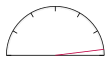
Question: A student said this angle measures 173 degrees. Is she correct?
- A. Yes, the angle is close to 180 degrees
- B. No, the angle is much smaller, around 7 degrees
- C. Yes, all small angles are close to 180 degrees
- D. No, you cannot measure angles smaller than 30 degrees
Why it works: This angle is tiny—it opens just \(7\degree\) from the baseline. Reading \(173\degree\) would be confusing the inner and outer scales. A common mistake is to read the wrong scale when an angle is very small or very large. The answer is \(\mathbf{\text{no, about 7 degrees}}\).
Answer: No, about 7 degrees
Common Mistakes
- Rushing before identifying what the numbers represent.
- Choosing an operation that does not match the situation.
- Dropping labels, units, or context from the answer.
- Skipping the estimate or reasonableness check.
Strategy Tips
- Underline the question being asked.
- Use a model before jumping to computation.
- Write an equation that matches the story or picture.
- Explain the final answer in a sentence.
Practice Questions
Question 1
Which tool is used to measure the size of an angle in degrees?
- A. Protractor
- B. Compass
- C. Ruler
- D. Calculator
Question 2
How many degrees does a right angle measure?
- A. 45 degrees
- B. 90 degrees
- C. 120 degrees
- D. 180 degrees
Question 3
Which angle measure is an acute angle?
- A. 95 degrees
- B. 15 degrees
- C. 135 degrees
- D. 180 degrees
Question 4
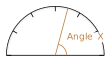
What is the best estimate of the angle shown as Angle X?
- A. About 60 degrees
- B. About 75 degrees
- C. About 90 degrees
- D. About 120 degrees
Question 5
A straight angle measures how many degrees?
- A. 90 degrees
- B. 180 degrees
- C. 150 degrees
- D. 120 degrees
Question 6
Which angle classification fits the angle shown above?

- A. Acute
- B. Right
- C. Obtuse
- D. Straight
Full Answer Explanations Click to show all answers and explanations
Question 1
Answer: Protractor
A protractor is the special tool we use to measure angles in whole-number degrees. The ruler measures length and the compass draws circles, but only the protractor shows us how many degrees are in an angle.
Question 2
Answer: 90 degrees
A right angle is a special angle that measures exactly \(90\degree\) every time—no more, no less. You see right angles at the corners of books, windows, doors, and many shapes we use every day. The answer is \(\mathbf{90}\) degrees.
Question 3
Answer: 15 degrees
An acute angle opens less wide than a right angle—it measures less than \(90\degree\). At \(15\degree\), this is a very small acute angle. The other choices are all \(90\degree\) or bigger, so they cannot be acute. The answer is \(\mathbf{15}\) degrees.
Question 4
Answer: About 75 degrees
The ray falls between the \(60\degree\) benchmark and the \(90\degree\) benchmark. It's closer to the midpoint between them, which is around \(75\degree\). The answer is \(\mathbf{75}\) degrees.
Question 5
Answer: 180 degrees
A straight angle is perfectly flat—it's a straight line with two rays pointing opposite directions. This special angle always measures exactly \(180\degree\), which is the full width of the protractor. The answer is \(\mathbf{180}\) degrees.
Question 6
Answer: Obtuse
Obtuse angles are wider than right angles but not quite flat. Since \(150\degree\) is between \(90\degree\) and \(180\degree\), it fits the obtuse definition perfectly. The answer is \(\mathbf{\text{obtuse}}\).
Connection to Standards
This lesson supports Grade 4 math expectations for reasoning, modeling, problem solving, and explaining answers clearly. It connects classroom skills to the kind of questions students see on state math assessments.
Summary
Measuring Angles with a Protractor becomes easier when students connect the question to a model, use clear steps, and explain why the answer fits.
GOLDEN RULE
Understand the model before choosing the operation.