




Introduction
Circle Graphs is an important Grade 6 math skill because students are moving from simple answers toward explaining how the math works.
In this lesson, students use models, real questions, worked examples, practice problems, and two online quizzes to build confidence with circle graphs.
What Is Circle Graphs?
Circle Graphs means reading, creating, and explaining displays so data can answer real questions.
The goal is not only to get the answer. Students should be able to show the idea, explain the strategy, and check whether the answer makes sense.
Understanding Circle Graphs
Before solving, students should slow down and decide what each number, shape, unit, or label represents.
- Read the title, labels, and scale before answering.
- Use the scale value instead of counting marks as ones when the graph is scaled.
- Compare categories by subtracting or adding values from the display.
- Explain what the data shows in a complete sentence.
Visual Models
Visual Model 1
Question: A circle graph shows the favorite ice cream flavors of 200 people. If \(30\%\) prefer vanilla, how many people prefer vanilla?

- A. \(60\)
- B. \(50\)
- C. \(30\)
- D. \(80\)
Why it works: \(30\%\) of \(200\) is \(0.30\times200=60\) people.
Answer: \(60\)
Visual Model 2
Question: A restaurant surveyed 180 customers about their favorite drink. The circle graph shows \(25\%\) like coffee. How many customers prefer coffee?

- A. \(45\)
- B. \(35\)
- C. \(25\)
- D. \(55\)
Why it works: \(25\%\) of \(180\) is \(0.25\times180=45\) customers.
Answer: \(45\)
Worked Examples
Example 1
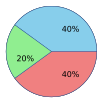
Question: A circle graph shows the results of a survey with 300 students. One section is \(20\%\). How many students are in this section?
- A. \(20\)
- B. \(60\)
- C. \(80\)
- D. \(100\)
- \(20\%\) of \(300\) is \(0.20\times300=60\) students.
Answer: \(60\)
Example 2
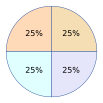
Question: The circle graph shows equal portions of 120 total items. What is the measure of the central angle for each section?
- A. 45°
- B. 75°
- C. 120°
- D. 90°
- Each section represents \(25\%\).
- The central angle is \(0.25\times360°=90°\).
Answer: 90°
Example 3
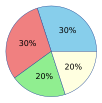
Question: The circle graph shows survey results for 500 people. What is the central angle for the \(30\%\) section?
- A. 90°
- B. 135°
- C. 120°
- D. 108°
- \(30\%\) of the circle: \(0.30\times360°=108°\).
Answer: 108°
Real-World Word Problems
Problem 1
Question: A circle graph shows that \(40\%\) of \(250\) students prefer pizza for lunch. How many students prefer pizza?
- A. \(40\)
- B. \(75\)
- C. \(100\)
- D. \(150\)
Why it works: \(40\%\) of \(250\) is \(0.40\times250=100\) students.
Answer: \(100\)
Problem 2
Question: A music store polled 200 customers about preferred instruments. If the circle graph shows \(50\%\) prefer guitar, how many customers prefer guitar?

- A. \(100\)
- B. \(75\)
- C. \(50\)
- D. \(150\)
Why it works: \(50\%\) of \(200\) is \(0.50\times200=100\) customers.
Answer: \(100\)
Common Mistakes
- Ignoring the graph scale.
- Reading the wrong category or axis label.
- Answering a comparison question without subtracting.
- Writing a number without explaining what it represents.
Strategy Tips
- Circle the scale before using the graph.
- Write down the value for each category you compare.
- Use addition for totals and subtraction for differences.
- Answer in words so the data result has meaning.
Practice Questions
Question 1
A circle graph shows transportation methods for 500 commuters. If \(45\%\) drive a car, how many commuters drive a car?
- A. \(200\)
- B. \(180\)
- C. \(225\)
- D. \(250\)
Question 2
A survey of 360 people asked about favorite pizza toppings. One section of the circle graph represents \(\frac{1}{5}\) of the total. What central angle does this represent?
- A. 36°
- B. 60°
- C. 90°
- D. 72°
Question 3
A baker made 560 cookies. The circle graph shows \(\frac{1}{4}\) are chocolate chip. How many chocolate chip cookies did the baker make?

- A. \(140\)
- B. \(100\)
- C. \(180\)
- D. \(200\)
Question 4
A circle graph is divided into 5 equal sections. Each section represents what percent?
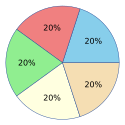
- A. \(20\%\)
- B. \(15\%\)
- C. \(10\%\)
- D. \(25\%\)
Question 5
A survey asked 320 families about car color preference. The circle graph shows \(12.5\%\) prefer blue. How many families prefer blue?

- A. \(30\)
- B. \(40\)
- C. \(60\)
- D. \(50\)
Question 6
A park counted 600 visitors. The circle graph shows \(\frac{3}{10}\) came on Saturday. How many visitors came on Saturday?
- A. \(150\)
- B. \(120\)
- C. \(180\)
- D. \(200\)
Full Answer Explanations Click to show all answers and explanations
Question 1
Answer: \(225\)
\(45\%\) of \(500\) is \(0.45\times500=225\) commuters.
Question 2
Answer: 72°
\(\frac{1}{5}\) equals \(20\%\). The central angle is \(0.20\times360°=72°\).
Question 3
Answer: \(140\)
\(\frac{1}{4}=25\%\). So \(0.25\times560=140\) chocolate chip cookies.
Question 4
Answer: \(20\%\)
A circle has \(100\%\). Divide by 5: \(100\div5=20\%\) per section.
Question 5
Answer: \(40\)
\(12.5\%\) of \(320\) is \(0.125\times320=40\) families.
Question 6
Answer: \(180\)
\(\frac{3}{10}=30\%\). So \(0.30\times600=180\) visitors.
Connection to Standards
This lesson supports Grade 6 math expectations for reasoning, modeling, problem solving, and explaining answers clearly. It connects classroom skills to the kind of questions students see on state math assessments.
Summary
Circle Graphs becomes easier when students connect the question to a model, use clear steps, and explain why the answer fits.
GOLDEN RULE
Read the scale before reading the answer.