





Introduction
Finding the Unit Rate is an important Grade 6 math skill because students are moving from simple answers toward explaining how the math works.
In this lesson, students use models, real questions, worked examples, practice problems, and two online quizzes to build confidence with finding the unit rate.
What Is Finding the Unit Rate?
Finding the Unit Rate means choosing a model, naming what each number means, and explaining the strategy.
The goal is not only to get the answer. Students should be able to show the idea, explain the strategy, and check whether the answer makes sense.
Understanding Finding the Unit Rate
Before solving, students should slow down and decide what each number, shape, unit, or label represents.
- Read the question carefully and identify what is being asked.
- Choose a model, equation, table, or diagram that matches the situation.
- Solve one step at a time and keep units or labels attached.
- Use the answer explanation to check that the result makes sense.
Visual Models
Visual Model 1
Question: The table below shows the relationship between apples and their cost. Which represents the unit rate?
| Number of Apples | Total Cost |
|---|---|
| 3 | $1.80 |
| 6 | $3.60 |
| 9 | $5.40 |
- A. \($0.60\) per apple
- B. \($0.90\) per apple
- C. \($1.80\) per apple
- D. \($3.00\) per apple
Why it works: Take any row: \($1.80 \div 3 = $0.60\) per apple. All rows confirm this unit rate.
Answer: \($0.60\) per apple
Visual Model 2
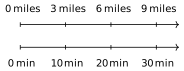
Question: A runner completes a race at a constant speed. The double number line shows the distance and time. What is the unit rate in miles per minute?
- A. \(0.2\) mi/min
- B. \(0.3\) mi/min
- C. \(3\) mi/min
- D. \(10\) mi/min
Why it works: From the double number line, \(3\) miles in \(10\) minutes gives \(3 \div 10 = 0.3\) miles per minute.
Answer: \(0.3\) miles per minute
Worked Examples
Example 1
Question: A grocery receipt shows: Which item has the highest unit price?
| Item | Price |
|---|---|
| Apples (5 lbs) | $4.50 |
| Cheese (3 lbs) | $12.00 |
| Bread (2 loaves) | $5.00 |
- A. Apples
- B. Cheese
- C. Bread
- D. They are all equal
- Apples: \($4.50 \div 5 = $0.90\)/lb.
- Cheese: \($12.00 \div 3 = $4.00\)/lb.
- Bread: \($5.00 \div 2 = $2.50\)/loaf.
- Cheese has the highest unit price.
Answer: Cheese
Example 2
Question: The ratio table shows the cost of different quantities of books. What is the unit price per book?
| Books | 2 | 4 | 6 |
|---|---|---|---|
| Cost | $8 | $16 | $24 |
- A. $2 per book
- B. $4 per book
- C. $6 per book
- D. $8 per book
- From any column: \($8 \div 2 = $4\) per book.
- All columns confirm this unit rate.
Answer: $4 per book
Example 3
Question: A store has two cereal brands: Which brand has the lower unit price per ounce?
| Brand | Size | Price |
|---|---|---|
| Honey Flakes | 12 oz | $3.60 |
| Crispy Oats | 16 oz | $5.12 |
- A. Honey Flakes at $0.30/oz
- B. Honey Flakes at $0.40/oz
- C. Crispy Oats at $0.30/oz
- D. Crispy Oats at $0.40/oz
- Honey Flakes cost \(3.60\div12=$0.30\) per ounce.
- Crispy Oats cost \(5.12\div16=$0.32\) per ounce.
- Honey Flakes has the lower unit price.
Answer: Honey Flakes at $0.30/oz
Real-World Word Problems
Problem 1
Question: A grocery store sells \(8\) pounds of rice for \($12\). What is the unit price in dollars per pound?
- A. \($1.50\) per pound
- B. \($1.25\) per pound
- C. \($2.00\) per pound
- D. \($3.00\) per pound
Why it works: Unit price is total cost divided by number of units: \($12 \div 8 = $1.50\) per pound.
Answer: \($1.50\) per pound
Problem 2
Question: A car travels \(240\) miles in \(4\) hours. What is the unit rate in miles per hour?
- A. \(60\) mph
- B. \(56\) mph
- C. \(64\) mph
- D. \(80\) mph
Why it works: Divide the total distance by time: \(240 \div 4 = 60\) miles per hour.
Answer: \(60\) mph
Common Mistakes
- Rushing before identifying what the numbers represent.
- Choosing an operation that does not match the situation.
- Dropping labels, units, or context from the answer.
- Skipping the estimate or reasonableness check.
Strategy Tips
- Underline the question being asked.
- Use a model before jumping to computation.
- Write an equation that matches the story or picture.
- Explain the final answer in a sentence.
Practice Questions
Question 1
A recipe uses \(3\) cups of flour to make \(12\) cookies. How much flour is needed per cookie?
- A. \(0.25\) cups
- B. \(0.75\) cups
- C. \(1\) cup
- D. \(4\) cups
Question 2
A water fountain fills \(10\) gallons in \(2\) minutes. What is the unit rate in gallons per minute?
- A. \(2\) gal/min
- B. \(5\) gal/min
- C. \(8\) gal/min
- D. \(20\) gal/min
Question 3
A store sells \(5\) notebooks for \($7.50\). What is the price per notebook?
- A. \($1.25\)
- B. \($1.50\)
- C. \($2.50\)
- D. \($7.50\)
Question 4
Which unit rate is equivalent to \($15\) for \(6\) pounds?
- A. \($2.50\) per pound
- B. \($3.00\) per pound
- C. \($2.00\) per pound
- D. \($4.00\) per pound
Question 5
A printer produces \(180\) pages in \(3\) minutes. At this rate, how many pages does it print per minute?
- A. \(60\) pages/min
- B. \(90\) pages/min
- C. \(120\) pages/min
- D. \(180\) pages/min
Question 6
At a bakery, \(4\) loaves of bread cost \($16\). At this rate, what is the cost of \(7\) loaves?
- A. \($24\)
- B. \($28\)
- C. \($32\)
- D. \($36\)
Full Answer Explanations Click to show all answers and explanations
Question 1
Answer: \(0.25\) cups per cookie
Unit rate: \(3 \div 12 = 0.25\) cups per cookie.
Question 2
Answer: \(5\) gallons per minute
Divide total gallons by time: \(10 \div 2 = 5\) gallons per minute.
Question 3
Answer: \($1.50\) per notebook
Unit price: \($7.50 \div 5 = $1.50\) per notebook.
Question 4
Answer: \($2.50\) per pound
\($15 \div 6 = $2.50\) per pound. This is the unit rate.
Question 5
Answer: \(60\) pages per minute
Unit rate: \(180 \div 3 = 60\) pages per minute.
Question 6
Answer: \($28\)
Unit rate: \($16 \div 4 = $4\) per loaf. For \(7\) loaves: \(7 \times $4 = $28\).
Connection to Standards
This lesson supports Grade 6 math expectations for reasoning, modeling, problem solving, and explaining answers clearly. It connects classroom skills to the kind of questions students see on state math assessments.
Summary
Finding the Unit Rate becomes easier when students connect the question to a model, use clear steps, and explain why the answer fits.
GOLDEN RULE
Understand the model before choosing the operation.