






Introduction
Graphing Ratios is an important Grade 6 math skill because students are moving from simple answers toward explaining how the math works.
In this lesson, students use models, real questions, worked examples, practice problems, and two online quizzes to build confidence with graphing ratios.
What Is Graphing Ratios?
Graphing Ratios means reading, creating, and explaining displays so data can answer real questions.
The goal is not only to get the answer. Students should be able to show the idea, explain the strategy, and check whether the answer makes sense.
Understanding Graphing Ratios
Before solving, students should slow down and decide what each number, shape, unit, or label represents.
- Read the title, labels, and scale before answering.
- Use the scale value instead of counting marks as ones when the graph is scaled.
- Compare categories by subtracting or adding values from the display.
- Explain what the data shows in a complete sentence.
Visual Models
Visual Model 1
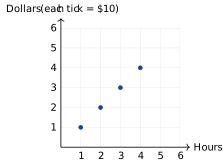
Question: The coordinate plane shows ordered pairs representing the ratio of hours worked to dollars earned. Based on the graph, how much is earned per hour?
- A. \($1\) per hour
- B. \($5\) per hour
- C. \($10\) per hour
- D. \($20\) per hour
Why it works: Look at the y-axis label: each tick on the dollars axis stands for $10. The point \((1,1)\) means \(1\) hour and \(1\times10=$10\), so the rate is \($10\) per hour.
Answer: \($10\) per hour
Visual Model 2
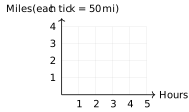
Question: A ratio table shows the relationship between hours and miles traveled at a constant speed. Which graph correctly represents the data from this table? Looking at the coordinate plane below, which set of points matches this ratio?
| Hours | Miles |
|---|---|
| 1 | 50 |
| 2 | 100 |
| 3 | 150 |
- A. \((1,1), (2,2), (3,3)\)
- B. \((1,2), (2,4), (3,6)\)
- C. \((1,5), (2,7), (3,9)\)
- D. \((1,3), (2,6), (3,9)\)
Why it works: The vertical axis is scaled in groups of \(50\) miles. So \(50\) miles is shown as \(1\), \(100\) miles as \(2\), and \(150\) miles as \(3\), giving the points \((1,1)\), \((2,2)\), and \((3,3)\).
Answer: \((1,1), (2,2), (3,3)\)
Worked Examples
Example 1
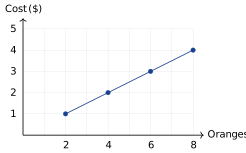
Question: A store sells oranges at a constant rate. The graph below shows the relationship between the number of oranges and the total cost in dollars. What is the unit rate (cost per orange)?
- A. \($0.25\) per orange
- B. \($2.00\) per orange
- C. \($1.00\) per orange
- D. \($0.50\) per orange
- At the point where oranges \(= 2\), cost \(= $1\), giving a ratio of \($1 \div 2 = $0.50\) per orange.
- Or use any point: at \((8, 4)\), the rate is \($4 \div 8 = $0.50\) per orange.
Answer: \($0.50\) per orange
Example 2
Question: This table shows the relationship between gallons of water used and plants watered at a greenhouse. If this relationship is graphed with gallons on the x-axis and plants on the y-axis, what does the point \((1, 4)\) represent?
| Gallons of Water | Plants Watered |
|---|---|
| 3 | 12 |
| 5 | 20 |
| 7 | 28 |
- A. 1 gallon waters 4 plants
- B. 4 gallons water 1 plant
- C. 1 plant needs 4 gallons
- D. 4 gallons water 4 plants
- On the graph with gallons on the x-axis and plants on the y-axis, the point \((1, 4)\) means 1 gallon (x-value) corresponds to 4 plants watered (y-value).
- This shows the unit rate: 4 plants per gallon.
Answer: 1 gallon waters 4 plants
Example 3
Question: A student created this ratio table about babysitting rates: If the student plots \((0, 0)\), \((2, 24)\), \((4, 48)\), and \((6, 72)\) on a coordinate plane, which statement about the points is true?
| Hours | Dollars Earned |
|---|---|
| 2 | 24 |
| 4 | 48 |
| 6 | 72 |
- A. The points form a vertical line
- B. The points form a diagonal line through the origin
- C. The points form a horizontal line
- D. The points do not form a straight line
- All these points lie on a straight line passing through \((0, 0)\) because the ratio is constant (\(12\) dollars per hour).
- Proportional relationships always graph as straight lines through the origin.
Answer: The points form a diagonal line through the origin
Real-World Word Problems
Problem 1
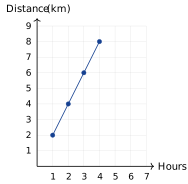
Question: Which scenario best matches the graph showing hours on the x-axis and total distance in kilometers on the y-axis?
- A. Traveling at 2 km per hour
- B. Traveling at 4 km per hour
- C. Traveling at 6 km per hour
- D. Traveling at 8 km per hour
Why it works: Using two points on the line, e.g., \((1,2)\) and \((2,4)\): slope \(=\frac{4-2}{2-1}=2\) km/hr. Verify with \((4,8)\): \(8\div 4=2\) km/hr. The constant rate is \(2\) km per hour.
Answer: Traveling at 2 km per hour
Problem 2
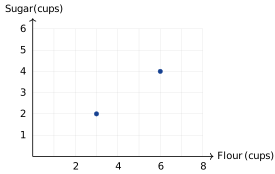
Question: A recipe uses a 3:2 ratio of flour to sugar. The graph below shows ordered pairs of this ratio. Which point should also be plotted to continue this ratio pattern?
- A. \((4, 3)\)
- B. \((9, 6)\)
- C. \((5, 4)\)
- D. \((8, 5)\)
Why it works: The ratio is 3:2 (flour:sugar). Points on this line satisfy \(\text{sugar} = \frac{2}{3} \times \text{flour}\). Check: \((3, 2)\) gives \(2 = \frac{2}{3}(3)\) ✓; \((6, 4)\) gives \(4 = \frac{2}{3}(6)\) ✓; \((9, 6)\) gives \(6 = \frac{2}{3}(9)\) ✓. The other options do not maintain this ratio.
Answer: \((9, 6)\)
Common Mistakes
- Ignoring the graph scale.
- Reading the wrong category or axis label.
- Answering a comparison question without subtracting.
- Writing a number without explaining what it represents.
Strategy Tips
- Circle the scale before using the graph.
- Write down the value for each category you compare.
- Use addition for totals and subtraction for differences.
- Answer in words so the data result has meaning.
Practice Questions
Question 1
A ratio table shows the number of apples and oranges in a fruit basket. If this ratio is graphed with apples on the x-axis, what is the y-coordinate when the x-coordinate is 8?
| Apples | Oranges |
|---|---|
| 2 | 5 |
| 4 | 10 |
| 6 | 15 |
- A. 18
- B. 24
- C. 22
- D. 20
Question 2
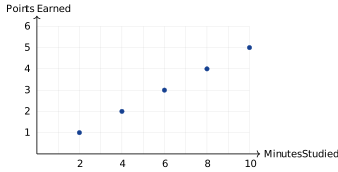
The graph shows the relationship between minutes studied and test score points earned. What is the unit rate (points per minute)?
- A. \(0.25\) points per minute
- B. \(0.5\) points per minute
- C. \(1\) point per minute
- D. \(2\) points per minute
Question 3
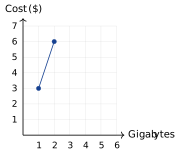
A cell phone plan charges a constant rate per gigabyte of data used. The graph below shows this relationship. What does the point \((1, 3)\) represent?
- A. 1 GB costs 3 dollars
- B. 3 GB costs 1 dollar
- C. 1 dollar buys 3 GB
- D. 1 GB costs 1 dollar
Question 4
A fruit vendor sells bananas at a constant price. This table shows the relationship: Which equation represents the relationship between pounds (\(p\)) and cost (\(c\))?
| Pounds of Bananas | Total Cost ($) |
|---|---|
| 2 | 1.50 |
| 4 | 3.00 |
| 6 | 4.50 |
- A. \(c = 0.5p\)
- B. \(c = 0.75p\)
- C. \(c = 1.5p\)
- D. \(c = 3p\)
Question 5
A graph shows the relationship between the number of soccer practice hours and the number of goals scored. The points \((2, 6)\) and \((5, 15)\) are on the line. What is the unit rate (goals per practice hour)?
- A. 2 goals per hour
- B. 6 goals per hour
- C. 5 goals per hour
- D. 3 goals per hour
Question 6
A student is making a trail mix with a ratio of 4:3 (nuts to dried fruit). If the graph has nuts on the x-axis and dried fruit on the y-axis, which point represents a mixture with 12 cups of nuts?
- A. \((12, 8)\)
- B. \((12, 9)\)
- C. \((12, 12)\)
- D. \((12, 16)\)
Full Answer Explanations Click to show all answers and explanations
Question 1
Answer: 20
The ratio is apples to oranges at 2:5. For every 2 apples, there are 5 oranges. When apples = 8, the multiplier is \(8 \div 2 = 4\). So oranges = \(5 \times 4 = 20\).
Question 2
Answer: \(0.5\) points per minute
Using the point \((2, 1)\): unit rate \(= 1 \div 2 = 0.5\) points per minute. Or from \((10, 5)\): unit rate \(= 5 \div 10 = 0.5\) points per minute.
Question 3
Answer: 1 GB costs 3 dollars
On a graph with gigabytes on the x-axis and cost on the y-axis, the point \((1, 3)\) means 1 gigabyte (x-value) costs $3 dollars (y-value).
Question 4
Answer: \(c = 0.75p\)
For 2 pounds, cost is \($1.50\), so the unit rate is \(1.50 \div 2 = 0.75\) per pound. Check: \(c = 0.75p\) gives \(c = 0.75(2) = 1.50\) ✓ and \(c = 0.75(4) = 3.00\) ✓.
Question 5
Answer: 3 goals per hour
The unit rate is the change in goals divided by the change in hours: \(\frac{15 - 6}{5 - 2} = \frac{9}{3} = 3\) goals per hour.
Question 6
Answer: \((12, 9)\)
The ratio is nuts:dried fruit = 4:3. If nuts = 12, then \(12 \div 4 = 3\), so dried fruit \(= 3 \times 3 = 9\). The point is \((12, 9)\).
Connection to Standards
This lesson supports Grade 6 math expectations for reasoning, modeling, problem solving, and explaining answers clearly. It connects classroom skills to the kind of questions students see on state math assessments.
Summary
Graphing Ratios becomes easier when students connect the question to a model, use clear steps, and explain why the answer fits.
GOLDEN RULE
Read the scale before reading the answer.