




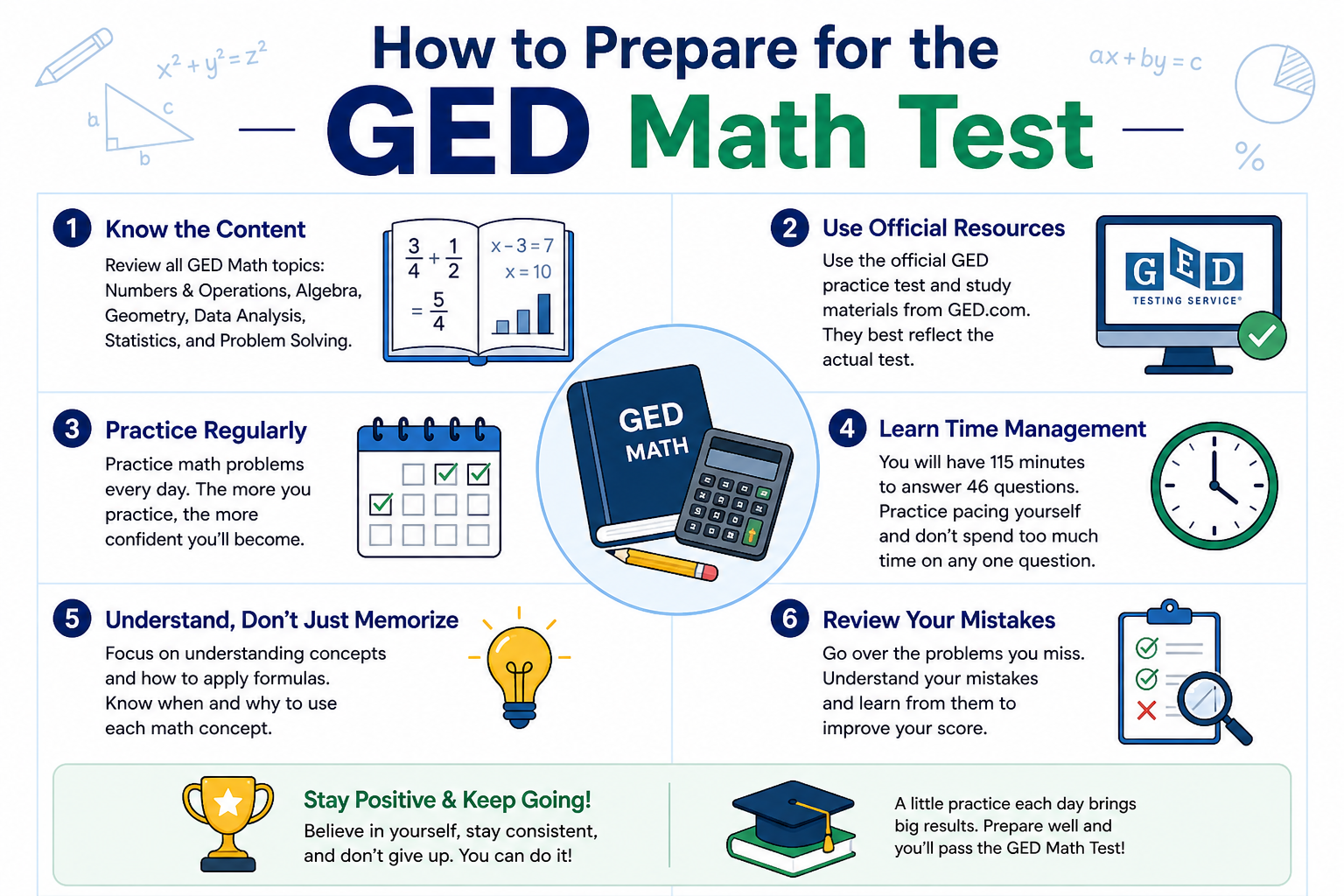
How to Prepare for the GED Math Test
Read,5 minutes
The GED Math test measures practical problem solving. You do not need to be a math genius to do well, but you do need a plan. The strongest students prepare by learning the main topics, practicing with realistic questions, using the calculator wisely, and reviewing mistakes until patterns become familiar.
Know What the GED Math Test Covers
The GED Mathematical Reasoning test focuses on math that appears in school, work, and everyday life. You should be ready for number operations, fractions, decimals, percents, ratios, proportions, algebra, equations, inequalities, functions, geometry, data, graphs, and word problems. Many questions combine more than one skill, so the key is learning how to recognize the structure of a problem.
For example, a question about a sale price may use percents and equations. A question about a garden may use area and unit conversion. A question about a graph may ask you to interpret slope, compare values, or choose an equation. When you study, practice naming the topic before you solve the problem.
Start with Number Sense
Number sense is the foundation. Review adding, subtracting, multiplying, and dividing whole numbers, decimals, fractions, and signed numbers. Make sure you understand place value, rounding, estimation, and order of operations. These skills show up everywhere, even inside algebra and geometry questions.
A good habit is to estimate before calculating. If the answer choices are far apart, estimation can help you eliminate wrong answers quickly. If your calculator answer is much larger or smaller than expected, estimation can alert you to a typing mistake.
Review the Algebra You Actually Need
GED Math includes expressions, equations, inequalities, and formulas. You should know how to combine like terms, use the distributive property, solve one-step and multi-step equations, and substitute numbers into formulas. Algebra becomes easier when you treat an equation like a balance: whatever you do to one side, you must do to the other side.
For word problems, define the unknown first. If a question asks for a price, let \(x\) be the price. If it asks for the number of hours, let \(h\) be the hours. A clear variable makes the equation easier to build.
Practice Geometry and Measurement
Geometry questions often involve perimeter, area, volume, angles, triangles, circles, and coordinate grids. Learn the common formulas, but also learn what each formula measures. Perimeter is distance around. Area is space inside a flat shape. Volume is space inside a solid. Surface area is the total area covering the outside of a solid.
When a geometry question feels confusing, sketch the shape and label the information given. A simple drawing can make the correct formula obvious.
Use Data and Graphs Carefully
The GED Math test often includes tables, bar graphs, line graphs, scatter plots, and basic statistics. Read titles, labels, and units before answering. For data questions, review mean, median, mode, range, probability, and interpreting trends. Many graph mistakes happen because students answer too quickly without checking the scale.
Build a Weekly Study Routine
A steady routine works better than one long cram session. Study three or four times per week. Spend one day reviewing a topic, one day practicing questions, one day reviewing mistakes, and one day doing mixed timed practice.
- Day 1: Review one skill, such as fractions or equations.
- Day 2: Solve 15 to 25 GED-style questions from that skill.
- Day 3: Rework every missed question and write why you missed it.
- Day 4: Complete a mixed timed set to practice switching topics.
Keep an Error Log
An error log is a simple notebook or document where you track missed questions. For each mistake, write the topic, the correct method, and the reason for the error. Common reasons include sign errors, formula confusion, calculator entry mistakes, rushing, or misunderstanding the question. After a few weeks, your error log will show exactly what to review.
Use the Calculator as a Tool, Not a Crutch
The calculator can help with arithmetic, but it cannot decide how to set up a problem. Write the expression first, then type it carefully. Use parentheses around fractions, negative numbers, and grouped operations. If the answer choices are available, you can sometimes plug them back into the problem to check which one works.
Test-Day Strategy
On test day, read each question carefully and underline what it is asking. If a problem seems too long, skip it and come back later. Protect your time. The goal is to collect as many correct answers as possible, not to prove you can solve one difficult question while easier points disappear.
Before choosing an answer, ask: Does this answer match the units? Is it reasonable? Did I answer the actual question? That final check catches many avoidable mistakes.
Final Study Advice
GED Math preparation is about confidence through repetition. Learn the core skills, practice realistic questions, review your mistakes, and keep improving one topic at a time. If you study consistently and stay organized, the test becomes less intimidating because you will recognize the patterns behind the questions.