




Introduction
Number and Shape Patterns is an important Grade 4 math skill because students are moving from simple answers toward explaining how the math works.
In this lesson, students use models, real questions, worked examples, practice problems, and two online quizzes to build confidence with number and shape patterns.
What Is Number and Shape Patterns?
Number and Shape Patterns means looking at attributes such as sides, angles, equal parts, and shape categories.
The goal is not only to get the answer. Students should be able to show the idea, explain the strategy, and check whether the answer makes sense.
Understanding Number and Shape Patterns
Before solving, students should slow down and decide what each number, shape, unit, or label represents.
- Look for attributes such as side count, equal sides, angles, and parallel sides.
- Classify shapes using evidence instead of only how the shape looks.
- Remember that one shape can belong to more than one category.
- Use drawings to test whether the attributes really match the name.
Visual Models
Visual Model 1
Question: Look at the table below. What is the rule for the pattern?
| Input | \(1\) | \(2\) | \(3\) | \(4\) |
|---|---|---|---|---|
| Output | \(5\) | \(10\) | \(15\) | \(20\) |
- A. Divide by \(2\)
- B. Add \(4\)
- C. Multiply by \(4\) then add \(1\)
- D. Multiply by \(5\)
Why it works: Check the rule: \(1 \times 5 = 5\), \(2 \times 5 = 10\), \(3 \times 5 = 15\), \(4 \times 5 = 20\). The rule is "multiply by \(5\)". \checkmark
Answer: Multiply by \(5\)
Visual Model 2
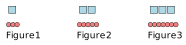
Question: A shape pattern uses squares and circles. The pattern is: How many circles are in Figure 4?
- A. \(7\)
- B. \(8\)
- C. \(9\)
- D. \(10\)
Why it works: Count circles: Figure 1 has \(3\), Figure 2 has \(5\), Figure 3 has \(7\). Each time adds \(2\) circles. So Figure 4 has \(7 + 2 = \mathbf{9}\) circles.
Answer: \(9\)
Worked Examples
Example 1
Question: Complete the table using the rule "multiply by \(2\) then add \(1\)":
| Input | \(1\) | \(2\) | \(3\) | \(4\) |
|---|---|---|---|---|
| Output | \(3\) | \(5\) | \(7\) | \(\mathbf{?}\) |
- A. \(8\)
- B. \(13\)
- C. \(11\)
- D. \(9\)
- Apply the rule "multiply by \(2\) then add \(1\)" to input \(4\): \((2 \times 4) + 1 = 8 + 1 = \mathbf{9}\).
Answer: \(9\)
Example 2
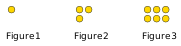
Question: A pattern of stars is shown: How many stars are in Figure 4?
- A. \(8\)
- B. \(9\)
- C. \(10\)
- D. \(12\)
- Count stars: Figure 1 has \(1\), Figure 2 has \(3\), Figure 3 has \(6\).
- The increases are \(+2\), then \(+3\).
- Following the pattern, the next increase is \(+4\): \(6 + 4 = \mathbf{10}\) stars.
Answer: \(10\)
Example 3
Question: A function rule is "divide by \(2\)." Complete the table:
| Input | \(4\) | \(8\) | \(12\) | \(20\) |
|---|---|---|---|---|
| Output | \(2\) | \(4\) | \(6\) | \(\mathbf{?}\) |
- A. \(8\)
- B. \(15\)
- C. \(12\)
- D. \(10\)
- Apply the rule "divide by \(2\)" to input \(20\): \(20 \div 2 = \mathbf{10}\).
Answer: \(10\)
Real-World Word Problems
Problem 1
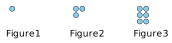
Question: A pattern of circles grows as shown: How many circles are in Figure 4?
- A. \(9\)
- B. \(16\)
- C. \(12\)
- D. \(10\)
Why it works: Circles in each figure: \(1, 3, 6\). The increases are \(+2\), then \(+3\). Next increase is \(+4\): \(6 + 4 = \mathbf{10}\) circles.
Answer: \(10\)
Problem 2
Question: A pattern of dots is arranged in rows: If the pattern continues, how many dots are in Figure 4?
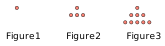
- A. \(12\)
- B. \(20\)
- C. \(18\)
- D. \(16\)
Why it works: Dots form odd-number rows: Figure 1 = \(1\), Figure 2 = \(1+3=4\), Figure 3 = \(1+3+5=9\). Figure 4 = \(9+7 = \mathbf{16}\) dots.
Answer: \(16\)
Common Mistakes
- Naming a shape from appearance instead of attributes.
- Forgetting that squares are also rectangles and quadrilaterals.
- Mixing up sides and angles.
- Assuming a rotated shape changed its category.
Strategy Tips
- List attributes before naming the shape.
- Use examples and non-examples to test a category.
- Look for shared attributes across shape groups.
- Draw a quick sketch when the wording feels abstract.
Practice Questions
Question 1
A pattern starts at \(3\) and follows the rule "add \(4\)." What is the \(5\)th term in the pattern?
- A. \(15\)
- B. \(16\)
- C. \(19\)
- D. \(23\)
Question 2
Which number comes next in the pattern? \(2, 6, 10, 14, 18, \underline{\quad}\)
- A. \(20\)
- B. \(26\)
- C. \(24\)
- D. \(22\)
Question 3
A pattern starts at \(50\) and follows the rule "subtract \(5\)." Which list shows the first four terms?
- A. \(50, 45, 40, 35\)
- B. \(50, 55, 60, 65\)
- C. \(50, 45, 40, 30\)
- D. \(50, 40, 30, 20\)
Question 4
Looking at this pattern, what is the rule?
\(8, 16, 24, 32, 40, \ldots\)
- A. Subtract \(8\)
- B. Add \(6\)
- C. Multiply by \(2\)
- D. Add \(8\)
Question 5
A pattern follows the rule "add \(3\)." If the second term is \(10\), what is the first term?
- A. \(6\)
- B. \(15\)
- C. \(13\)
- D. \(7\)
Question 6
Which of the following shows a pattern where all numbers are even?
- A. \(2, 5, 8, 11, 14\)
- B. \(4, 8, 12, 16, 20\)
- C. \(3, 6, 9, 12, 15\)
- D. \(1, 2, 3, 4, 5\)
Full Answer Explanations Click to show all answers and explanations
Question 1
Answer: \(19\)
Start at \(3\) and apply "add \(4\)" four more times: \(3, 7, 11, 15, \mathbf{19}\). The 5th term is \(\mathbf{19}\).
Question 2
Answer: \(22\)
First find the rule by looking at the gaps: \(6-2=4\), \(10-6=4\), \(14-10=4\), \(18-14=4\). So the rule is "add \(4\)." Apply it once more: \(18 + 4 = \mathbf{22}\).
Question 3
Answer: \(50, 45, 40, 35\)
Apply "subtract \(5\)" starting at \(50\). Term 1: \(50\). Term 2: \(50 - 5 = 45\). Term 3: \(45 - 5 = 40\). Term 4: \(40 - 5 = 35\). So the first four terms are \(50, 45, 40, 35\), which matches choice A.
Question 4
Answer: Add \(8\)
Find the difference: \(16 - 8 = 8\), \(24 - 16 = 8\), \(32 - 24 = 8\). Each term increases by \(8\). \checkmark
Question 5
Answer: \(7\)
Work backwards: if "add \(3\)" gives \(10\), then the first term is \(10 - 3 = \mathbf{7}\).
Question 6
Answer: \(4, 8, 12, 16, 20\)
Remember: even numbers end in \(0\), \(2\), \(4\), \(6\), or \(8\). Check each list: choice A has \(5\) and \(11\) (odd), choice C has \(3\), \(9\), \(15\) (odd), choice D has \(1\), \(3\), \(5\) (odd). Only choice B---\(4, 8, 12, 16, 20\)---has every term ending in an even digit, so every term is even. \checkmark
Connection to Standards
This lesson supports Grade 4 math expectations for reasoning, modeling, problem solving, and explaining answers clearly. It connects classroom skills to the kind of questions students see on state math assessments.
Summary
Number and Shape Patterns becomes easier when students connect the question to a model, use clear steps, and explain why the answer fits.
GOLDEN RULE
Attributes prove the shape name.