




Introduction
In Grade 5, identify apparent relationships between corresponding terms of two patterns that start with the same number. They explain these relationships informally using operations and connect them to graphed points on the coordinate plane.
Analyzing Relationships Between Patterns matters because it blends concept understanding, visual reasoning, and accurate practice. When students can explain the math, model it, and apply it in context, they build confidence that carries into quizzes, classwork, and bigger Grade 5 problem solving.
What Is Analyzing Relationships Between Patterns?
Analyzing Relationships Between Patterns is the Grade 5 skill of students identify apparent relationships between corresponding terms of two patterns that start with the same number. They explain these relationships informally using operations and connect them to graphed points on the coordinate plane.
Strong understanding comes from naming what the numbers, shapes, units, or data values represent, then showing the idea with a model or clear steps before solving.
Understanding Analyzing Relationships Between Patterns
The key to this topic is understanding the structure behind the work, not just following a rule. Students should be able to talk through what is happening, point to a model, and explain why the answer makes sense.
- Identify what each number, unit, or symbol means before solving.
- Choose a model or strategy that makes the relationship visible.
- Explain why the answer fits the situation instead of stopping at computation.
- Use the topic language from class discussions: Students identify apparent relationships between corresponding terms of two patterns that start with the same number. They explain these relationships informally using operations and connect them to graphed points on the coordinate plane.
Visual Models
Visual Model 1
Question: Pattern A starts at 2. Pattern B starts at 2. Pattern A increases by 1 each step, and Pattern B increases by 3 each step. Complete the table.
| Step | Pattern A | Pattern B |
|---|---|---|
| 1 | 2 | 2 |
| 2 | 3 | 5 |
| 3 | 4 | ? |
- A. \(6\)
- B. \(7\)
- C. \(8\)
- D. \(9\)
How the model helps: Pattern B increases by 3 each step: 2, 5, 8. At step 3, Pattern B is 8.
Visual Model 2
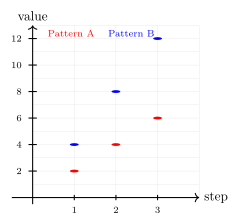
Question: Two patterns are shown on a coordinate grid. Pattern A is plotted at (1, 2), (2, 4), (3, 6). Pattern B is plotted at (1, 4), (2, 8), (3, 12). What rule describes the relationship?
| Step | Pattern A | Pattern B |
|---|---|---|
| 1 | 2 | 4 |
| 2 | 4 | 8 |
| 3 | 6 | 12 |
- A. Pattern B is 1 more than Pattern A
- B. Pattern B increases by the step number
- C. Pattern B is twice Pattern A
- D. Pattern B is 3 times the step number
How the model helps: Pattern B is always 2 times Pattern A: \(4=2\times2\), \(8=2\times4\), and \(12=2\times6\).
Step-by-Step Examples
Example 1
Question: Pattern M: 5, 10, 15, 20. Pattern N: 8, 13, 18, 23. What is the relationship?
| M | N | |
|---|---|---|
| 5 | 8 | |
| 10 | 13 | |
| 15 | 18 | |
| 20 | 23 |
- A. \(N = M - 3\)
- B. \(N = M + 1\)
- C. \(N = 2 \times M\)
- D. \(N = M + 3\)
- Each term in Pattern N is 3 more than the corresponding term in Pattern M: 5+3=8, 10+3=13, etc.
Answer: \(N = M + 3\)
Example 2
Question: Pattern P: 2, 4, 6, 8, 10. Pattern Q: 6, 12, 18, 24, 30. What is the rule?
| Position | Pattern P | Pattern Q |
|---|---|---|
| 1 | 2 | 6 |
| 2 | 4 | 12 |
| 3 | 6 | 18 |
- A. \(Q = P + 4\)
- B. \(Q = 3 \times P\)
- C. \(Q = P \times 2 + 2\)
- D. \(Q = P + 2\)
- Pattern Q is always 3 times Pattern P: 2 × 3 = 6, 4 × 3 = 12, 6 × 3 = 18.
Answer: \(Q = 3 \times P\)
Example 3
Question: Pattern R and Pattern S are shown in the table. Which relationship describes Pattern S?
| Pattern R | 1 | 2 | 3 | 4 | 5 |
|---|---|---|---|---|---|
| Pattern S | 4 | 7 | 10 | 13 | 16 |
- A. Add 4 to each R value
- B. Multiply each R value by 3, then add 1
- C. Double each R value, then add 2
- D. Multiply each R value by 4
- Check the table: \(3 \times 1+1=4\), \(3 \times 2+1=7\), and \(3 \times 3+1=10\).
Answer: Multiply each R value by 3, then add 1
Real-World Word Problems
Problem 1
Question: A video game store counts inventory. Game A: 50, 100, 150, 200. Game B: 10, 20, 30, 40. Write the relationship between A and B.
| Game B | Game A |
|---|---|
| 10 | 50 |
| 20 | 100 |
| 30 | 150 |
| 40 | 200 |
- A. \(A = 2 \times B + 30\)
- B. \(A = B + 40\)
- C. \(A = B - 40\)
- D. \(A = 5 \times B\)
Answer: \(A = 5 \times B\)
Why it works: Game A inventory is always 5 times Game B: 10 × 5 = 50, 20 × 5 = 100, 30 × 5 = 150, 40 × 5 = 200.
Problem 2
Question: A sports store tracks sales. The table compares basketballs and footballs sold. Which relationship is true?
| Basketballs | 5 | 10 | 15 | 20 |
|---|---|---|---|---|
| Footballs | 10 | 20 | 30 | 40 |
- A. Football sales are 3 more than basketball sales
- B. Football sales are double basketball sales
- C. Football sales are double basketball sales, then 2 less
- D. Football sales are 8 more than basketball sales
Answer: Football sales are double basketball sales
Why it works: Football sales are double basketball sales: \(2\times5=10\), \(2\times10=20\), \(2\times15=30\), and \(2\times20=40\).
Common Mistakes
- Starting the computation before identifying what the numbers, units, or parts represent.
- Skipping the model or visual and relying only on a memorized rule.
- Forgetting to estimate, which makes it easier to miss an unreasonable answer.
- Stopping at a number without explaining what the answer means in context.
Strategy Tips
- Read the situation slowly and name what each number or label represents.
- Use a model, table, chart, number line, or sketch before finishing the computation.
- Estimate first so you already know the answer's approximate size.
- Check the answer with an inverse operation, another representation, or a sentence explanation.
- Say the math idea out loud in simple words before writing the final answer.
Practice Questions
Question 1
Pattern A: 1, 2, 3, 4, 5. Pattern B: 2, 4, 6, 8, 10. What is the relationship between the values in Pattern A and Pattern B?
- A. Pattern B is 1 more than Pattern A
- B. Pattern B is 1 less than Pattern A
- C. Pattern B is 3 times Pattern A
- D. Pattern B is 2 times Pattern A
Question 2
Pattern X: 3, 6, 9, 12, 15. Pattern Y: 6, 12, 18, 24, 30. Which statement is true?
- A. Pattern Y is Pattern X plus 2
- B. Pattern Y is 2 times Pattern X
- C. Pattern Y is Pattern X plus 3
- D. Pattern Y is always 2 more than Pattern X
Question 3
Two patterns start with the same first value of 4. Pattern C increases by 2 each step. Pattern D increases by 5 each step. After 3 increases, what is the difference between Pattern D and Pattern C?
- A. \(3\)
- B. \(6\)
- C. \(9\)
- D. \(12\)
Question 4
Pattern L starts at 3 and increases by 2. Pattern K starts at 3 and is multiplied by 2 each step. Complete the table.
| Step | L (add 2) | K (multiply by 2) |
|---|---|---|
| 1 | 3 | 3 |
| 2 | 5 | 6 |
| 3 | 7 | ? |
- A. \(9\)
- B. \(10\)
- C. \(12\)
- D. \(15\)
Question 5
Pattern T: 4, 8, 12, 16, 20. Pattern U: 2, 4, 6, 8, 10. Which statement relates the matching terms?
| U | T |
|---|---|
| 2 | 4 |
| 4 | 8 |
| 6 | 12 |
| 8 | 16 |
| 10 | 20 |
- A. Pattern T is 2 more than Pattern U
- B. Pattern T is twice Pattern U
- C. Pattern T is 4 more than Pattern U
- D. Pattern T is 2 less than Pattern U
Question 6
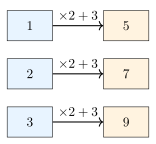
Use the rule shown in the arrow diagram to find which input gives 13. Which input would give an output of 13?
- A. \(4\)
- B. \(5\)
- C. \(7\)
- D. \(8\)
Full Answer Explanations Click to show all answers and explanations
Question 1
Answer: Pattern B is 2 times Pattern A
For each position, Pattern B equals 2 times the value in Pattern A. For example, when Pattern A is 3, Pattern B is 6.
Question 2
Answer: Pattern Y is 2 times Pattern X
Each value in Pattern Y is double the matching value in Pattern X: \(3 \times 2=6\), \(6 \times 2=12\), and \(9 \times 2=18\).
Question 3
Answer: \(9\)
After 3 increases, Pattern C is \(4+2+2+2=10\) and Pattern D is \(4+5+5+5=19\). The difference is \(19-10=9\).
Question 4
Answer: \(12\)
Pattern K multiplies by 2 each step: 3, 6, 12. At step 3, \(K = 12\).
Question 5
Answer: Pattern T is twice Pattern U
Pattern T is twice Pattern U: 2 × 2 = 4, 4 × 2 = 8, 6 × 2 = 12, etc.
Question 6
Answer: \(5\)
Using the rule \(\times 2 + 3\): when input is 5, output = 5 × 2 + 3 = 13.
Connection to Standards
Analyzing Relationships Between Patterns supports important Grade 5 math thinking because students are expected to students identify apparent relationships between corresponding terms of two patterns that start with the same number. They explain these relationships informally using operations and connect them to graphed points on the coordinate plane.
Strong work in this topic means more than getting the answer. Students should be able to model the idea, explain the reasoning, choose an efficient strategy, and apply the concept in classwork and real situations.
Summary
Analyzing Relationships Between Patterns gets easier when students read the model, track what each number means, and explain why the answer fits the situation.
GOLDEN RULE
Understand the structure first, then solve, check, and explain why the answer makes sense.