




Introduction
Classify triangles by their sides (scalene, isosceles, equilateral) and by their angles (acute, right, obtuse). Classify quadrilaterals in a detailed hierarchy including trapezoids, parallelograms, rectangles, rhombuses, and squares.
Classifying Triangles and Quadrilaterals matters because it blends concept understanding, visual reasoning, and accurate practice. When students can explain the math, model it, and apply it in context, they build confidence that carries into quizzes, classwork, and bigger Grade 5 problem solving.
What Is Classifying Triangles and Quadrilaterals?
Classifying Triangles and Quadrilaterals is the Grade 5 skill of classify triangles by their sides (scalene, isosceles, equilateral) and by their angles (acute, right, obtuse). Classify quadrilaterals in a detailed hierarchy including trapezoids, parallelograms, rectangles, rhombuses, and squares.
Strong understanding comes from naming what the numbers, shapes, units, or data values represent, then showing the idea with a model or clear steps before solving.
Understanding Classifying Triangles and Quadrilaterals
The key to this topic is understanding the structure behind the work, not just following a rule. Students should be able to talk through what is happening, point to a model, and explain why the answer makes sense.
- Identify what each number, unit, or symbol means before solving.
- Choose a model or strategy that makes the relationship visible.
- Explain why the answer fits the situation instead of stopping at computation.
- Use the topic language from class discussions: Classify triangles by their sides (scalene, isosceles, equilateral) and by their angles (acute, right, obtuse). Classify quadrilaterals in a detailed hierarchy including trapezoids, parallelograms, rectangles, rhombuses, and squares.
Visual Models
Visual Model 1
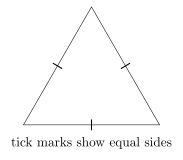
Question: Look at the triangle below. What type of triangle is it based on the marks on its sides?
- A. Scalene triangle
- B. Isosceles triangle
- C. Equilateral triangle
- D. Right triangle
How the model helps: All three sides have the same number of tick marks, meaning all three sides are equal in length. A triangle with all three equal sides is equilateral.
Visual Model 2
Question: Which diagram shows a right triangle?

- A. A
- B. B
- C. C
- D. D
How the model helps: Triangle B has a small square in the corner, which is the symbol for a right angle (90 degrees). This indicates a right triangle.
Step-by-Step Examples
Example 1
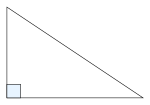
Question: Look at the triangle. One angle is marked with a small square. What does this symbol mean?
- A. The side is very long
- B. The angle is exactly 90 degrees
- C. The triangle is isosceles
- D. The triangle is equilateral
- The small square symbol marks a right angle, which measures exactly 90 degrees.
Answer: The angle is exactly 90 degrees
Example 2
Question: Which name describes a triangle with two equal sides and one right angle?

- A. Isosceles acute
- B. Right isosceles
- C. Scalene obtuse
- D. Equilateral
- The diagram shows a right angle (small square) and two equal sides (tick marks), making it a right isosceles triangle.
Answer: Right isosceles
Example 3
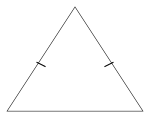
Question: Look at the triangle with tick marks. What type of triangle is it based on its sides?
- A. Scalene
- B. Isosceles
- C. Equilateral
- D. Right
- The tick marks on two sides show those sides are equal, making this an isosceles triangle.
Answer: Isosceles
Real-World Word Problems
Problem 1
Question: A student drew a triangle and said it was both right and obtuse. Is this possible?
- A. Yes, always
- B. Yes, sometimes
- C. No, never
- D. Cannot be determined
Answer: No, never
Why it works: A triangle cannot have both a \(90^\circ\) angle and an angle greater than \(90^\circ\), because the three angle measures must add to \(180^\circ\).
Problem 2
Question: Identify the error: A student said a triangle with sides 5 cm, 5 cm, and 8 cm is equilateral.
- A. Correct; all sides are present
- B. Incorrect; it is isosceles because two sides are equal
- C. Incorrect; it is scalene because the sides are different
- D. Incorrect; equilateral triangles must have sides over 5 cm
Answer: Incorrect; it is isosceles because two sides are equal
Why it works: Two sides measure 5 cm (equal) and one is 8 cm (different), making it isosceles, not equilateral.
Common Mistakes
- Starting the computation before identifying what the numbers, units, or parts represent.
- Skipping the model or visual and relying only on a memorized rule.
- Forgetting to estimate, which makes it easier to miss an unreasonable answer.
- Stopping at a number without explaining what the answer means in context.
Strategy Tips
- Read the situation slowly and name what each number or label represents.
- Use a model, table, chart, number line, or sketch before finishing the computation.
- Estimate first so you already know the answer's approximate size.
- Check the answer with an inverse operation, another representation, or a sentence explanation.
- Say the math idea out loud in simple words before writing the final answer.
Practice Questions
Question 1
A triangle has sides of length 5 cm, 5 cm, and 7 cm. What type of triangle is this based on its sides?
- A. Equilateral triangle
- B. Isosceles triangle
- C. Scalene triangle
- D. Right triangle
Question 2
A triangle has sides measuring 3 cm, 4 cm, and 5 cm. What type of triangle is this based on its sides?
- A. Equilateral
- B. Isosceles
- C. Scalene
- D. Obtuse
Question 3
A triangle has all angles less than 90 degrees. What type of triangle is this based on its angles?
- A. Right triangle
- B. Acute triangle
- C. Obtuse triangle
- D. Not enough information
Question 4
A triangle has one angle that measures 120 degrees. What type of triangle is this based on its angles?
- A. Acute triangle
- B. Right triangle
- C. Scalene triangle
- D. Obtuse triangle
Question 5
A triangle has side lengths 6 cm, 6 cm, and 6 cm. Each angle measures \(60^\circ\). Which classification describes the triangle by both side lengths and angle measures?
- A. Equilateral and obtuse
- B. Isosceles and right
- C. Scalene and acute
- D. Equilateral and acute
Question 6
Which statement is true about a right triangle?
- A. It has all angles less than 90\(^\circ\)
- B. It has exactly one angle of 90\(^\circ\)
- C. It has two angles of 90\(^\circ\)
- D. It has no angles of 90\(^\circ\)
Full Answer Explanations Click to show all answers and explanations
Question 1
Answer: Isosceles triangle
A triangle is classified as isosceles if it has at least two sides of equal length. In this triangle, two sides measure 5 cm each, which are equal. Therefore, this is an isosceles triangle.
Question 2
Answer: Scalene
All three sides have different lengths (3 cm, 4 cm, and 5 cm), so this is a scalene triangle.
Question 3
Answer: Acute triangle
When all three angles in a triangle are less than 90 degrees, the triangle is called acute.
Question 4
Answer: Obtuse triangle
An obtuse triangle has one angle greater than 90 degrees. Since 120 degrees is greater than 90 degrees, this is an obtuse triangle.
Question 5
Answer: Equilateral and acute
All three side lengths are equal, so the triangle is equilateral. All three angles are less than \(90^\circ\), so it is acute.
Question 6
Answer: It has exactly one angle of 90 degrees
A right triangle has exactly one right angle (90 degrees) and two other angles that are acute.
Connection to Standards
Classifying Triangles and Quadrilaterals supports important Grade 5 math thinking because students are expected to classify triangles by their sides (scalene, isosceles, equilateral) and by their angles (acute, right, obtuse). Classify quadrilaterals in a detailed hierarchy including trapezoids, parallelograms, rectangles, rhombuses, and squares.
Strong work in this topic means more than getting the answer. Students should be able to model the idea, explain the reasoning, choose an efficient strategy, and apply the concept in classwork and real situations.
Summary
Classifying Triangles and Quadrilaterals gets easier when students read the model, track what each number means, and explain why the answer fits the situation.
GOLDEN RULE
Understand the structure first, then solve, check, and explain why the answer makes sense.