




Introduction
Graphing and interpreting points helps Grade 5 students read information from a coordinate plane and explain what each point means in a real situation. Instead of seeing ordered pairs as just two numbers in parentheses, students learn that the first number tells how far to move along the horizontal axis and the second number tells how far to move along the vertical axis.
This topic matters because graphs appear in science, geography, data analysis, and problem solving. When students can plot points accurately and explain what those points represent, they build stronger reasoning skills across many areas of math.
What Is Graphing and Interpreting Points?
Graphing points means placing an ordered pair, such as (4, 3), on a coordinate plane. Interpreting points means explaining what that ordered pair means in context.
If a graph shows hours studied on the x-axis and test score on the y-axis, then the point (5, 85) means a student studied for 5 hours and scored 85 points. The point only makes sense when the axes are read correctly.
Understanding Graphing and Interpreting Points
Students should always remember these ideas:
- The x-coordinate is read first and shows horizontal movement.
- The y-coordinate is read second and shows vertical movement.
- A point on a graph can represent a real relationship such as time and distance, cost and number of items, or blocks east and blocks north.
- Points can be compared to describe change, distance, or patterns.
Strong understanding happens when students can do more than plot a point. They should also be able to explain what the point says about the situation.
Visual Models (VERY IMPORTANT)
Visual models help students see the movement from the origin and connect each coordinate to a real meaning.
Model A: Plotting the Point (4, 3)
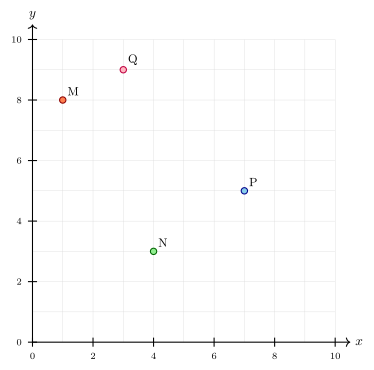
Start at the origin, move 4 units right, then move 3 units up. That lands at (4, 3).
Model B: Interpreting a Point in Context
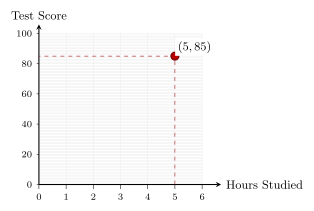
On this graph, x = hours studied and y = score, so the point (5, 85) means 5 hours studied and 85 points scored.
Step-by-Step Examples
Example 1: Plotting a Point with Ordered Pairs
Which ordered pair names point A on the grid below?
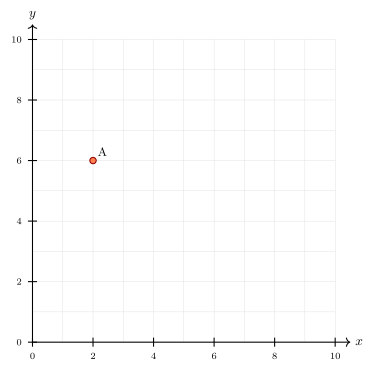
Point A is shown at the location where the graph moves 2 units right and 6 units up.
- Read the horizontal movement first. Point A is 2 units to the right, so the x-coordinate is 2.
- Read the vertical movement second. Point A is 6 units up, so the y-coordinate is 6.
- Write the ordered pair. The point is (2, 6).
Answer: Point A is located at (2, 6).
Example 2: Moving a Point on the Coordinate Plane
Point P is at (3, 2). If point P is moved 2 units right and 3 units up, what are the new coordinates of P'?
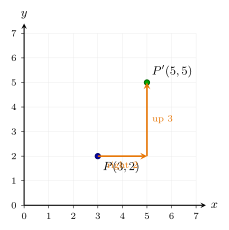
- Start with the original point. P is at (3, 2).
- Move 2 units right. Add 2 to the x-coordinate: 3 + 2 = 5.
- Move 3 units up. Add 3 to the y-coordinate: 2 + 3 = 5.
- Write the new point. The new coordinates are (5, 5).
Answer: P'(5, 5)
Example 3: Identifying a Point by Its Coordinates
Which point is located at (4, 3) on the coordinate plane?
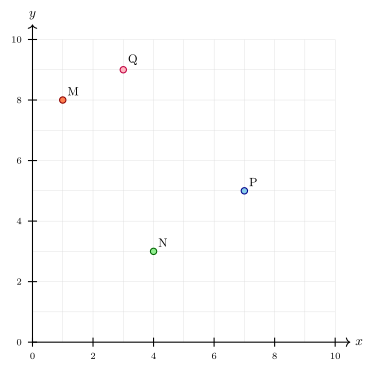
- Look for x = 4. Start by finding the point that is 4 units to the right.
- Then check y = 3. From there, look for the point that is 3 units up.
- Match the location. The point at (4, 3) is Point N.
Answer: Point N is at (4, 3).
Real-World Word Problems
Problem 1: Hours Studied and Test Score
A graph shows hours studied on the x-axis and test scores on the y-axis. Point (5, 85) is plotted. What does this point represent?
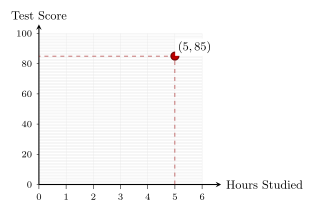
Answer: The point means a student studied for 5 hours and scored 85 points.
Problem 2: Apples and Cost
A grocery store graph shows number of apples on the x-axis and total cost on the y-axis. What does the point (8, 4) mean?
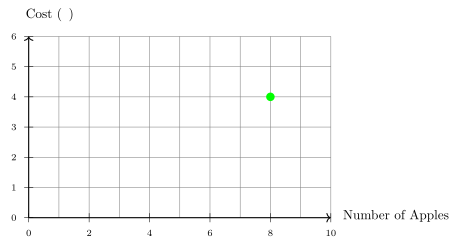
Answer: The point means 8 apples cost $4.
Problem 3: City Blocks on a Map
The library is at (3, 2) and the park is at (3, 6). If each unit is 1 block, how many blocks apart are they?
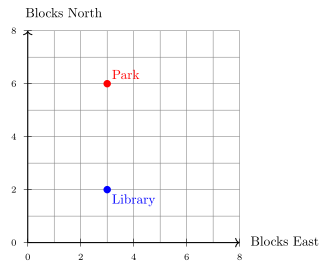
Answer: Both points have the same x-coordinate, so the distance is vertical: 6 - 2 = 4. They are 4 blocks apart.
Common Mistakes
- Switching the coordinates. Students may read (2, 6) as 6 right and 2 up instead of 2 right and 6 up.
- Ignoring the graph labels. A point only makes sense if students read what each axis represents.
- Plotting in the wrong order. The x-coordinate must be read first, then the y-coordinate.
- Missing vertical or horizontal distance. When two points share the same x-coordinate or y-coordinate, students should subtract the changing coordinate only.
Strategy Tips
- Say "right, then up" every time you graph an ordered pair.
- Read the axis labels before interpreting a point in context.
- Use dashed helper lines from the point to each axis when learning.
- When comparing two points, check whether the change is horizontal, vertical, or both.
- Write a short sentence after solving: "This point means ..."
Practice Questions
Question 1
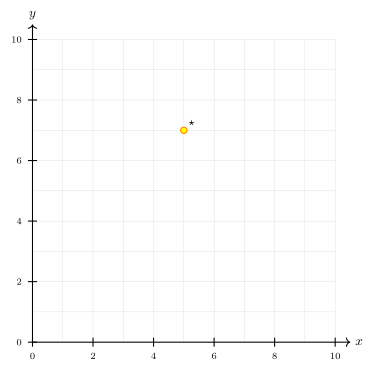
Which ordered pair best describes the location of the star on this grid?
- A. (7, 5)
- B. (5, 7)
- C. (5, 5)
- D. (7, 7)
Question 2
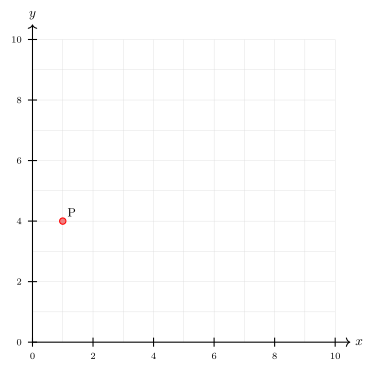
If you plot the point (1, 4) on the coordinate plane, where will it be?
- A. 1 unit right, 4 units up
- B. 4 units right, 1 unit up
- C. 1 unit up, 4 units right
- D. 4 units right, 4 units up
Question 3
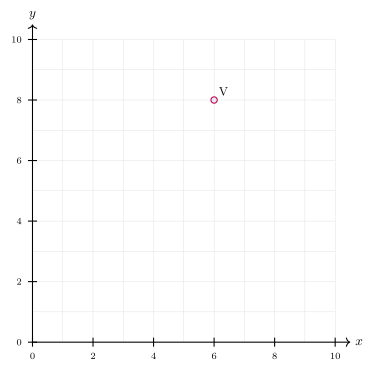
At what coordinates is point V located?
- A. (8, 6)
- B. (6, 8)
- C. (6, 6)
- D. (8, 8)
Question 4
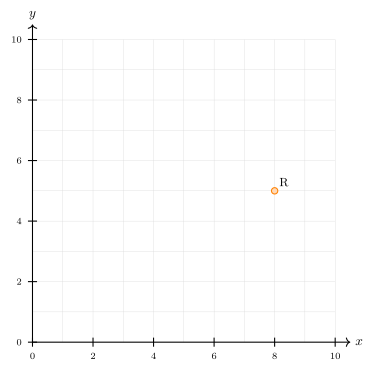
Which coordinate is shown by the point on this grid?
- A. (5, 8)
- B. (8, 5)
- C. (8, 8)
- D. (5, 5)
Question 5
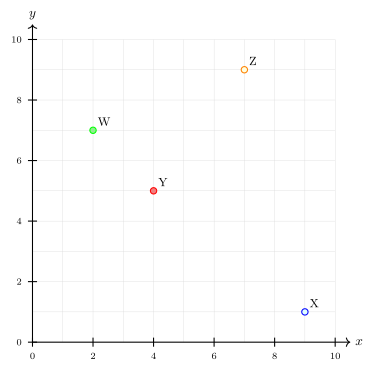
On this coordinate plane, which point is located at (9, 1)?
- A. Point W
- B. Point X
- C. Point Y
- D. Point Z
Question 6
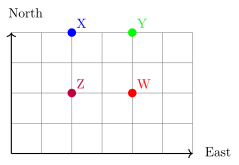
Which point on the coordinate grid shows a location that is 4 units east and 2 units north?
- A. W
- B. X
- C. Y
- D. Z
Question 7
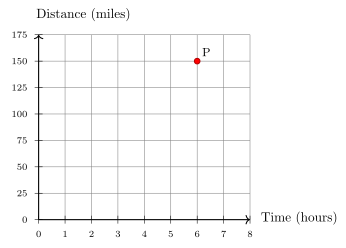
On a time-distance graph, what does the plotted point represent?
- A. 6 hours, 150 miles
- B. 150 hours, 6 miles
- C. 150 hours, 150 miles
- D. 6 hours, 6 miles
Question 8
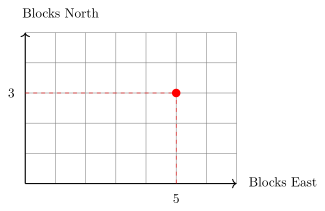
A point is located 5 blocks east and 3 blocks north from the origin. What are the coordinates of this point?
- A. (3, 5)
- B. (5, 8)
- C. (8, 3)
- D. (5, 3)
Full Answer Explanations
- (5, 7). The point is 5 units right on the x-axis and 7 units up on the y-axis.
- 1 unit right, 4 units up. In (1, 4), the first number shows horizontal movement and the second shows vertical movement.
- (6, 8). The x-coordinate is 6 and the y-coordinate is 8.
- (8, 5). Read the x-coordinate first and the y-coordinate second.
- Point X. The point at (9, 1) is 9 units right and 1 unit up.
- Point W. A location 4 units east and 2 units north matches the ordered pair (4, 2).
- 6 hours and 150 miles. The x-axis gives the time, and the y-axis gives the distance.
- (5, 3). The x-coordinate is 5 for east movement, and the y-coordinate is 3 for north movement.
Connection to Standards
This topic supports Grade 5 geometry because students are expected to graph points in the first quadrant and explain what those points mean in mathematical and real-life situations. The goal is not just to plot correctly, but to connect a point to a relationship such as time and distance, items and cost, or blocks east and north.
That is why interpretation matters so much. A point is only useful when students can explain the story it tells.
Summary
Graphing and interpreting points becomes much easier when students read x first, y second, check the axis labels, and explain what each point represents in words.
GOLDEN RULE
Read x first, y second, and explain what the point means.