





Introduction
In Grade 5, make a line plot to display a data set of measurements in fractions of a unit (halves, quarters, eighths). They collect and organize data, and create accurate line plots that show the distribution.
Line Plots with Fractional Data matters because it blends concept understanding, visual reasoning, and accurate practice. When students can explain the math, model it, and apply it in context, they build confidence that carries into quizzes, classwork, and bigger Grade 5 problem solving.
What Is Line Plots with Fractional Data?
Line Plots with Fractional Data is the Grade 5 skill of students make a line plot to display a data set of measurements in fractions of a unit (halves, quarters, eighths). They collect and organize data, and create accurate line plots that show the distribution.
Strong understanding comes from naming what the numbers, shapes, units, or data values represent, then showing the idea with a model or clear steps before solving.
Understanding Line Plots with Fractional Data
The key to this topic is understanding the structure behind the work, not just following a rule. Students should be able to talk through what is happening, point to a model, and explain why the answer makes sense.
- Identify the whole first so every fraction part keeps the same meaning.
- Use equal parts, number lines, or area models to show the relationship.
- Check whether the answer should be larger, smaller, or equivalent before finishing.
- Use the topic language from class discussions: Students make a line plot to display a data set of measurements in fractions of a unit (halves, quarters, eighths). They collect and organize data, and create accurate line plots that show the distribution.
Visual Models
Visual Model 1
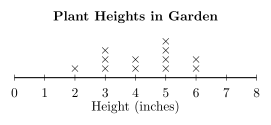
Question: The line plot shows the heights of plants in Mrs.\ Garcia's garden: What is the most common plant height?
- A. 3 inches
- B. 4 inches
- C. 5 inches
- D. 6 inches
How the model helps: Count the X marks at each height on the line plot. The height with the greatest number of X marks is 5 inches, which has 4 plants. Therefore, the most common plant height is 5 inches.
Visual Model 2
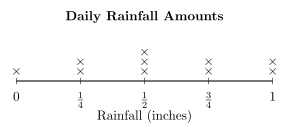
Question: The line plot displays rainfall amounts (in inches) recorded over 10 days: What is the total rainfall recorded over the 10 days?
- A. \(4\frac{1}{2}\) inches
- B. \(5\) inches
- C. \(5\frac{1}{2}\) inches
- D. \(6\) inches
How the model helps: Add the rainfall amounts shown: \(0 + 2(\frac{1}{4}) + 3(\frac{1}{2}) + 2(\frac{3}{4}) + 2(1) = 0 + \frac{1}{2} + 1\frac{1}{2} + 1\frac{1}{2} + 2 = 5\frac{1}{2}\) inches.
Step-by-Step Examples
Example 1
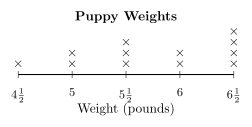
Question: The line plot shows the weights (in pounds) of 12 puppies at a shelter: How many puppies weigh \(5\frac{1}{2}\) pounds?
- A. 2
- B. 3
- C. 4
- D. 5
- Count the X marks above \(5\frac{1}{2}\).
- There are 3 X marks, so 3 puppies weigh exactly \(5\frac{1}{2}\) pounds.
Answer: 3
Example 2
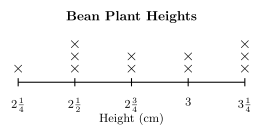
Question: The line plot shows bean plant growth (in centimeters) for 11 students' projects: Which height is the least common?
- A. \(2\frac{1}{4}\) cm
- B. \(2\frac{1}{2}\) cm
- C. \(2\frac{3}{4}\) cm
- D. \(3\) cm
- Count the X marks above each height.
- The height \(2\frac{1}{4}\) cm has only 1 mark, so it is the least common.
Answer: \(2\frac{1}{4}\) cm
Example 3
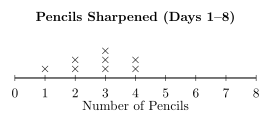
Question: The line plot shows the number of pencils students sharpened on 8 days: How many data points are shown on the line plot?
- A. 6
- B. 7
- C. 9
- D. 8
- Count all the X marks on the line plot.
- There are 1 + 2 + 3 + 2 = 8 X marks total, meaning 8 data points.
Answer: 8
Real-World Word Problems
Problem 1
Question: A student is making a line plot for these pencil lengths, in inches: \[ 4\frac{1}{4}, 4\frac{1}{2}, 4\frac{1}{2}, 4\frac{3}{4}, 4\frac{3}{4}, 4\frac{3}{4}, 5, 5 \] How many X's should be placed above \(4\frac{1}{2}\) inches?
- A. 1
- B. 4
- C. 3
- D. 2
Answer: 2
Why it works: The measurement \(4\frac{1}{2}\) appears two times in the list, so the line plot should have 2 X's above \(4\frac{1}{2}\).
Problem 2
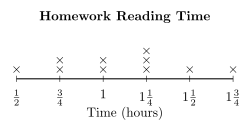
Question: The line plot displays reading time (in hours) spent on homework by 10 students: What is the most common reading time?
- A. \(\frac{3}{4}\) hour
- B. \(1\) hour
- C. \(1\frac{1}{4}\) hours
- D. \(1\frac{1}{2}\) hours
Answer: \(1\frac{1}{4}\) hours
Why it works: Count the X marks above each value. The value \(1\frac{1}{4}\) has 3 marks, which is more than any other value.
Common Mistakes
- Starting the computation before identifying what the numbers, units, or parts represent.
- Combining numerators and denominators without first checking whether the fraction pieces match in size.
- Forgetting to estimate, which makes it easier to miss an unreasonable answer.
- Stopping at a number without explaining what the answer means in context.
Strategy Tips
- Read the situation slowly and name what each number or label represents.
- Draw fraction bars, area models, or number lines so equal parts stay visible.
- Estimate first so you already know the answer's approximate size.
- Check the answer with an inverse operation, another representation, or a sentence explanation.
- Say the math idea out loud in simple words before writing the final answer.
Practice Questions
Question 1
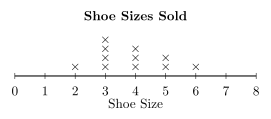
The line plot shows the number of shoes various sizes sold at a store: What is the most popular shoe size?
- A. 2
- B. 3
- C. 4
- D. 5
Question 2
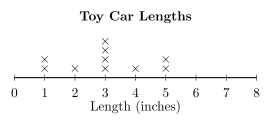
The line plot displays the lengths of toy cars (in inches) collected by a child: How many cars are less than 3 inches long?
- A. 2
- B. 3
- C. 4
- D. 5
Question 3
The line plot shows ribbon lengths (in yards) measured by 10 students: How many ribbons were longer than \(\frac{1}{2}\) yard?
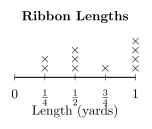
- A. 3
- B. 4
- C. 5
- D. 6
Question 4
The line plot displays distances (in feet) that students jumped in gym class: What is the range of jump distances?
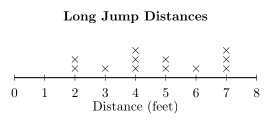
- A. 3 feet
- B. 4 feet
- C. 5 feet
- D. 6 feet
Question 5
The line plot shows ribbon lengths, in inches, measured by 11 students: How many ribbon lengths are 4 inches or longer?
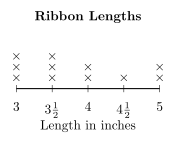
- A. 3
- B. 4
- C. 5
- D. 6
Question 6
The line plot displays ribbon lengths in yards: What is the total length of the three ribbons that each measure \(\frac{1}{2}\) yard?
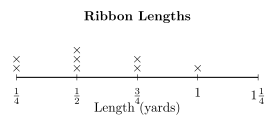
- A. \(1\) yard
- B. \(1\frac{1}{4}\) yards
- C. \(1\frac{1}{2}\) yards
- D. \(2\) yards
Full Answer Explanations Click to show all answers and explanations
Question 1
Answer: 3
Count the X marks above each shoe size. Size 3 has 4 X marks, which is more than any other size.
Question 2
Answer: 3
Count X marks above 1 and 2 inches only. There are 2 marks at 1 inch and 1 mark at 2 inches, totaling 3 cars less than 3 inches.
Question 3
Answer: 5
Lengths longer than \(\frac{1}{2}\) yard are \(\frac{3}{4}\) and \(1\) yard. The plot shows \(1+4=5\) such ribbons.
Question 4
Answer: 5 feet
The greatest distance is 7 feet and the least is 2 feet. Range = \(7 - 2 = 5\) feet.
Question 5
Answer: 5
Count X marks at \(4\), \(4\frac{1}{2}\), and \(5\) inches. That is \(2+1+2=5\) ribbon lengths that are 4 inches or longer.
Question 6
Answer: \(1\frac{1}{2}\) yards
There are three ribbons at \(\frac{1}{2}\) yard. Their total length is \(\frac{1}{2}+\frac{1}{2}+\frac{1}{2}=1\frac{1}{2}\) yards.
Connection to Standards
Line Plots with Fractional Data supports important Grade 5 math thinking because students are expected to students make a line plot to display a data set of measurements in fractions of a unit (halves, quarters, eighths). They collect and organize data, and create accurate line plots that show the distribution.
Strong work in this topic means more than getting the answer. Students should be able to model the idea, explain the reasoning, choose an efficient strategy, and apply the concept in classwork and real situations.
Summary
Line Plots with Fractional Data gets easier when students read the model, track what each number means, and explain why the answer fits the situation.
GOLDEN RULE
Keep the whole consistent, show equal parts clearly, and explain what the fraction means.