





Introduction
In Grade 5, fluently multiply multi-digit whole numbers using the standard algorithm. They apply this skill to problems involving two-digit by two-digit, three-digit by two-digit, and larger products.
Multiplying Multi-Digit Whole Numbers matters because it blends concept understanding, visual reasoning, and accurate practice. When students can explain the math, model it, and apply it in context, they build confidence that carries into quizzes, classwork, and bigger Grade 5 problem solving.
What Is Multiplying Multi-Digit Whole Numbers?
Multiplying Multi-Digit Whole Numbers is the Grade 5 skill of students fluently multiply multi-digit whole numbers using the standard algorithm. They apply this skill to problems involving two-digit by two-digit, three-digit by two-digit, and larger products.
Strong understanding comes from naming what the numbers, shapes, units, or data values represent, then showing the idea with a model or clear steps before solving.
Understanding Multiplying Multi-Digit Whole Numbers
The key to this topic is understanding the structure behind the work, not just following a rule. Students should be able to talk through what is happening, point to a model, and explain why the answer makes sense.
- Identify what each number, unit, or symbol means before solving.
- Choose a model or strategy that makes the relationship visible.
- Explain why the answer fits the situation instead of stopping at computation.
- Use the topic language from class discussions: Students fluently multiply multi-digit whole numbers using the standard algorithm. They apply this skill to problems involving two-digit by two-digit, three-digit by two-digit, and larger products.
Visual Models
Visual Model 1
Question: This area model shows \(25 \times 13\) broken into four partial products. What is the total product?
| \(20 \times 10\) | \(5 \times 10\) |
| \(20 \times 3\) | \(5 \times 3\) |
| \(= 25 \times 13\) |
- A. 315
- B. 325
- C. 335
- D. 345
How the model helps: Add the four partial products: \((20 \times 10) + (5 \times 10) + (20 \times 3) + (5 \times 3) = 200 + 50 + 60 + 15 = 325\).
Visual Model 2
Question:
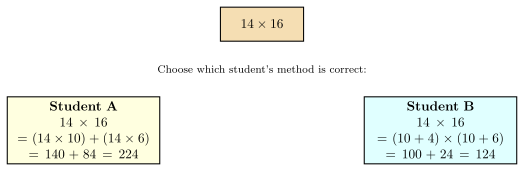
- A. Student A is correct.
- B. Student B is correct.
- C. Both are correct.
- D. Neither is correct.
How the model helps: Student A correctly applies the distributive property: \(14 \times 16 = 14 \times (10 + 6) = 140 + 84 = 224\). Student B made an error; the correct product is 224, not 124.
Step-by-Step Examples
Example 1
Question: This area model shows the partial products for \(27 \times 25\). What is the total?
| \(20 \times 20 = 400\) | \(7 \times 20 = 140\) |
| \(20 \times 5 = 100\) | \(7 \times 5 = 35\) |
- A. 665
- B. 675
- C. 685
- D. 695
- Sum the partial products: \(400 + 140 + 100 + 35 = 675\).
Answer: 675
Example 2
Question: Using the area model above, what is \(32 \times 15\)?
| \(32 \times 15\) | ||||||||||||||||||||||||
|---|---|---|---|---|---|---|---|---|---|---|---|---|---|---|---|---|---|---|---|---|---|---|---|---|
</td></tr></tbody></table>
Answer: 480 Example 3Question: Which student made an error?
Answer: David made an error. Real-World Word ProblemsProblem 1Question: A school bought 12 boxes of colored pencils. Each box contains 24 pencils. How many pencils did the school buy?
Answer: 288 pencils Why it works: Multiply: \(12 \times 24 = 12 \times (20 + 4) = (12 \times 20) + (12 \times 4) = 240 + 48 = 288\) pencils. Problem 2Question: A farmer plants corn in rows. There are 15 rows, and each row has 23 corn plants. How many corn plants does the farmer have?
Answer: 345 corn plants Why it works: Multiply: \(15 \times 23 = 15 \times (20 + 3) = (15 \times 20) + (15 \times 3) = 300 + 45 = 345\) plants. Common Mistakes
Strategy Tips
Practice QuestionsQuestion 1What is \(45 \times 7\)?
Question 2What is \(24 \times 15\)?
Question 3A school orders 132 boxes of pencils. Each box has 24 pencils. How many pencils are ordered in all?
Question 4Estimate the product of \(23 \times 18\) by rounding each factor to the nearest ten, then multiply.
Question 5What is \(31 \times 7\)?
Question 6A theater has 4 sections with 112 seats in each section. Which place-value sum can be used to find the total number of seats?
Full Answer Explanations Click to show all answers and explanationsQuestion 1Answer: 315 Break 45 into 40 and 5: \((40 \times 7) + (5 \times 7) = 280 + 35 = 315\). Question 2Answer: 360 Multiply: \(24 \times 15 = 24 \times (10+5) = 240 + 120 = 360\). Question 3Answer: 3,168 Multiply: \(132 \times 24 = 132 \times (20+4) = 2{,}640 + 528 = 3{,}168\). Question 4Answer: 400 Round 23 to 20 and 18 to 20. Then \(20 \times 20 = 400\). Question 5Answer: 217 Multiply: \(31 \times 7 = (30 \times 7) + (1 \times 7) = 210 + 7 = 217\). Question 6Answer: \(400+40+8\) Use place value: \(112 \times 4 = (100 \times 4) + (10 \times 4) + (2 \times 4) = 400 + 40 + 8 = 448\) seats. Connection to StandardsMultiplying Multi-Digit Whole Numbers supports important Grade 5 math thinking because students are expected to students fluently multiply multi-digit whole numbers using the standard algorithm. They apply this skill to problems involving two-digit by two-digit, three-digit by two-digit, and larger products. Strong work in this topic means more than getting the answer. Students should be able to model the idea, explain the reasoning, choose an efficient strategy, and apply the concept in classwork and real situations. SummaryMultiplying Multi-Digit Whole Numbers gets easier when students read the model, track what each number means, and explain why the answer fits the situation. GOLDEN RULEUnderstand the structure first, then solve, check, and explain why the answer makes sense. Recommended books |