




Introduction
Create and analyze simple budgets that include income and expenses. Develop savings plans, compare costs, and understand the concept of opportunity cost when making financial decisions.
Personal Financial Literacy - Saving and Budgeting matters because it blends concept understanding, visual reasoning, and accurate practice. When students can explain the math, model it, and apply it in context, they build confidence that carries into quizzes, classwork, and bigger Grade 5 problem solving.
What Is Personal Financial Literacy - Saving and Budgeting?
Personal Financial Literacy - Saving and Budgeting is the Grade 5 skill of create and analyze simple budgets that include income and expenses. Develop savings plans, compare costs, and understand the concept of opportunity cost when making financial decisions.
Strong understanding comes from naming what the numbers, shapes, units, or data values represent, then showing the idea with a model or clear steps before solving.
Understanding Personal Financial Literacy - Saving and Budgeting
The key to this topic is understanding the structure behind the work, not just following a rule. Students should be able to talk through what is happening, point to a model, and explain why the answer makes sense.
- Identify what each number, unit, or symbol means before solving.
- Choose a model or strategy that makes the relationship visible.
- Explain why the answer fits the situation instead of stopping at computation.
- Use the topic language from class discussions: Create and analyze simple budgets that include income and expenses. Develop savings plans, compare costs, and understand the concept of opportunity cost when making financial decisions.
Visual Models
Visual Model 1
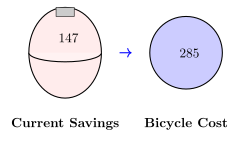
Question: Marcus is saving money to buy a bicycle that costs \(285. He already has \)147. His grandmother gives him \(25 each week for doing chores. If Marcus also earns \)12 from selling lemonade every weekend, how many weeks will it take him to have enough money to buy the bicycle?
- A. 3 weeks
- B. 4 weeks
- C. 5 weeks
- D. 6 weeks
How the model helps: Marcus needs \(285 - 147 = 138\) additional dollars. Each week he earns $\(25 + \)12 = \(37\). Dividing: \(138 \div 37 \approx 3.73\), so he needs 4 full weeks. Check: \(147 + 4 \times 37 = 295 \geq 285\).
Visual Model 2
Question: A bakery spent \(45.75 on flour. They also spent \)32.50 on sugar, \(18.25 on butter, and \)12.00 on yeast. What is the total amount spent on baking supplies?
| Item | Cost |
|---|---|
| Flour | $45.75 |
| Sugar | $32.50 |
| Butter | $18.25 |
| Yeast | $12.00 |
| Total | ? |
- $98.50
- $128.50
- $118.50
- $108.50
How the model helps: Add all costs: \(45.75 + 32.50 + 18.25 + 12.00 = 108.50\). The total is $108.50.
Step-by-Step Examples
Example 1
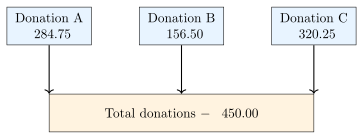
Question: A library fundraiser collected three donations: $\(284.75\), $\(156.50\), and $\(320.25\). The library spends $\(450.00\) on new books. How much money is left?
- $301.50
- $761.50
- $321.50
- $311.50
- Add the donations: \(284.75+156.50+320.25=761.50\).
- Then subtract the cost of the books: \(761.50-450.00=311.50\).
Answer: $311.50
Example 2
Question: A runner completes a 5-mile course in 4 segments: 1.2 miles, 1.3 miles, 1.1 miles, and the final segment. How long is the final segment?

- A. 1.2 miles
- B. 1.3 miles
- C. 1.4 miles
- D. 1.5 miles
- Total is 5 miles.
- Sum of known segments: \(1.2 + 1.3 + 1.1 = 3.6\) miles.
- Final segment: \(5 - 3.6 = 1.4\) miles.
Answer: 1.4 miles
Example 3
Question: Maria buys a sweater for \(42.50 and pants for \)38.75. She pays with a $100 bill. How much change does she receive?
| Item | Price |
|---|---|
| Sweater | $42.50 |
| Pants | $38.75 |
| Subtotal | ? |
| Paid | $100.00 |
| Change | ? |
- $25.00
- $20.25
- $21.50
- $18.75
- Total cost: \(42.50 + 38.75 = 81.25\) dollars.
- Change: \(100 - 81.25 = 18.75\) dollars.
Answer: $18.75
Real-World Word Problems
Problem 1
Question: A classroom has 156 pencils. Ms. Chen distributes them equally among 12 students. How many pencils does each student get?
- A. 11 pencils
- B. 12 pencils
- C. 13 pencils
- D. 14 pencils
Answer: 13 pencils
Why it works: Divide total pencils by number of students: \(156 \div 12 = 13\) pencils per student.
Problem 2
Question: A recipe calls for 2.5 cups of flour, 1.75 cups of sugar, and 0.5 cups of butter. If Sarah doubles the recipe, how many cups of flour does she need?
- A. 2.5 cups
- B. 3.5 cups
- C. 5.0 cups
- D. 5.5 cups
Answer: 5.0 cups
Why it works: Double the flour: \(2.5 \times 2 = 5.0\) cups of flour.
Common Mistakes
- Starting the computation before identifying what the numbers, units, or parts represent.
- Skipping the model or visual and relying only on a memorized rule.
- Forgetting to estimate, which makes it easier to miss an unreasonable answer.
- Stopping at a number without explaining what the answer means in context.
Strategy Tips
- Read the situation slowly and name what each number or label represents.
- Use a model, table, chart, number line, or sketch before finishing the computation.
- Estimate first so you already know the answer's approximate size.
- Check the answer with an inverse operation, another representation, or a sentence explanation.
- Connect each calculation to a spending, saving, or budgeting choice.
Practice Questions
Question 1
At a school carnival, tickets cost $0.75 each. How much do 48 tickets cost?
- $30.00
- $24.00
- $36.00
- $42.00
Question 2
A farmer has 840 pounds of grain to pack into bags. Each bag holds 35 pounds. How many bags does the farmer need?
- A. 20 bags
- B. 28 bags
- C. 24 bags
- D. 32 bags
Question 3
A water tank holds 250 liters. It currently has 165.5 liters. How many more liters are needed to fill the tank completely?
- A. 74.5 liters
- B. 94.5 liters
- C. 84.5 liters
- D. 104.5 liters
Question 4
Three friends share $63.45 equally. How much does each friend get?
- $19.15
- $20.15
- $21.15
- $18.15
Question 5
A grocery store receives a shipment of 2,160 apples. The apples are packed in boxes of 24. How many boxes are in the shipment?
- A. 85 boxes
- B. 95 boxes
- C. 90 boxes
- D. 100 boxes
Question 6
A class project uses string. They have 12.5 meters, 8.75 meters, and 6.25 meters of string. What is the total length?

- A. 27.5 meters
- B. 26.5 meters
- C. 25.5 meters
- D. 28.5 meters
Full Answer Explanations Click to show all answers and explanations
Question 1
Answer: $36.00
Choose the operation from the story, then keep the unit with the answer. Multiply: \(48 \times 0.75 = 36.00\) dollars. This confirms the answer.
Question 2
Answer: 24 bags
Choose the operation from the story, then keep the unit with the answer. Divide: \(840 \div 35 = 24\) bags. This confirms the answer.
Question 3
Answer: 84.5 liters
Choose the operation from the story, then keep the unit with the answer. Subtract: \(250 - 165.5 = 84.5\) liters needed. This confirms the answer.
Question 4
Answer: $21.15
Divide: \(63.45 \div 3 = 21.15\) dollars per friend.
Question 5
Answer: 90 boxes
Choose the operation from the story, then keep the unit with the answer. Divide: \(2,160 \div 24 = 90\) boxes. This confirms the answer.
Question 6
Answer: 27.5 meters
Add: \(12.5 + 8.75 + 6.25 = 27.5\) meters.
Connection to Standards
Personal Financial Literacy - Saving and Budgeting supports important Grade 5 math thinking because students are expected to create and analyze simple budgets that include income and expenses. Develop savings plans, compare costs, and understand the concept of opportunity cost when making financial decisions.
Strong work in this topic means more than getting the answer. Students should be able to model the idea, explain the reasoning, choose an efficient strategy, and apply the concept in classwork and real situations.
Summary
Personal Financial Literacy - Saving and Budgeting gets easier when students read the model, track what each number means, and explain why the answer fits the situation.
GOLDEN RULE
Use the numbers to make a smart decision, not just a fast calculation.